August 2025
1975 Triumph T160 Trident 750
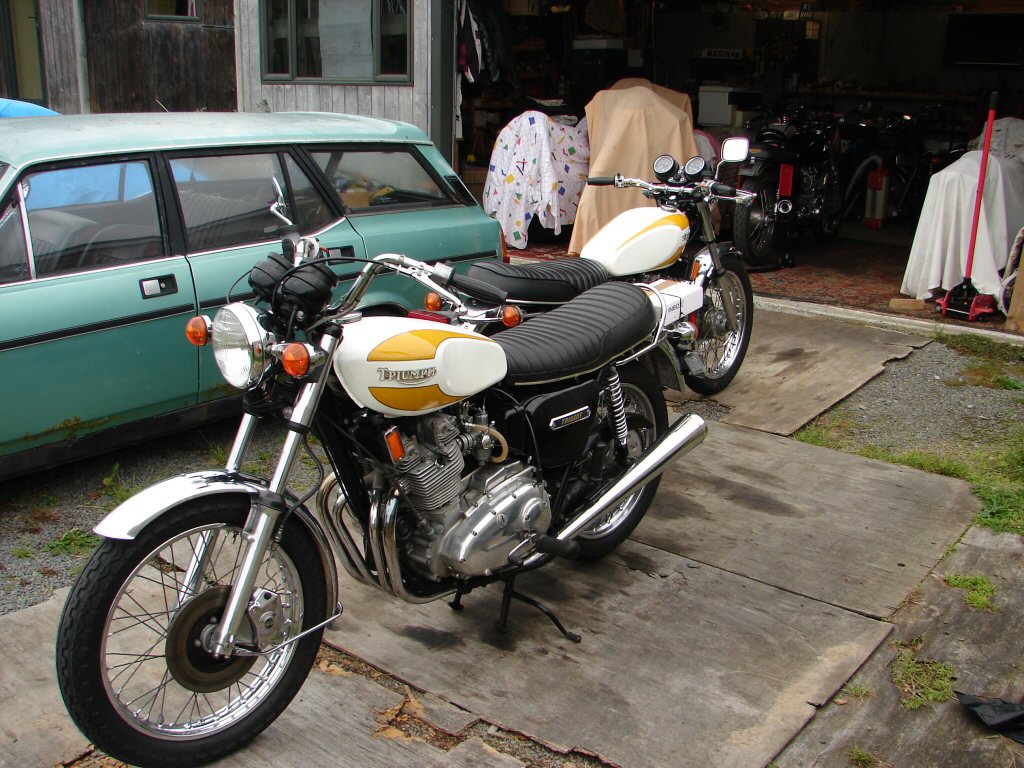
This bike left here in April after sorting a few tasks including fitting a Trispark ignition and replacing some failed rocker box base gaskets. It had been running fine since from all reports, but recently while travelling at town speeds it suddenly lost power and there was at least some evidence of exhaust smoke.
It arrived back here yesterday and all I have done since is to remove the spark plugs for a look. I was happy with their recent fuel burning habits, but there was some foreign material stuck to the earth electrode on the middle plug, which I only really noticed when using the macro setting on the camera to take this picture.
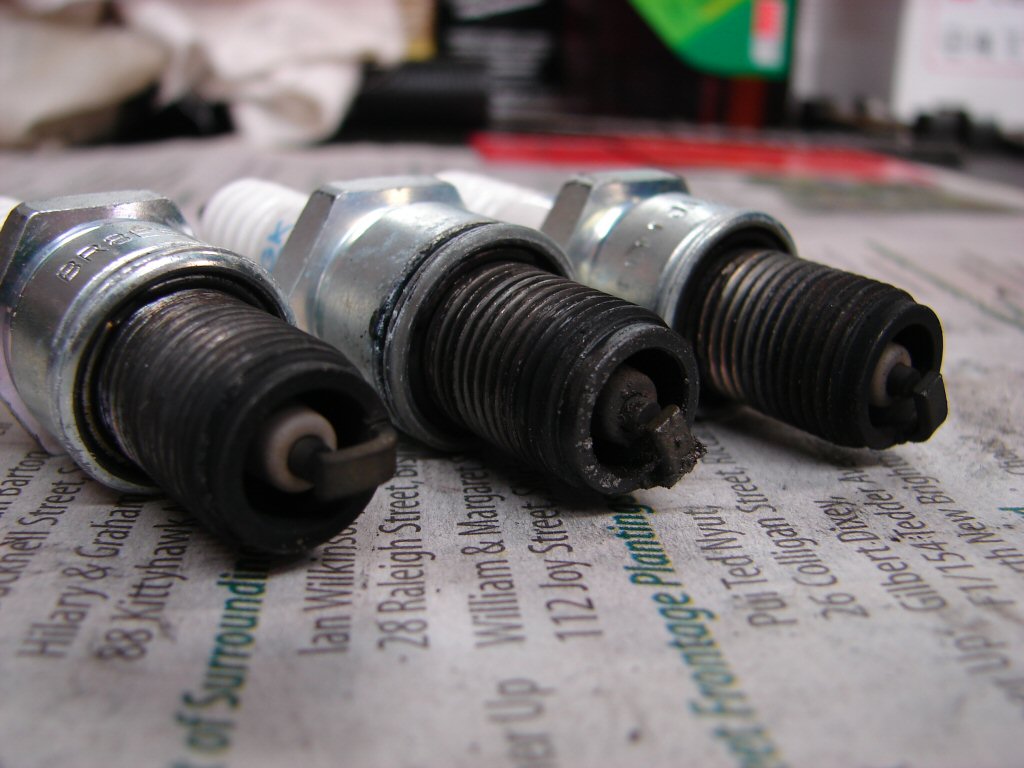
That led to me running a compression test just to see if anything was at odds with anything else.
Sure was.
The middle compression was absolutely zero, and with the aid of a small torch looking down the spark plug hole I could see a hole in the crown of the piston which looked about the size of a 20 cent piece. In fact, I could see right through the hole to the top of the conrod and the gudgeon pin, which is a pretty huge event to have taken place so quietly.
There are no signs of heat trauma indicating lean mixture, no colouring of exhaust headers, and the Trispark would tend to ensure that all cylinders are timed to the same degree, so the only thing that currently makes sense is that the piston was in some way compromised. The fun shall begin.
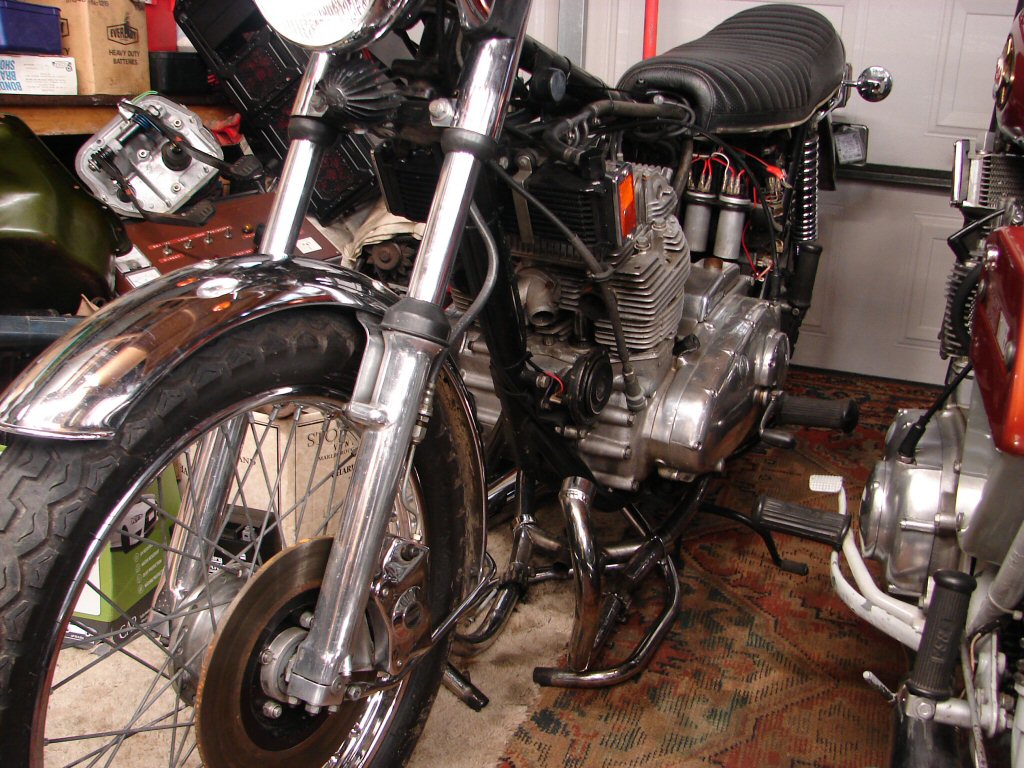
And it all begins to come apart. Tank, exhaust, carbs and filter, blah blah. And yes - it is taking place in that amount of space right now. This bike is potentially going to take root while awaiting any form of machining, so it gets to be at the far side.
Happily the beautiful blue Commando is leaving in the morning so things will get a reshuffle. On fine days I push several bikes outside, so it is not normal to work in a micro-space like this, but I am keen to make progress and to find out all there is to know.
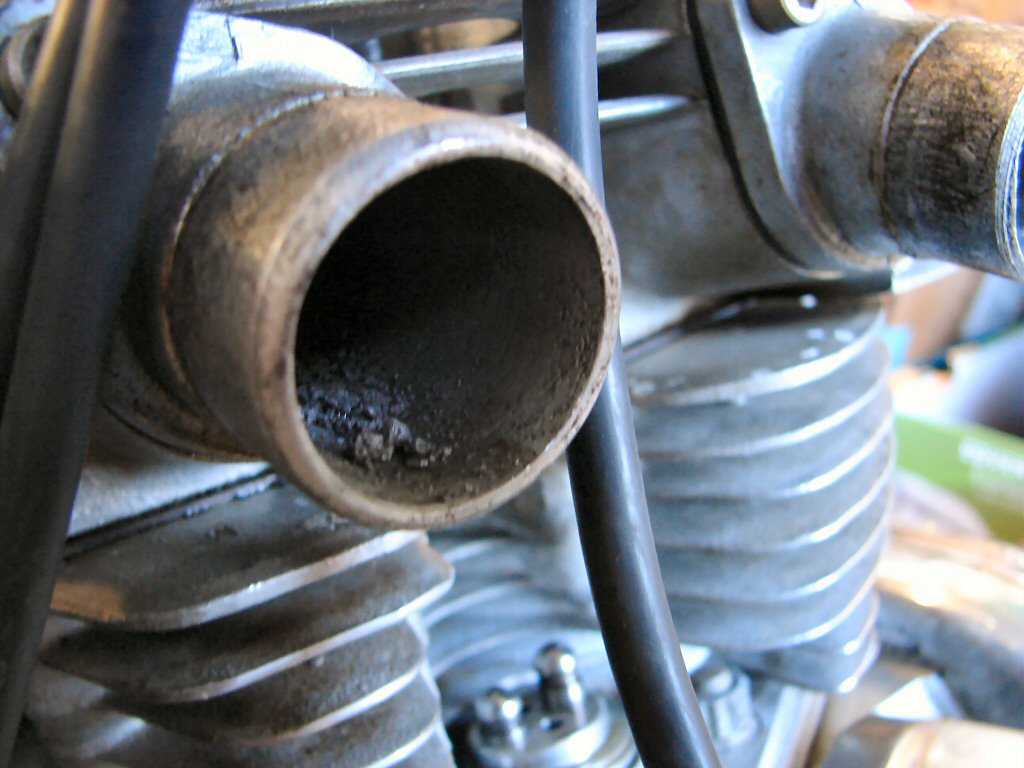
I am of course hopeful that this will only be a top end intervention, in which case the engine stays put in the frame, but it will require a very comprehensive internal cleanup. For example I found alloy crumbs inside the middle inlet manifold, as the valve overlap causes a certain amount of combustion gases to be pushed out the inlet valves before they close, but it is the interior of the crankcases that are of greatest concern. The oil system and tank will get close scrutiny as well.
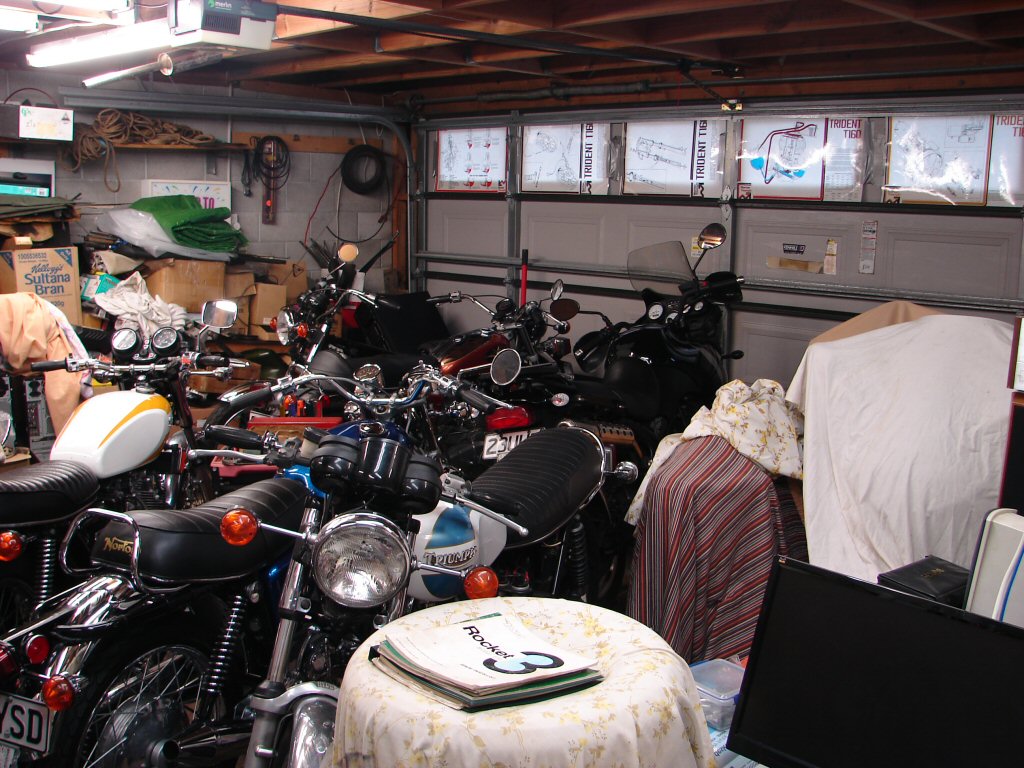
The shed was at maximum capacity several bikes ago...
I figured I should get a pic of the crumbs in the inlet manifold. There are actually a number of quite large fragments sitting in there considering the amount that is missing from the piston.
It will be interesting to see how much visible debris is inside the crankcases, beginning with removing the sump plate. The main concern would be fragments in the main bearings in the outer cases, so they will get the most critical inspection.
I will drain the oil from the primary chaincase and see if any bits have made their way that far. The engine only ran for a short time after the piston failed, so here's hoping the environmental impact is local.
Well, we are definitely going to need a new piston, but apart from that I cannot tell yet. The pistons appear to be standard, so we will measure the bores and see if they are good enough to remain as is. The problem is that we can only buy pistons in sets of three, so if there is any doubt at all about cylinder wear we might as well move to the first oversize.
While not leaking to the outside world, the head gasket appears to have been under stress, although that may have occurred before the rocker box base gaskets were replaced as the head tension was loose at that time. Because there are no signs of lean running on the middle cylinder we are looking for any other factors which may have influenced the death of piston #2.
I was talking to the Norton owner today and remembered the story of a mate who holed two pistons on the same cylinder, one on the way to Beezumph and one on the way home. He finally discovered that the carb on that cylinder had a flaw in the body casting which would open up when it got hot, allowing too much air in and causing this very failure. Nothing can afford to be ruled out at this stage.
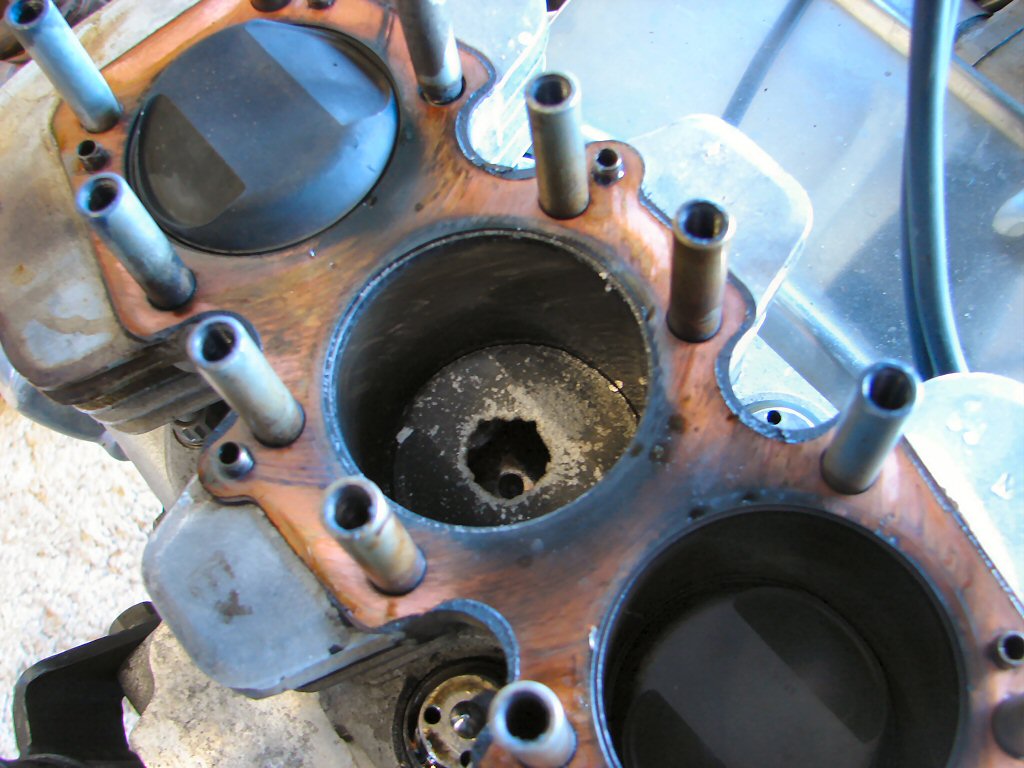
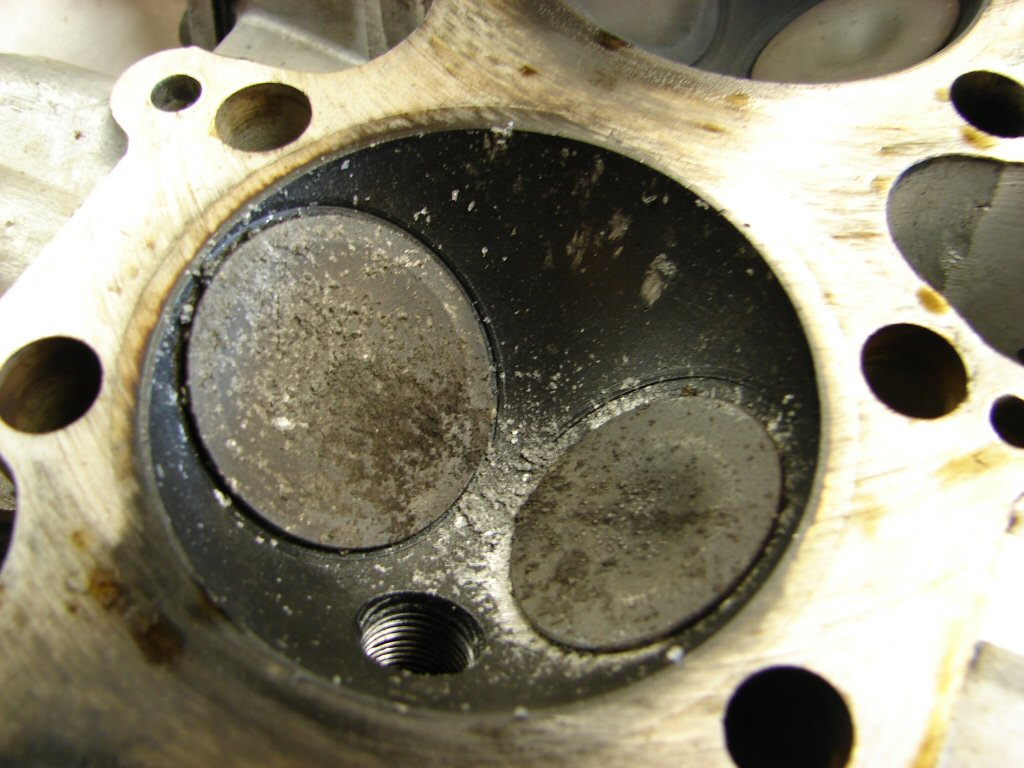
I don't think that the head will be too badly effected, as alloy is soft, especially in its molten state, so getting trapped between valve and seat would not likely cause any serious damage. However, all these parts are an unknown quantity, as I have never been inside this engine before. Thinking about it - as you do - I will remove the centre conrod seeing I can undo the big end nuts via the sump plate, and that way I can eyeball the big end bearing shells on at least one journal to ascertain their current state of wear. We might as well find out everything we possibly can for the least disruption.
I would observe that the signs of combustion leakage around the immediate edge of cylinder and gasket can be symptomatic of cylinder liners having dropped in the block. It would not be difficult to surface grind the barrels if so, but as we are looking for some weirdness like air being drawn past the head gasket or something similar we cannot risk missing anything that would cause this happening again.
Rest assured that the fuel delivery system to the centre carb will get a colonoscopy to say the least. They don't like it up 'em...
So I did the fuel bit, drained the float bowls, checked all the banjo filters, slides and needles, removed some grit from the centre carb engine side but the rest was clean as and nothing untoward. I sat the tank on the bench and ran some fuel off, both taps great flow, checked the fuel cap breather holes and both fine. Nothing I could even point a blunt stick at as being slightly suspicious.
So I ripped the barrels off. The phone rings a lot at times like this, for no apparent reason. A few things of interest were found, notably that the bore of the centre cylinder looked in really good condition, whereas the timing side bore had a number of bad score marks which were deep enough to accommodate a fingernail. The liners while not sitting noticeably above the block surface were neither sitting below it. Perhaps surfaced at an earlier time.
One of the pillar studs had unscrewed itself to some extent, even though the head bolts came out freely, and there is a visible compression leak across the head gasket just to the right of the loose stud. The right cylinder had a slightly lower compression test than the other two cylinders prior to me working on the rocker boxes last time around, so possibly this was a symptom of the loose head when the bike first arrived. The head gasket looked like it had seen a lot more miles than since the last engine intervention before I met the bike.
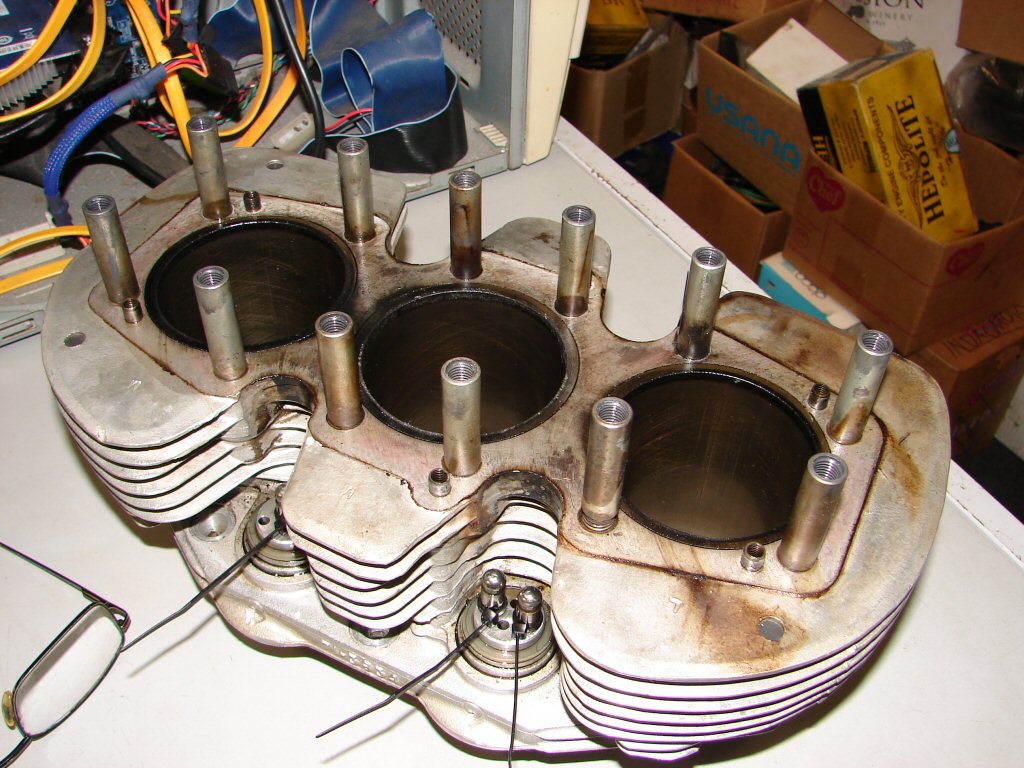
The pistons have factory part numbers and as such appear to be the original standard ones. Even the rings look like early type, with a very narrow second ring. While the remains of some cross-hatching can be seen in bores #3 and #2, it does not look fresh, and the rings look like they have seen a fair amount of service. I have seen some fairly old bores still showing signs of honing in the past, so its hard to say if any recent work has been done in here.
The gudgeon pin is a bit tight in the centre piston, so I will take the rod out with it still in place so I can heat the piston to make that a friendlier task. I can understand the piston being a bit distorted after its trial by fire, but the conrod needs to be the main concern during this process.
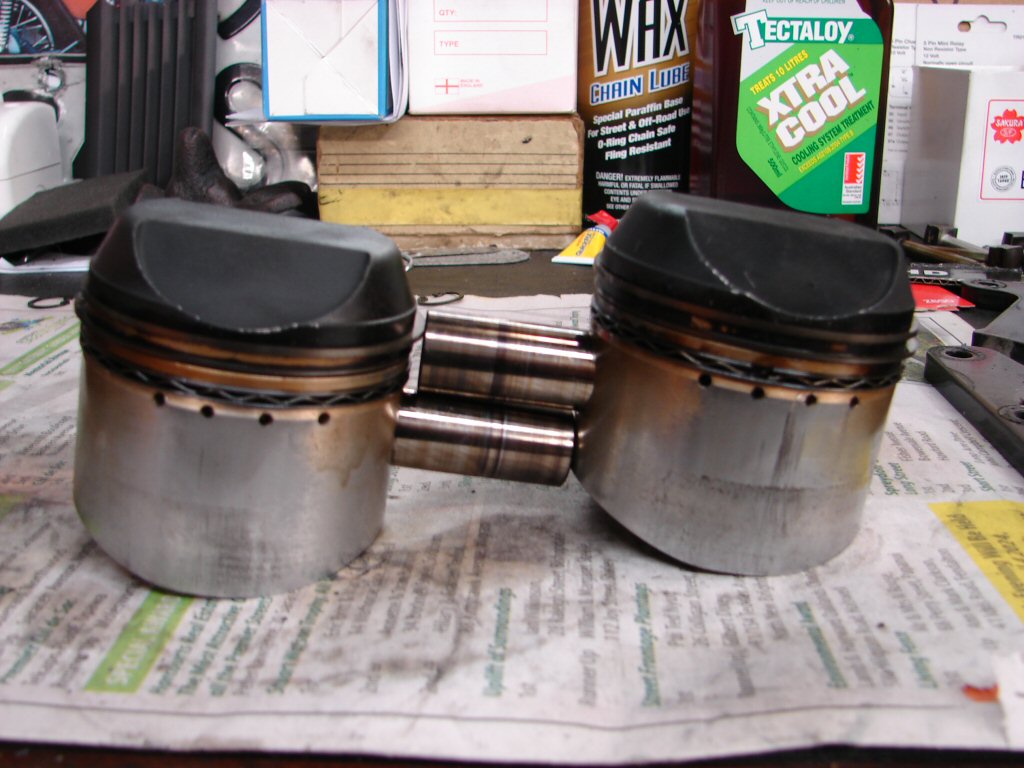
The colour of the base gasket tends to suggest it is a newer type than that used by the factory. Someone has been in here before, and the absence of matching score marks on the other side of #1 piston makes me wonder if it may have been previously replaced.
The inside of the crankcase looks remarkably clean from the top, so I will be keen to see what the sump filter looks like. I have left it draining overnight. Next job will be removing the centre rod and a good look at the inside can happen then.
As we have to buy a whole set of new pistons I doubt I would want to put them in these bores, and I am leaning toward a minimal rebore. A few measurements will throw more light, but I felt that if anything the pistons almost felt a bit too tight in the bores rather than loose when I worked the barrels off.
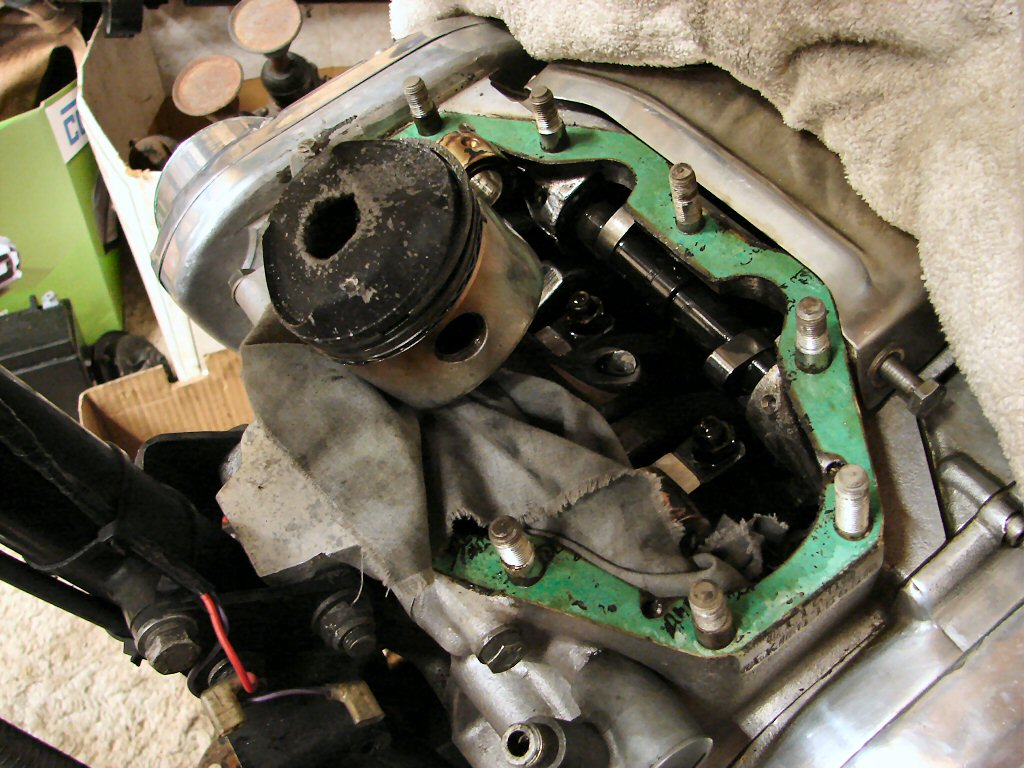
The minimum oversize pistons available are +.040" and there are not many stocks left. I have no doubt that the bores will clean up at this size so they are ordered and as soon as they arrive they will head off to Glen for the cylinder rebore. The taper at the bottom of the bores will also be smoothed a bit to allow easy fitting of rings into bores. The cast oil rings used these days are very brittle and must be handled with great care.
So all the pillar studs came out, and very easily I might add. Certainly not as tight as I would fit them, and one had unscrewed itself during the strip. The oil drain dowels are also removed and checking with a steel rule does not show any sign of the cylinder surface not being flat. All good news.
The two outer pistons got their tops cleaned and they are both factory originals, so if any were previously replaced it would have been early in the bike's history. I will take everything to Glen and see if he has any ideas as to what the cause could have been. I guess he sees a lot of air-cooled pistons...
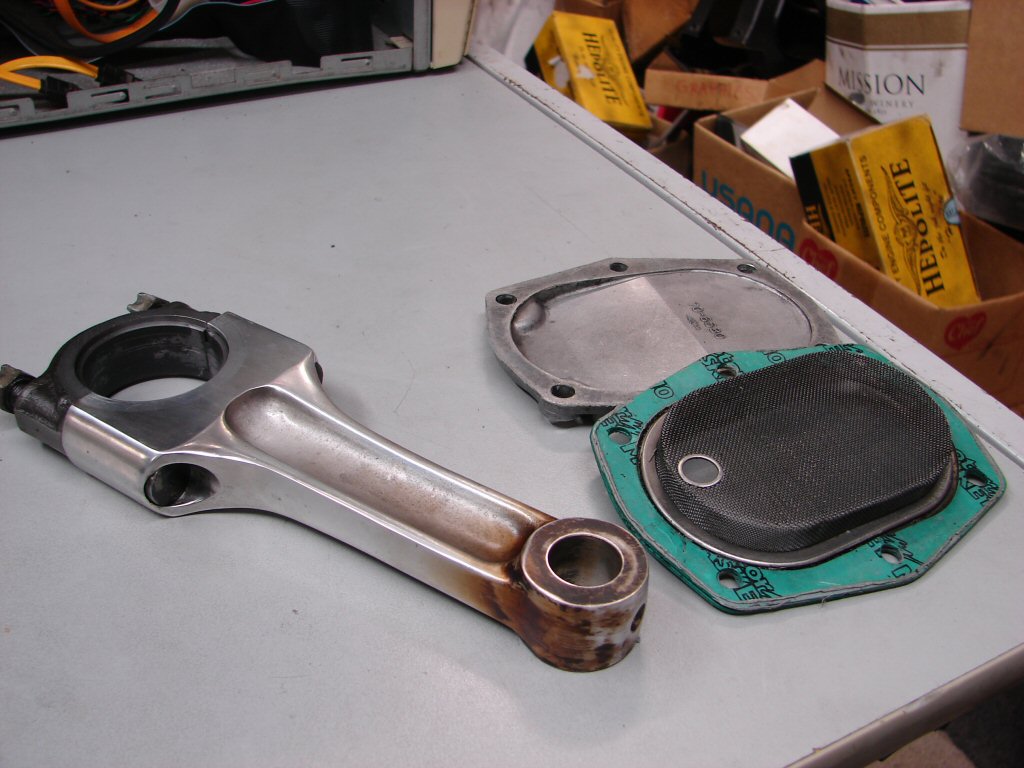
While the sump filter was pretty cruddy it cleaned up well, and there was only a small amount of fairy dust that had made its way through the gauze. That gets carried by the return oil back through the cooler to the tank, so I intend to sacrifice a bit of clean oil on the first run by pushing it through the cooler in the reverse direction in order to give it a good flush. The oil tank will get a clean as well.
The conrod looks very good considering, and this is after only a mild clean. I will polish it to remove any small scratches before it goes back, but I am happy with it and the little end bush is a perfect fit on the pin. I did have to clean the oil hole on the top which was understandably full of debris, but that was it.
The big end shells are still the factory original copper/lead items, and as such are the best that could be in there. All three rods felt to be a good firm fit on the crank, echoing the oil pressure readings I got during the bike's first visit.
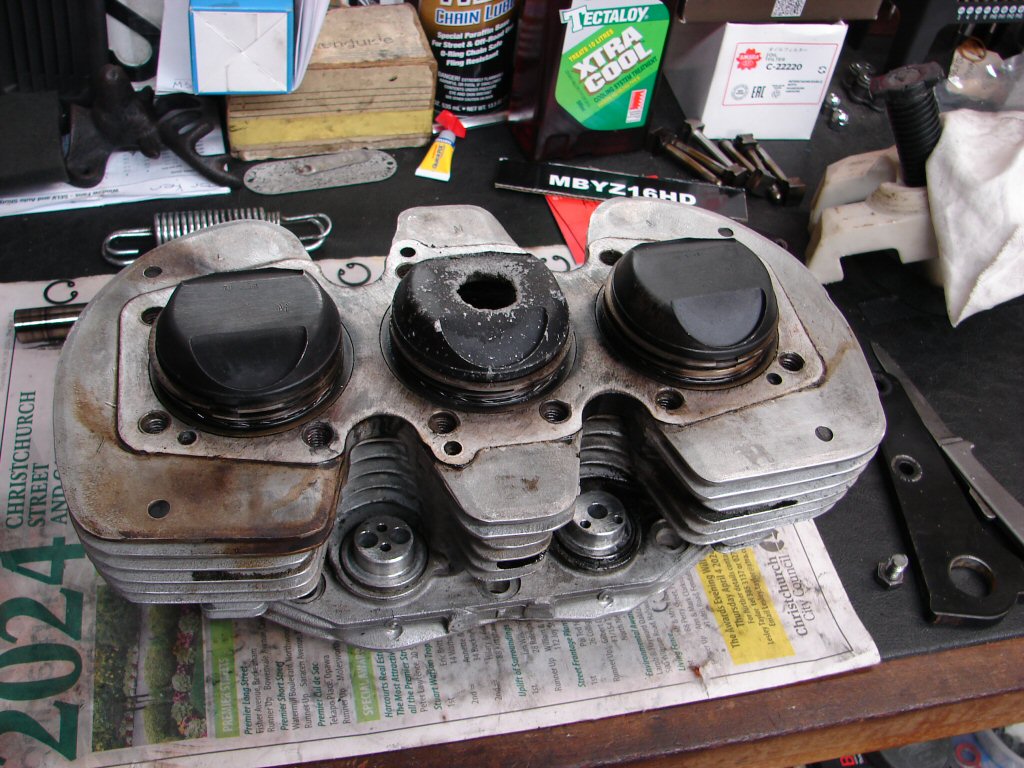
The head will be going for treatment with the cylinders, so the valve gear all came out in preparation. There is a lot of alloy spatter on the valves and seats which will need careful machining, and if necessary the rest of the valves and seats will be lightly reseated also.
As the head will likely go in the engine bath I always remove the inlet stubs in order to preserve the gaskets and thermal insulators. Suddenly we have a potential suspect. The stub allen screws were not very tight. The loosest was in fact the centre one, so could it be possible that there was air getting sucked in here when it got hot. The centre one is going to be the hottest, so it can't be ruled out. Obviously I shall not be giving it a second chance...
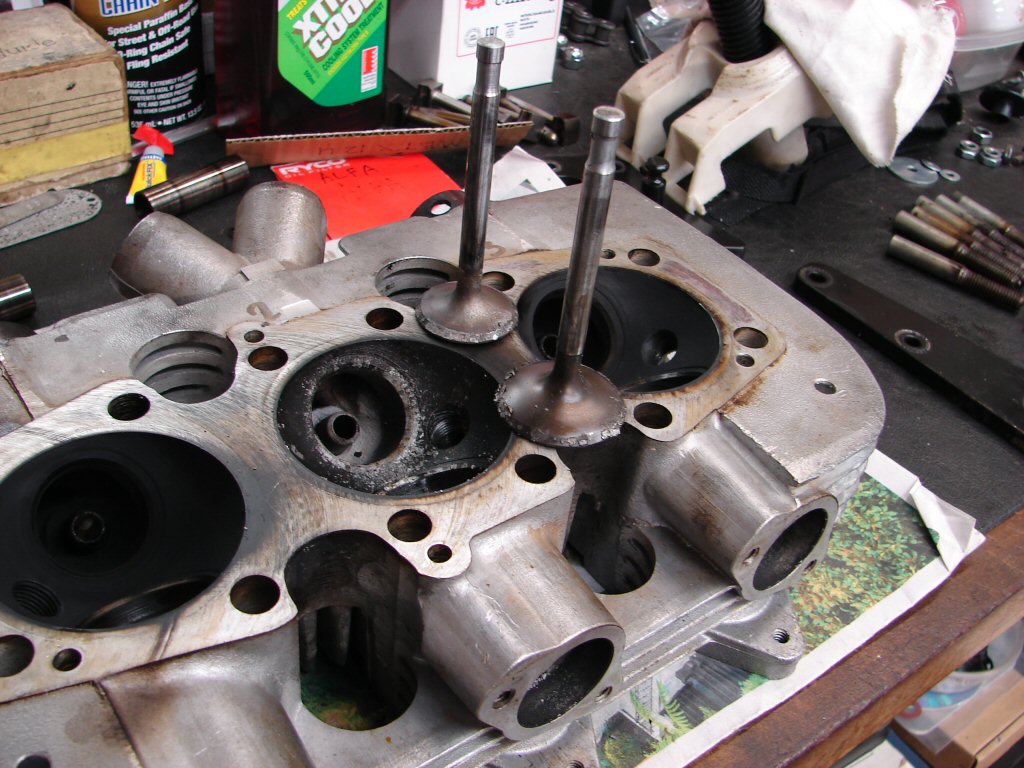
Today all the stripped parts went off to Glen along with a new set of pistons. He did not have any other opinions on the cause of the meltdown, but agreed that an air leak at the inlet stub would have a greater effect than one in the carb.
For a change of pace I stripped the carbs themselves when I got back, checking every jet including the removable pilot jets on these premiers. Those fitted are 17 and were all above board. When having trouble tuning this bike back in April I tried fitting the richer pilot jets to see if it helped, but it seemed to make matters worse so these stayed.
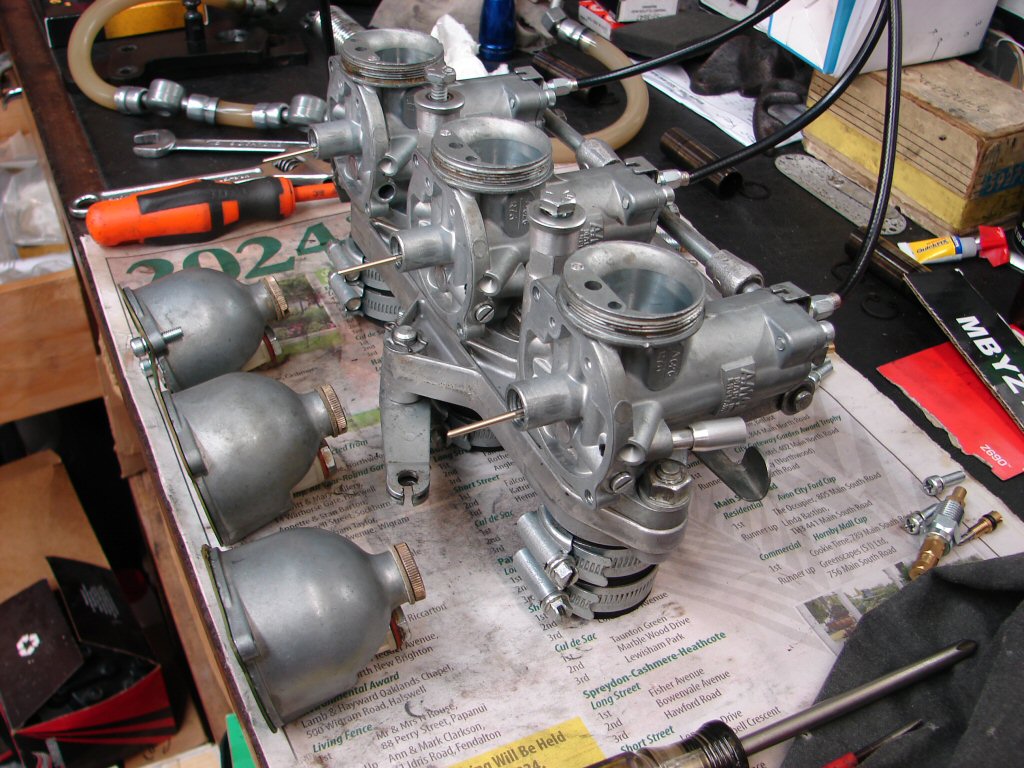
I also loosened the carbs on the adaptor to make sure that the O rings were fitted between each carb and the adaptor, but all were present and correct. The needles were all on the same setting and the needle and main jets all the right size and clear.
But I did find a problem. Three problems really, the same one on each carb.
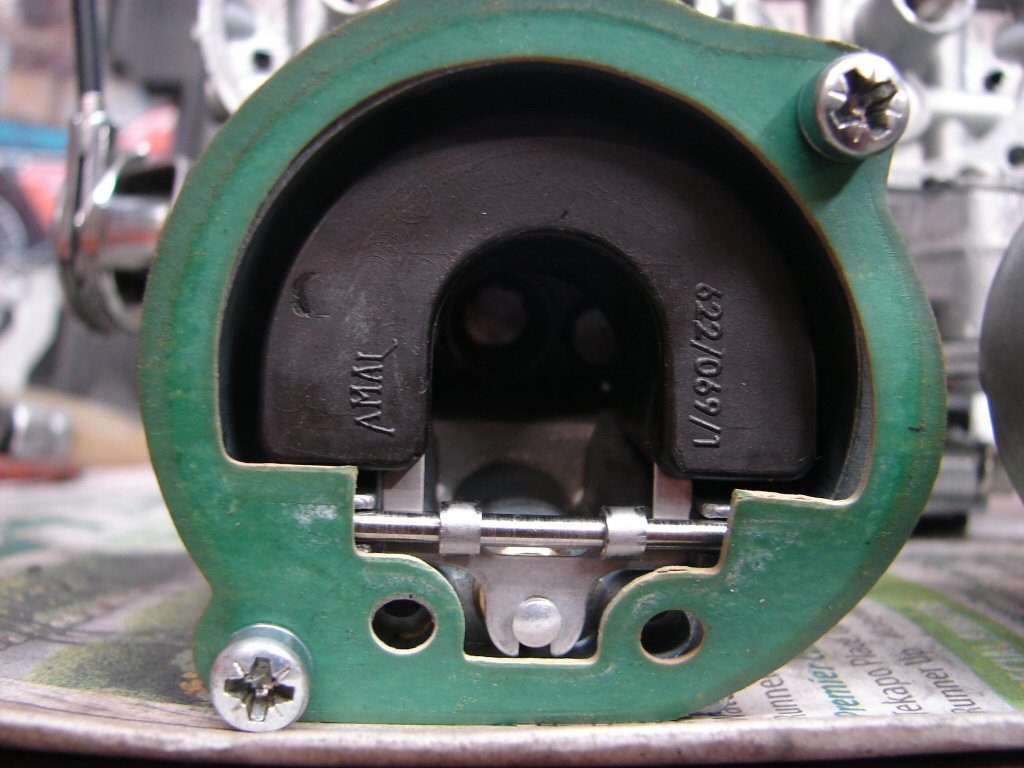
The float bowl gaskets are badly trimmed, such that the two flat edges at the lower sides protrude far enough into the float area that they collide with the lower edges (in this photo..) of the float, preventing it from rising far enough to completely operate the float needle. This would likely cause occasional unexplained flooding, so I can't blame it for melting a piston, but it was certainly problematic. They all got trimmed with a sharp blade.
The primary cover was to be removed for several reasons. The clutch had become unadjustable of late, and I wanted to flush WD40 through the main bearing into the crankcase to displace any debris that may have travelled in this direction.
As can be the case, there are often things that come to light and need attending to at the same time, if for no other reason than to shift them to where they really should be so I can work on what I need to. Initially the footpeg retaining bolt was obscured by the speedo cable which should not have been there, and which had also run foul of the drive chain, so that got relocated first, and led to adjusting the drive chain because it needed to be.
I had previously spotted that there were new gaskets fitted to primary cover and clutch adjustment cover, so I figured work had been done there. It was reasonable to assume this might be related to the clutch cable adjustment issues.
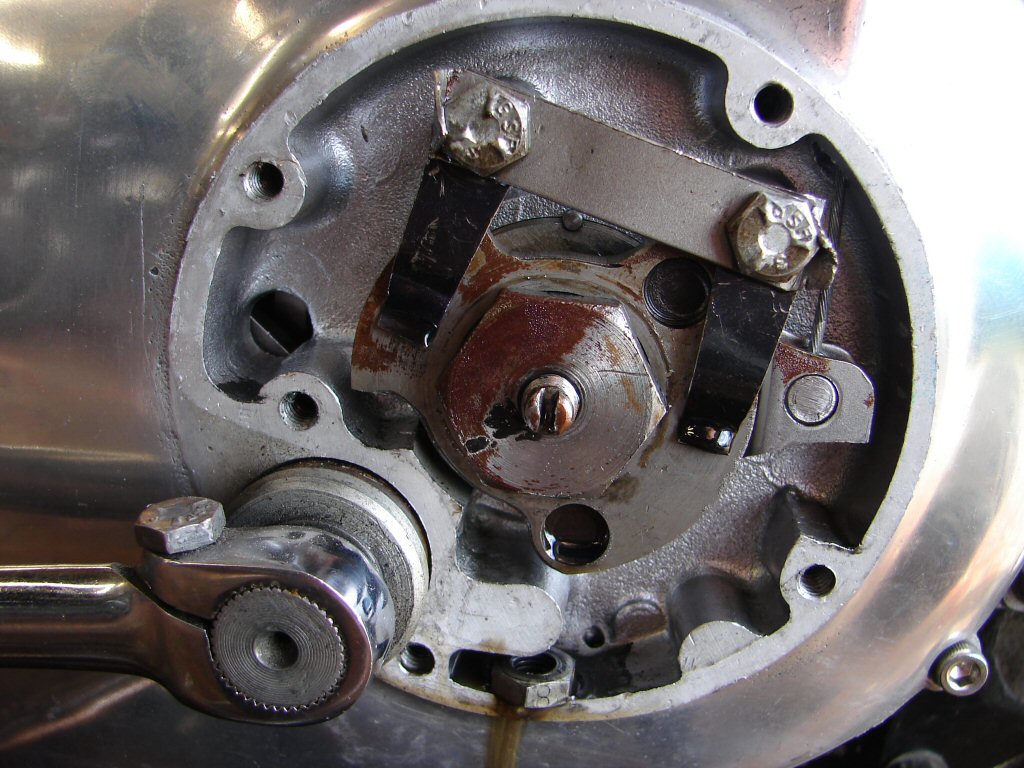
Voila.!
The clutch pullrod locknut has fallen off so the clutch has become self-adjusting. Or not. At least this explains one problem and it should be a cinch to reassemble it in a happy and workable fashion. I am using positive words as I wish to deflect the finding of any other nasty variables - like a seized clutch bearing...
Working my way around the primary cover removing the fasteners I was stopped by something not looking right.
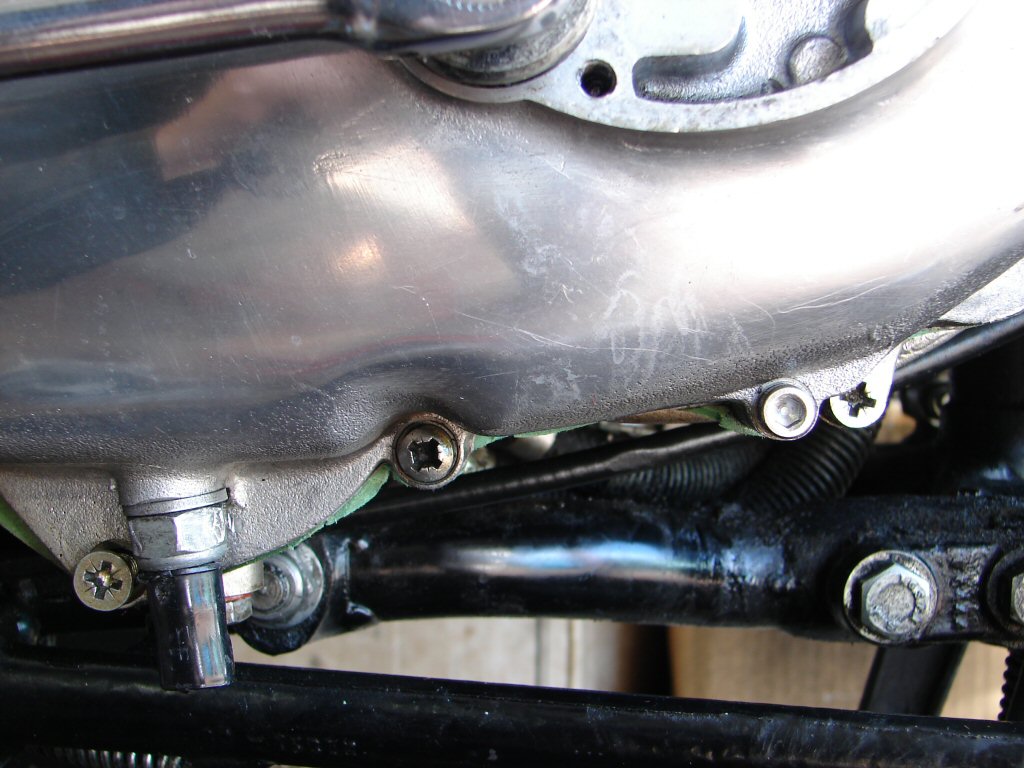
I don't give a toss if folks think I am obsessive, but it is just the visual appearance of things that catch my eye and seem "off". It was quickly identified. The T160 primary cover uses a number of contersunk head screws, and one was not where it should be. Instead there was a conventional screw in its place, which suggested that it may have been swapped for a specific reason, or a mistake. Obviously the answer was that it had been fitted to the inner primary cover instead, a bit further right.
Ok - it is no earth moving error, but attention to detail is what makes these bikes good or bad, and it is hard to think why a countersunk hole would not prefer a countersunk head screw, and vice versa with a conventional threaded hole nearby.
Always makes me wonder how all the locking tabs and big end nuts are assembled...
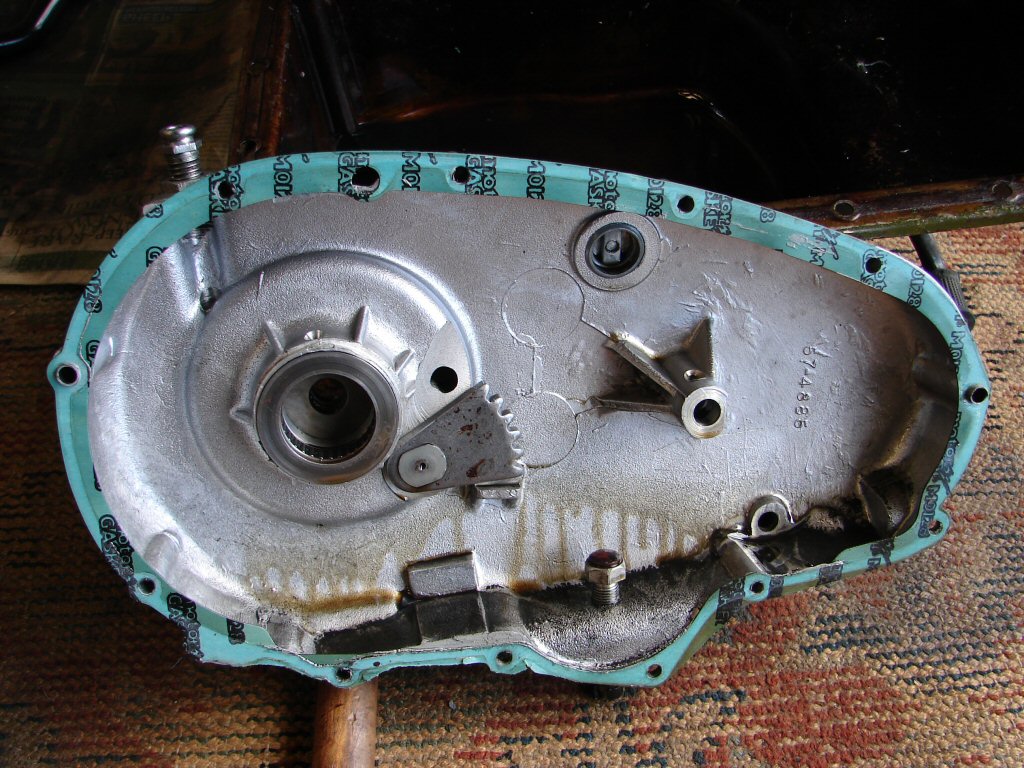
I was extremely pleased to find a total absence of alloy particles in here, although there was quite a lot of carbon deposit resting in the outer case, presumably from the escaping combustion gases. Would give the impression that the meltdown may have been initially much more gradual and over a longer time period.
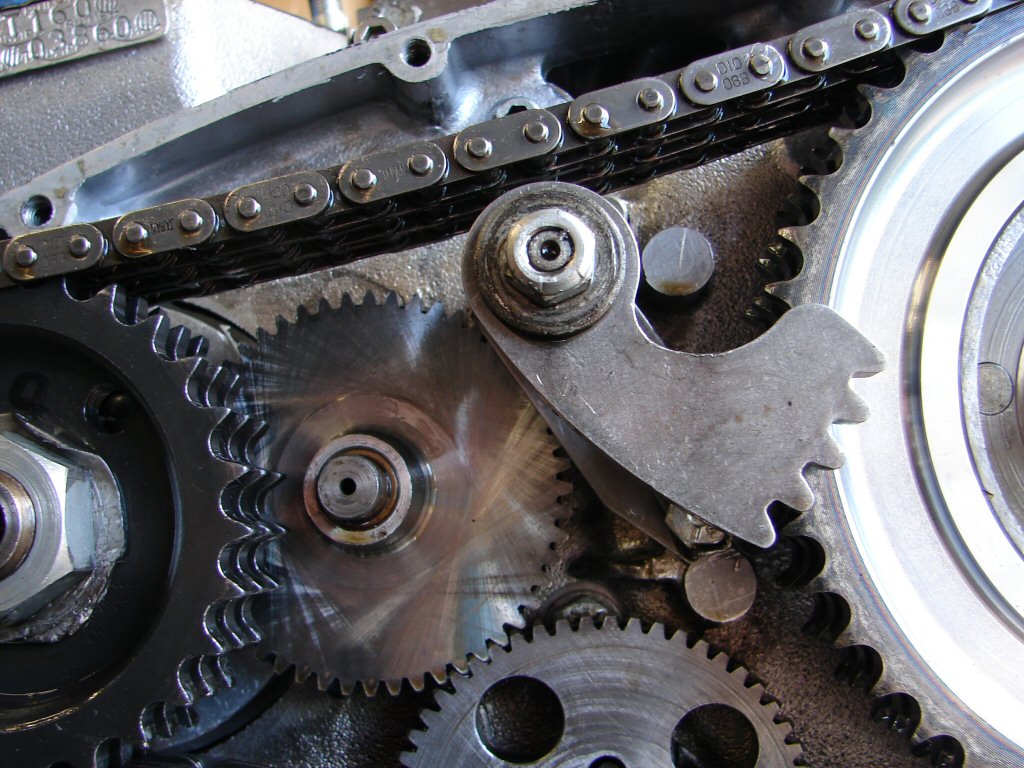
I had been recently told that as a part of the previous work done on the engine, a triplex chain conversion had been fitted. It surely had, and everything looked nicely made and well fitted - except for one thing...
The timing of the cross shaft for the left side gearchange can be a finicky process, and this one is slightly wrong. The first tooth of the quadrant should be positioned above the head of the bolt that can be seen underneath it, so it is one tooth out. I cannot see any part of the triplex setup which would require this to be altered, but the alteration has to be made on a spline at the gearbox end, so it is hard to imagine that it could happen by accident.
I do know that misalignment here can make the gearchange less sublime than it has the ability to be, so if I can't find fault with necessary clearances I shall correct it.
I'm thinking that I will also improve the locking of the crankshaft sprocket nut.
It is the day of the great crankcase cleanout. With a car sump beneath I used two entire aerosols of engine degreaser and doused all and sundry with the stuff. After that I used the airgun to blow whatever was left inside out the bottom, and was very pleased to find very little in the way of alloy scraps got washed out. There had been a small amount around the sump filter when first disturbed, but by far the greatest collection of bits had been what was in the inlet stub.
The overall impression is that the failure took place rather quickly, even though there appears to be no glaring reason as to why it did it at all.
I finished the job off by squirting an entire can of WD40 into the mix, both to collect anything still lurking, but as much to oil everything which had been degreased so it did not get the idea of surface rusting. I will do a bit more by hand around all the cam lobes.
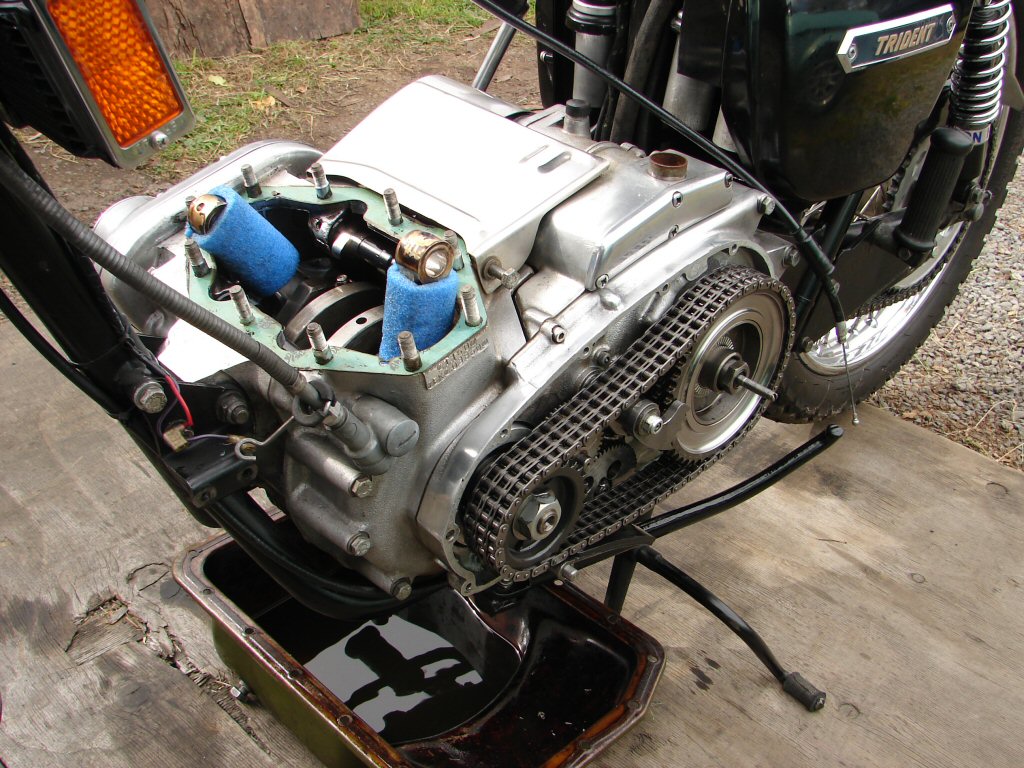
I included the left main bearing in the process, spraying liberal amounts of the degreaser then WD40 through to the inner crankcase. While the bearing still feels totally smooth in use I had found one small particle of alloy in the primary, but it did not look to have made contact with anything during its journey.
As I could not find any trustworthy photos of the gear selector quadrant positioning I decided to sit the primary cover in place with the gearlever foot in its correct position and mark a line on the sprocket. I then used a spare quadrant to mate them up with the cover on the floor and behold, they match perfectly. Perhaps the 50 tooth triplex sprocket is of different diameter to the duplex 43 tooth item, thus giving the impression that something is out of place. I also suspect that moving the spline on the far end only one tooth would probably make too big of a difference, so I will leave it as-is and see how the gearchange feels in use. It may be that any oddness in gearchanging would have been down to the clutch adjuster having done its thing.
A few too many mysteries for me to feel at all complacent right now.
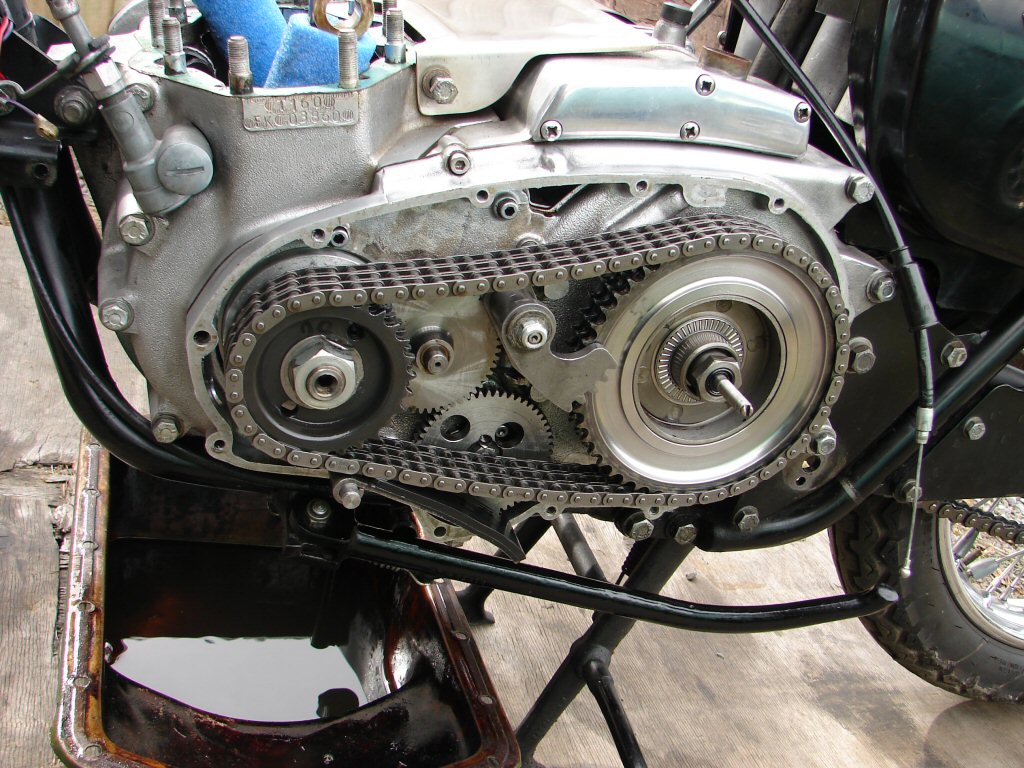
So thats the cleanup as far as I can manage it. Next job will be to complete cleaning the conrod and refitting it, after which I will clean the oil tank filter and the tank as well if it looks like it needs. I intend to get some fresh oil into the engine then circulate it by driving the pump manually. This will flush the oil filter cavity - which was clean when I removed the filter - as well as pumping oil to all the bearings. If I leave the sump plate off meantime I will not risk leaking oil all over the engine from the rocker feed pipes which are hanging in midair.
I am not fond of cleaning shit...
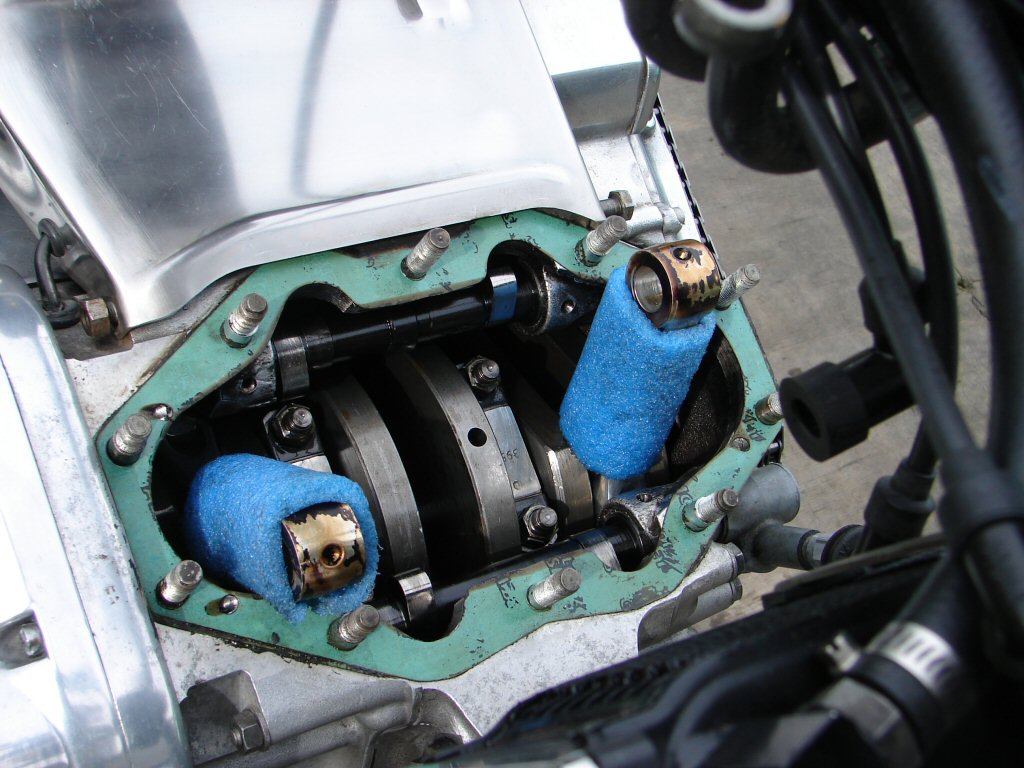
... although I will make exceptions for nice shiny alloy bits.
The rod responded happily and is restored to a thing of great beauty - for those who are involved in the world of triples from a bygone era.
The appearance of the bearing shells is normal for copper lead bearings, fitted from new by the factory but later seceded to white metal which are neither as robust nor forgiving when they wear out, so they are both a valuable asset and a true testament to this bike's low mileage history.
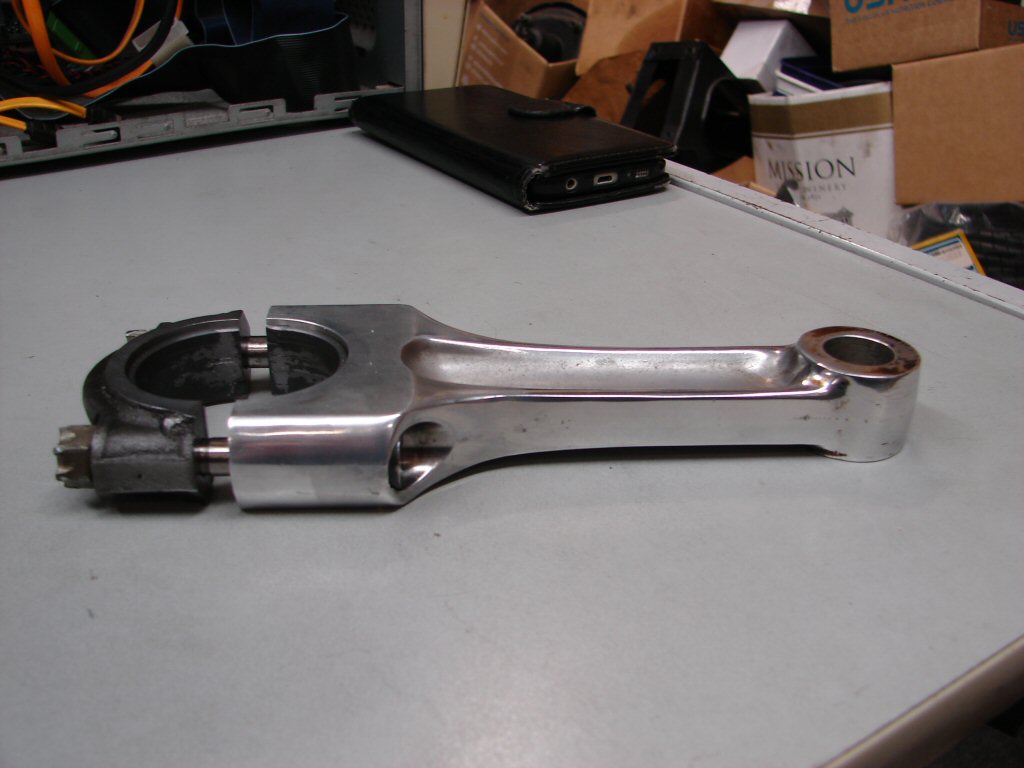
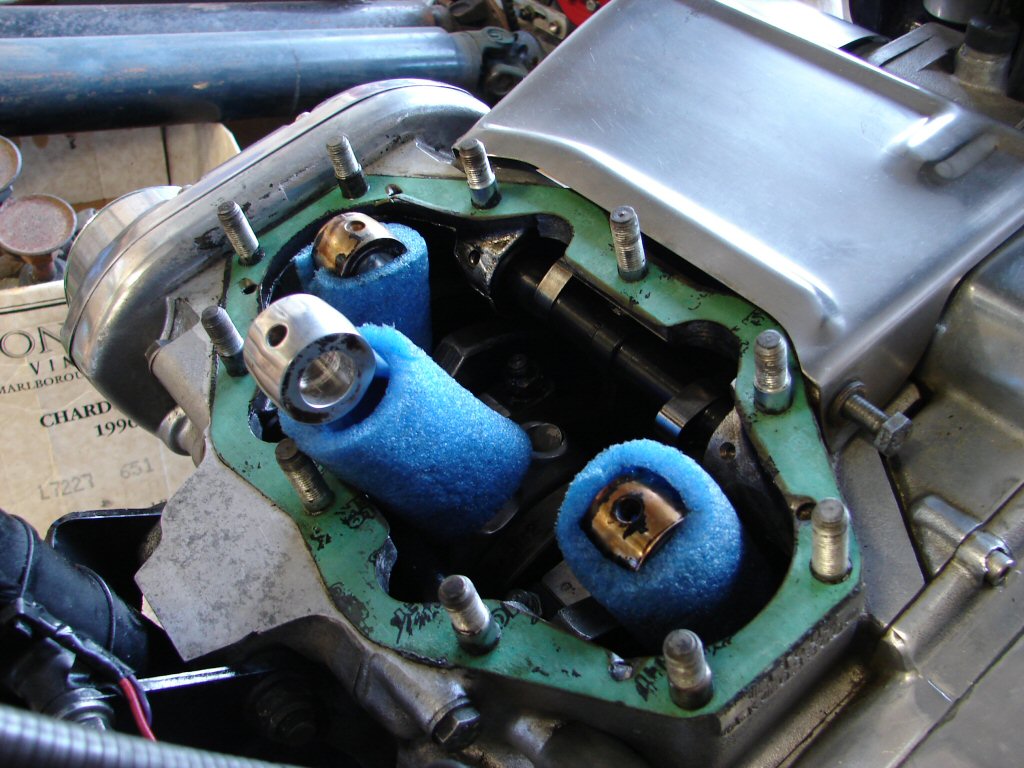
So, not being one to stand on ceremony the rod went straight back in and got torqued up to complete the full set.
While I am hopeful that the missing engine parts will soon return, there will no doubt be a stand down period inbetween now and then, so I shall coninue with the oil tank business and get some oil around the working surfaces.
The two oil lines came off the engine and were allowed to drain, although there was no oil from the tank. Looking in from the top there was no sign of oil, so I released the feed line from the tank filter and indeed, the tank had emptied itself while awaiting transport down here.
The lines got flushed with degreaser then WD40 and there were no signs of anything sparkly when examining the runoff. The oil tank needs to come out in order to remove the filter, so it did.
I was expecting it to look a whole lot worse than this...
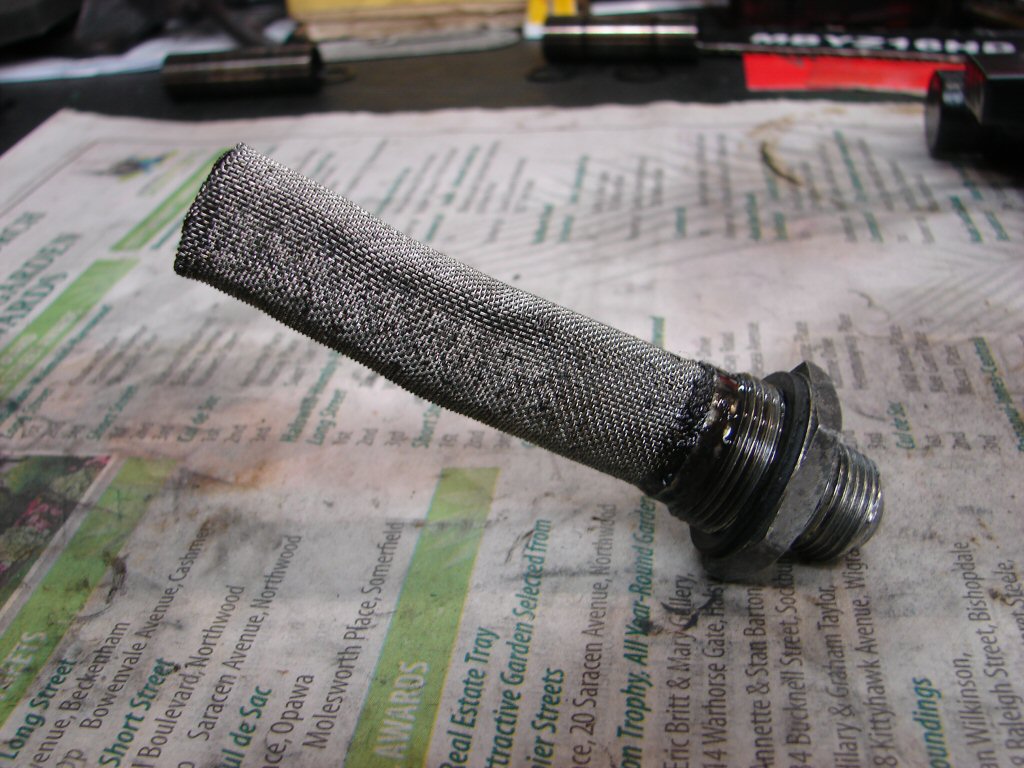
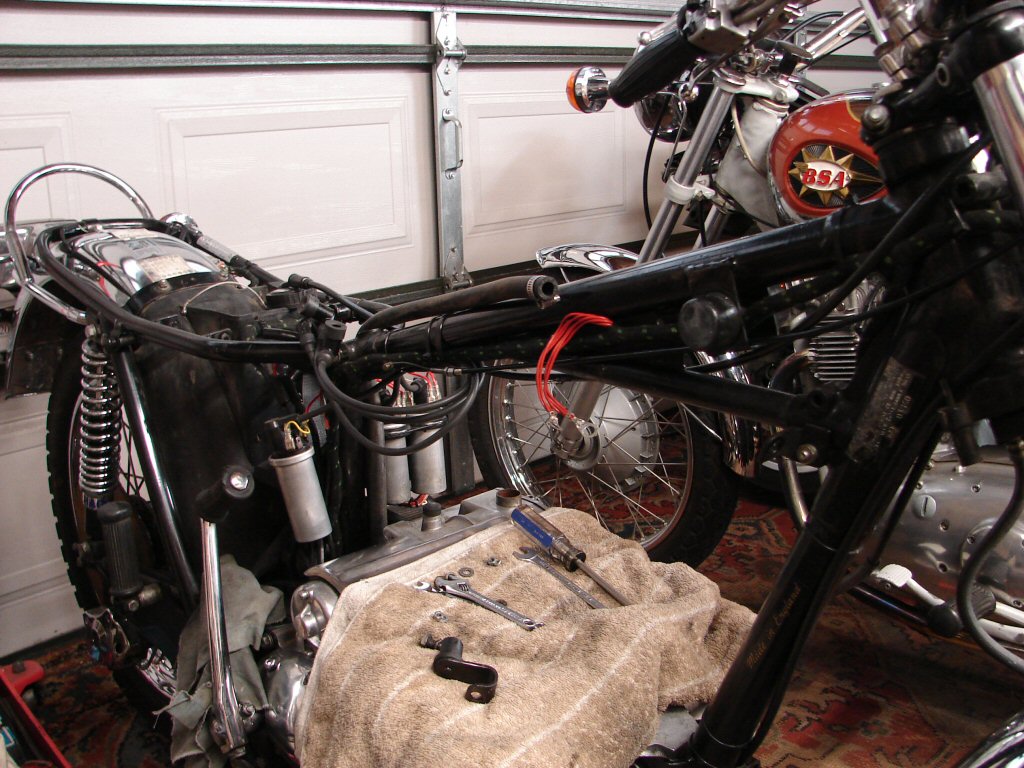
With the oil tank removed it was looking easier to also remove the oil cooler to clean both it and the attached lines rather than try to do that on the bike. None of these parts put up much of a fight, so the main consideration is which approach is the easiest to control.
Just the absence of these two fairly small items sure make the bike look like a skeleton though, and of course greatly exaggerated by the lack of the barrels and head.
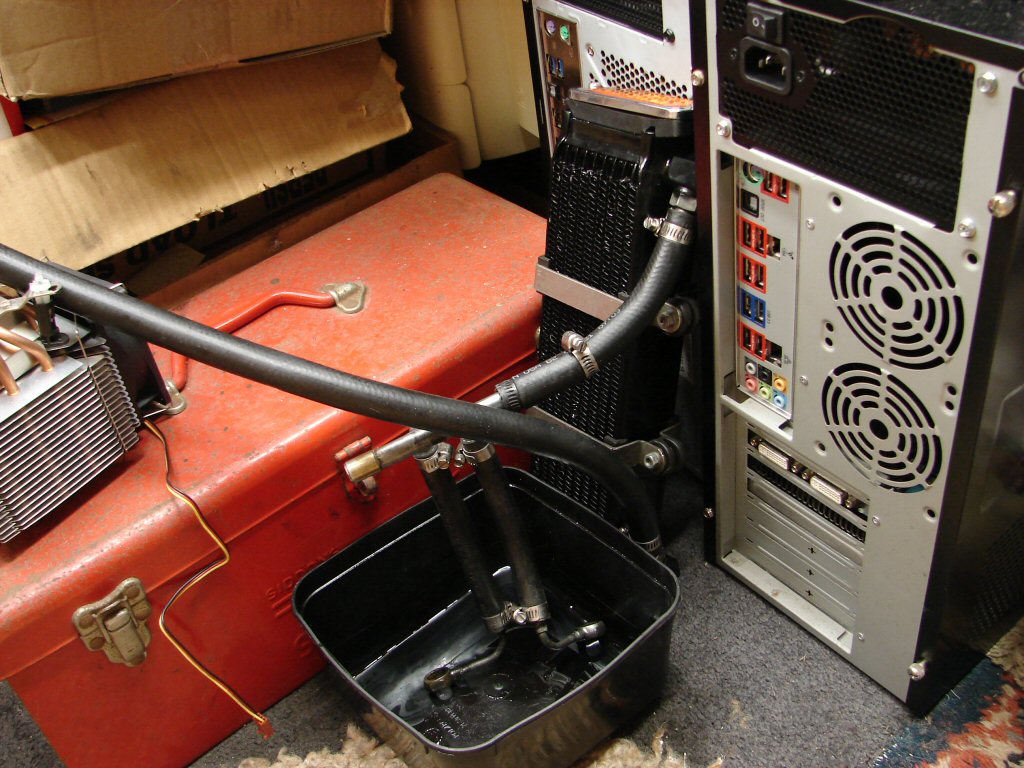
As the oil cooler could now be stood on its end I have left it propped up against a friendly computer while the oil slowly drains back the reverse way from which it arrived. I will later use an airgun to give things a hurry up, but I need it outdoors for such fun.
It will also by then be more conducive to having some degreaser or petrol added to the mix which will help unstick any stubborn mank.
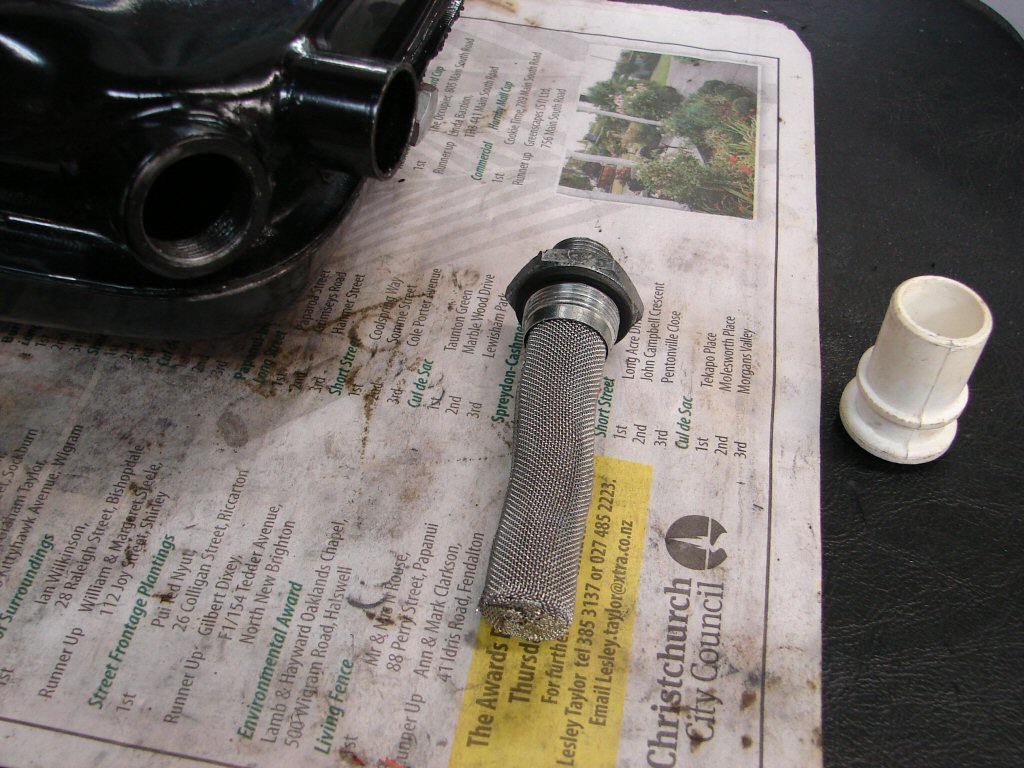
The tank filter cleaned up easily and was virtually free of anything looking like particles of alloy, or anything else for that matter. That reinforces the argument that the entire piston failure happened pretty quickly, but nothing promotes suspicion as to the guilty party. Apart from the slightly loose inlet stubs, the head gasket is the only part so far that looks like it was capable of causing trouble. The loose pillar stud would not have helped, but I am thinking that the gasket was not doing a proper job of sealing against the combustion gases, so maybe that got things started.
Despite giving the oil tank a fair number of rinses with degreaser there are still some gritty feeling tiny bits turning up in the filter threads after draining. I am going to give the tank the petrol treatment as well when the weather allows me to operate outside of the shed.
I found a suitably sized plastic bung that will help block the filter hole during the process.
The last time the bike was here I had to address a problem with the rear brake dragging, which was mostly due to the pad retaining pins being wrongly assembled. However, from the moment I heard the delivery guy wheeling the bike down my driveway this time, I could hear the rear brake still complaining. While the oil tank is out the rear brake cylinder is much more accessible, so now is best to look at it before the tank goes back in.
Taking a look underneath it was easy to see maybe three problems at a glance. The obvious fluid leak has nearly drained the reservoir, but the reason for the leak may have been induced by the fact that the cylinder has been mounted wrongly. I have struck this same problem on more T160s than I would like, and it is to do with the fact that there are two spacers used on the mounting bolts. They should actually be under the nuts, as the alloy housing is recessed which makes them hard to get a spanner on. People who did not take care to assemble things in the same order they came apart get the idea that the spacers should be between the cylinder and the frame, so the pushrod is now on an angle which adds side loading on the piston and wears seals quicker. It often also results in the threaded part of the pushrod bending, and although I could not get a good enough look at it in the space where the bike is, it looks as though there could be a bend towards the camera just where the threaded part leaves the rear locknut of the brake lever. The cylinder itself is definitely sitting angled away from the rear footrest plate which mounts it to the frame.
I guess its all going to come off.
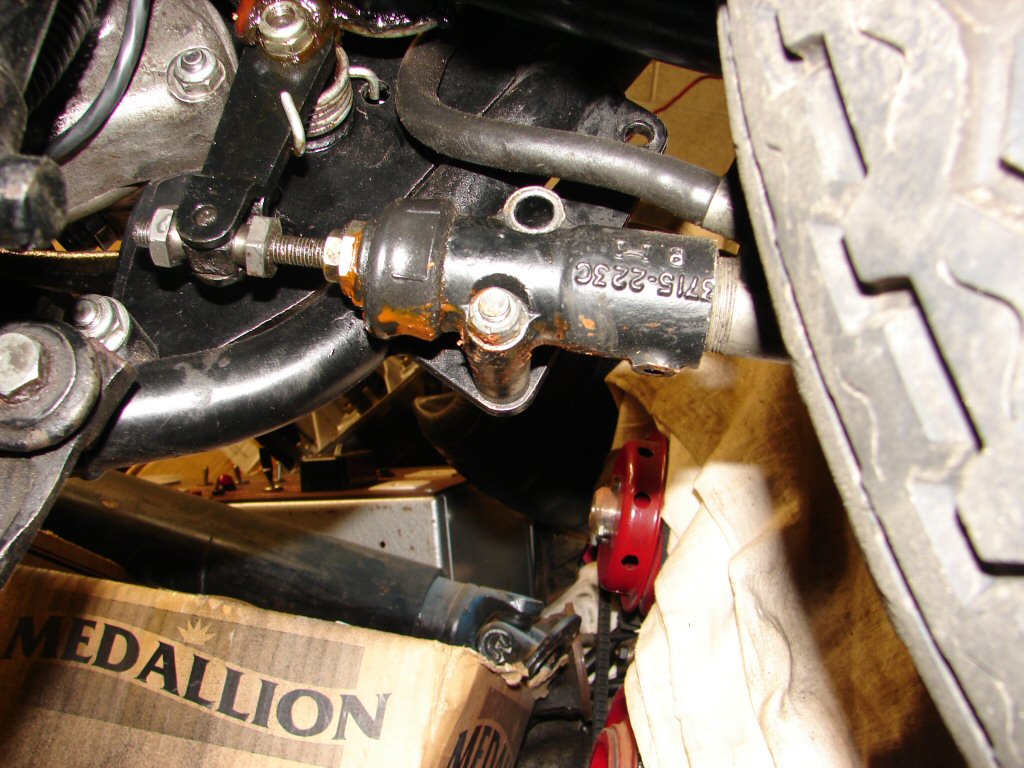
So it did come off, and in so doing it revealed another glaring omission which is perfectly clear in the previous pic, I just was not looking for it. The nut that holds the brake arm onto the footlever on a good day is in fact 3/4 off the thread. So that was also about to become self-adjusting. I figured I might as well pluck the right side engine mount plate off complete with brake lever and footpeg to make things easier on reassembly and to be sure we did not find anything else.
There was some good news. Once I had separated the brake cylinder from the caliper the brakes freed up and the wheel now turns freely, which is a first. No doubt the cylinder has gotten all sludged up and is holding some fluid pressure on rather than allowing it to bleed off. The other good news was that the grubscrew came out of the alloy housing which holds the brake cylinder, and is often corroded up. Mind you, even though it is out there is no way the two parts will unscrew from each other, so they will need the boiling water treatment on the alloy to make it let go.
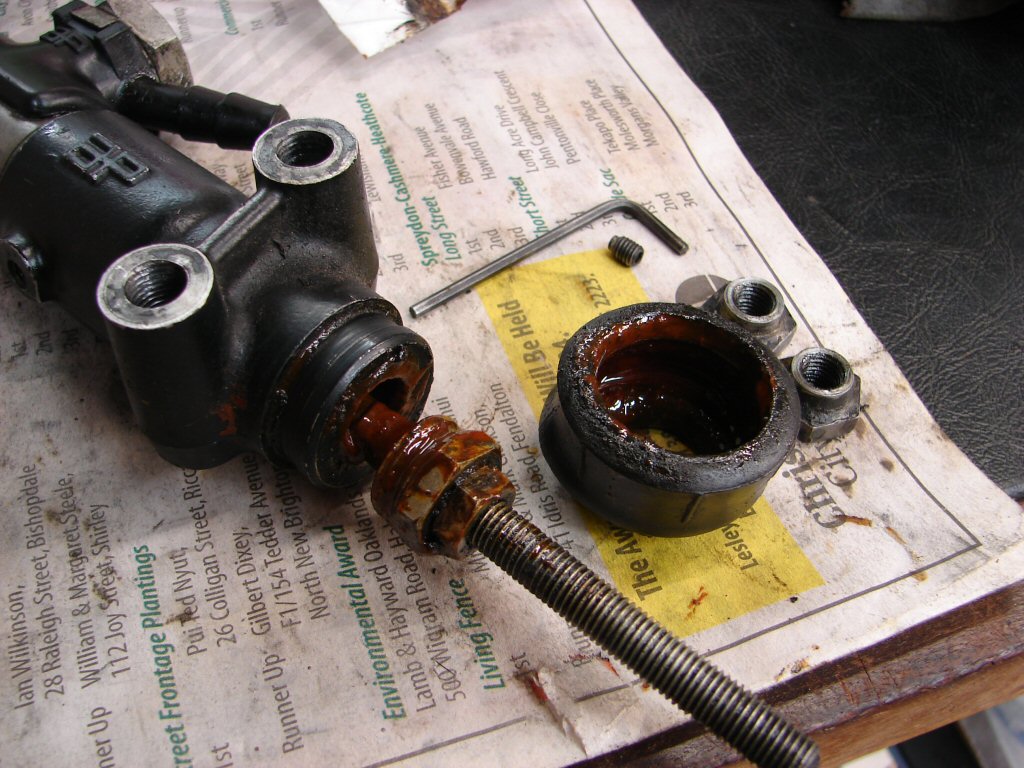
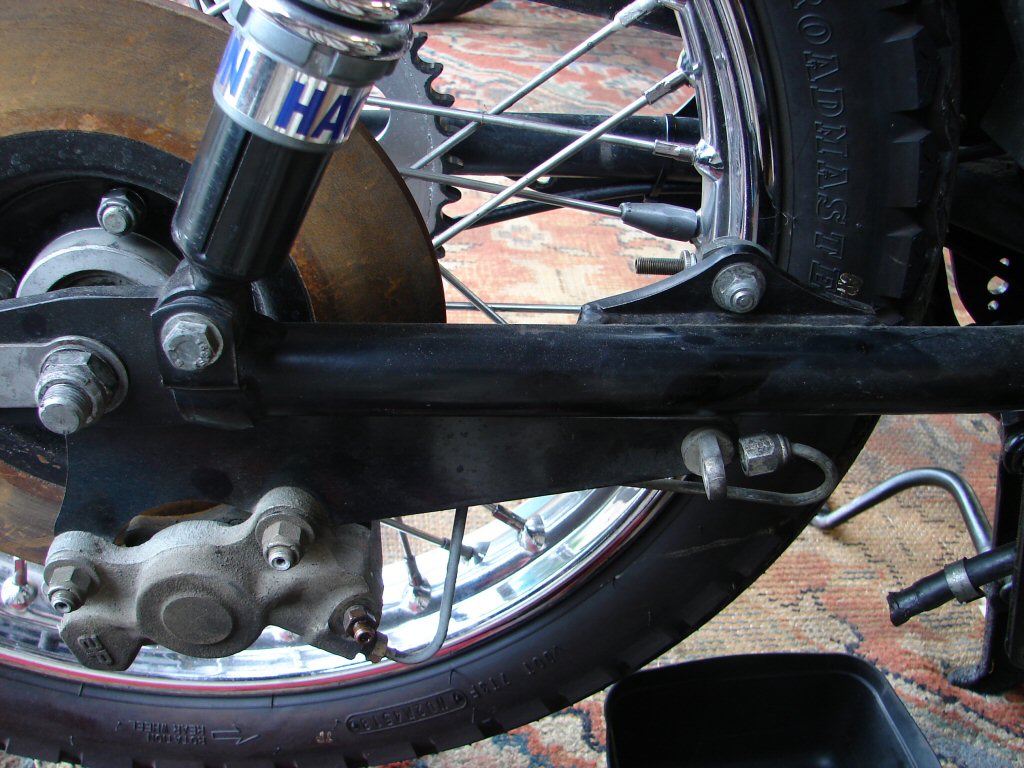
'Anything else' showed up when I removed the flexible hose in order to remove the brake cylinder, to find that the swivelling functions of both the hose retainer and its mate which holds the brake anchor plate are seized solid, which means the rear wheel is sorta locked in place and explains why I met a bit of resistance when adjusting the rear chain.
I had tried to bleed all the remaining brake fluid out of the caliper prior to undoing the fluid hose, and what came out was as rusty looking as the brake cylinder stuff, so I am hoping that I will not have to mess with the caliper. The fact that it freed up by itself is a good omen.
My suspicion about the seized bits is that they have been assembled incorrectly, as there are some spacers and springs which allow controlled movement and they will only work when assembled in the right order. Which nothing else about this brake seems to have been...
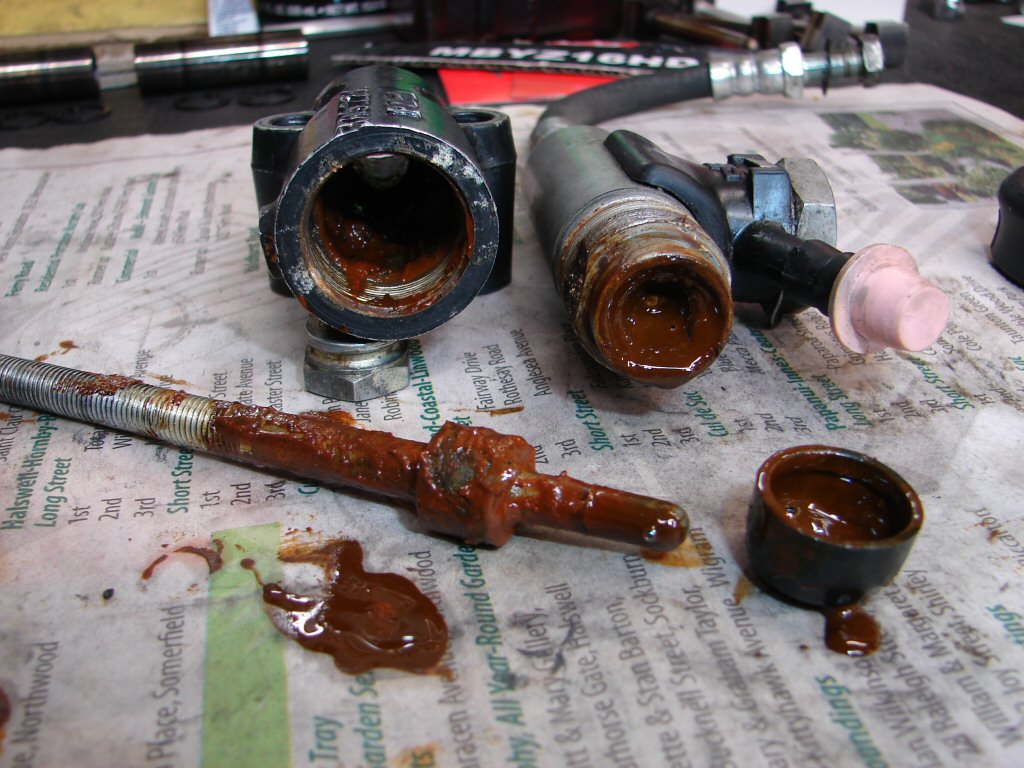
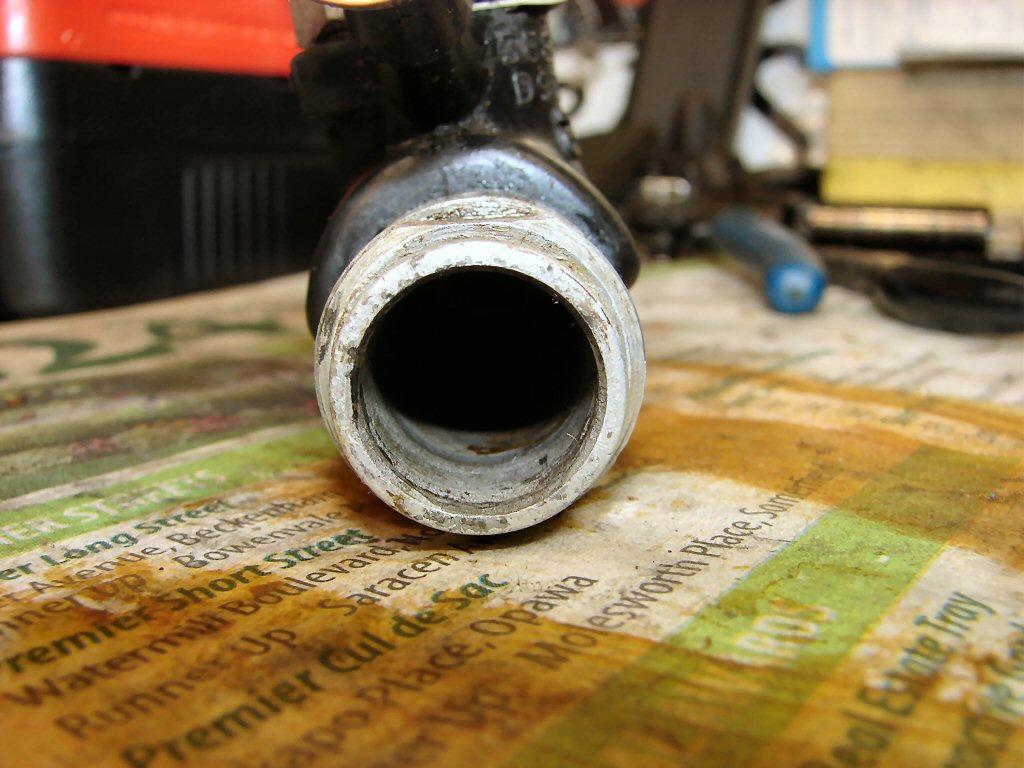
Happily the master cylinder succumbed to the boiling water treatment and the housing unscrewed. I usually describe what lives inside these cylinders as 'tomato soup', and the resemblance is kinda self-evident.
Considering that the orange colouring is in fact rust, it seems rather unlikely that this cylinder will be viable for re-kitting as that rust will have left a few craters.
Photos such as this are seldom successful as the light cannot get in while I have the camera stuffed up the gubbings, but the damage is in fact quite visible despite a red herring or three.
There is a patch of light surface rust disappearing into the gloom back there, but just in front of the rust is a smooth grey 'lake' more than 1mm deep at centre bottom, and this would have to be machined to make the seals work. It is also possible to get the bore of the cylinder stainless sleeved, but considering that the job is about the same cost as a complete new stainless cylinder there is no contest.
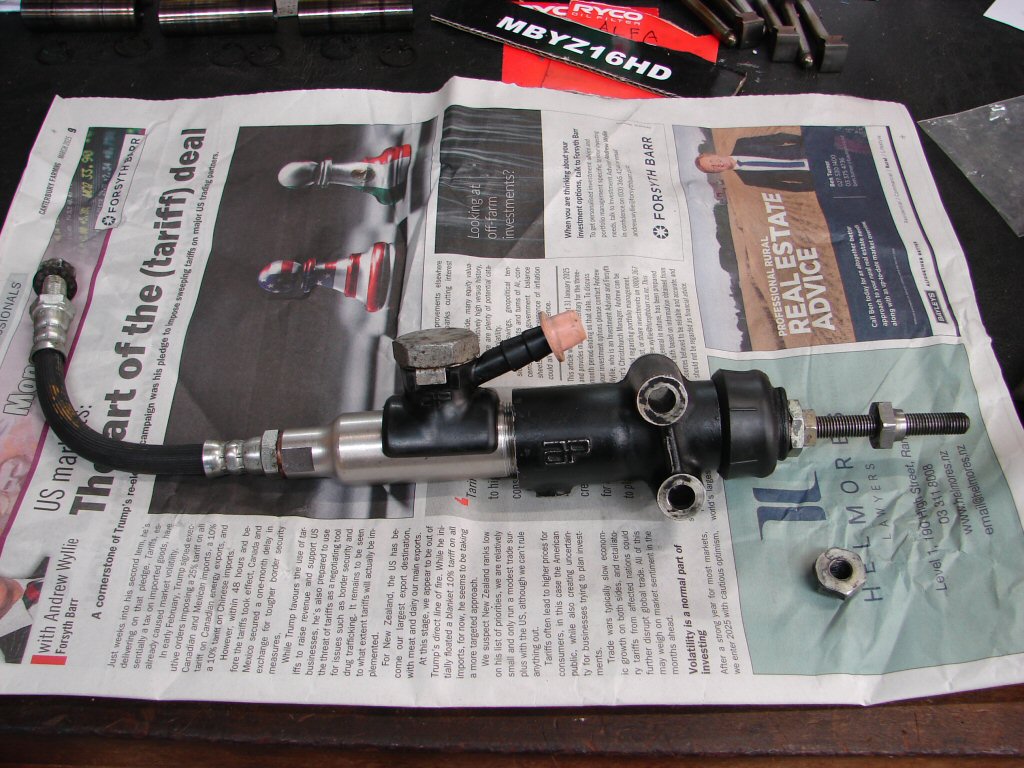
We need a new one.!
So we got one.
All ancillary bits were cleaned and greased and it went back together a happier unit. When fitting master cylinders to their housings there is a 'timing' process which needs to be observed if you want to be able to bleed the brake successfully, let alone use it. This is done by taking up all the free play between the operating rod and the piston by simply screwing the cylinder in far enough for that to happen. You then screw it in a further full turn, then continue until the grubscrew which locks them together lines up with its slot - you never turn it in the reverse direction at any stage.
For the first time ever this one initially lined up exactly on the mark, so one turn later we got locked up and then had all the swapped over parts fitted. It should not need to see any other maintenance for many a decade.
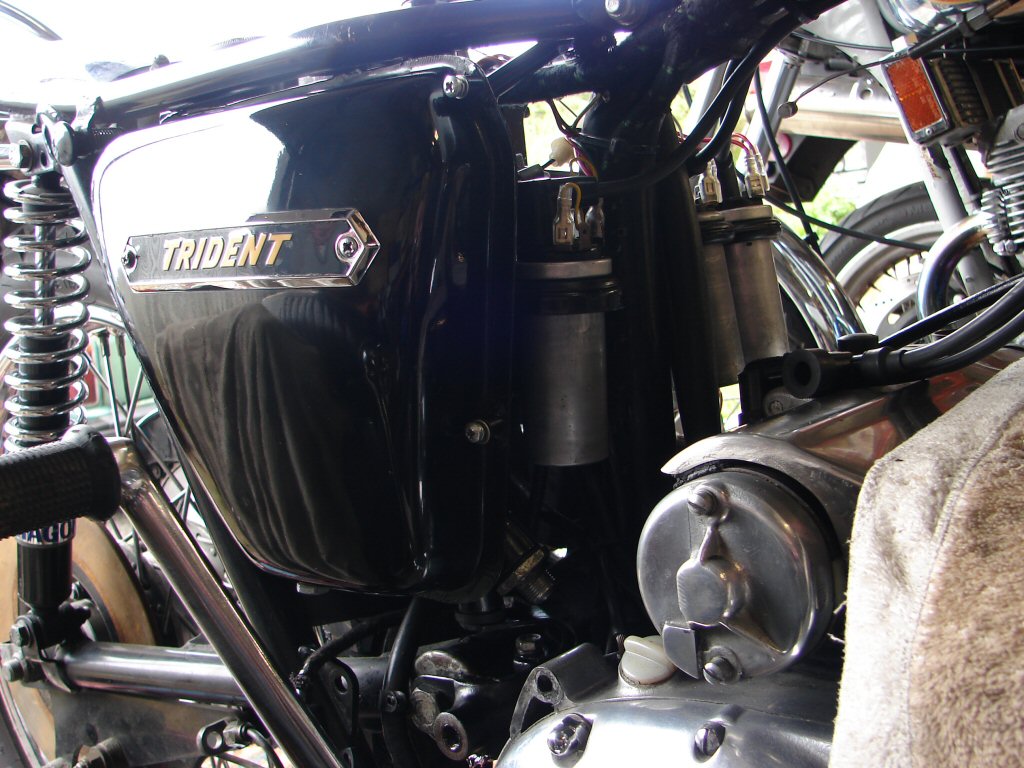
Before the cylinder can be refitted the oil tank needs to go back, then the engine mount along with footrest and brake lever. The tank fit was a breeze without the engine mount which allows easy access to its lower mount which is otherwise a real pain, and the time saved makes the extra dismantling well worth the effort. It also means everything gets cleaned along the way - not that anyone will see it - which makes the reassembly job far more pleasurable.
The coil went back and got all its wiring, and the oil tank breather and chain oiler hoses went on with no issues. Sometimes they need warming as the hoses get kinda solid with age.
The engine mounting plate comes next, with no less than six mounting bolts, the top front one also anchoring the heavy current battery earth which carries what the starter demands. Leaving this off by mistake usually melts the wiring loom to a certain extent, and while I have seen the results I have been fortunate not to yet repeat them. A few missing washers from the mounting bolts were reinvented during the process.
Before mounting the brake cylinder I decided to strip the seized anchor plate as it is more easily accessible without it. It also means that progress will continue in a logical fashion from front to rear, which makes it more difficult to overlook anything along the way. This will also involve releasing the rear axle, so I shall make an intention that it does not put up a fight, as some can...
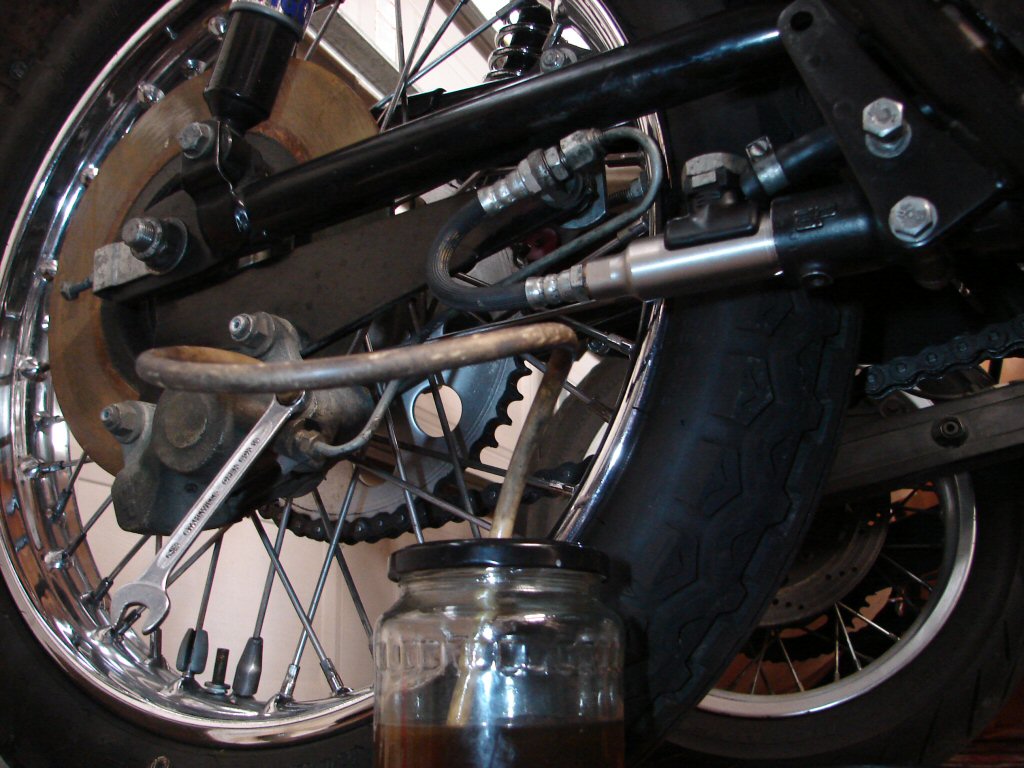
Well, there was no fight at all, so it did not take long to assemble the anchor link correctly with its missing oddball double coil spring washer, and everything now works as it should.
Even the new brake cylinder bled up without a murmur of complaint, so all the innards are now immersed in new fluid, which should be a surprise for them. I made a mental note to bleed my own twin front calipers in the next few days, as the years can go by without doing so until things start to bind up and you realise you left it too long. That one is also still the factory original cylinder, so I better not let the rust get to work and kill it.
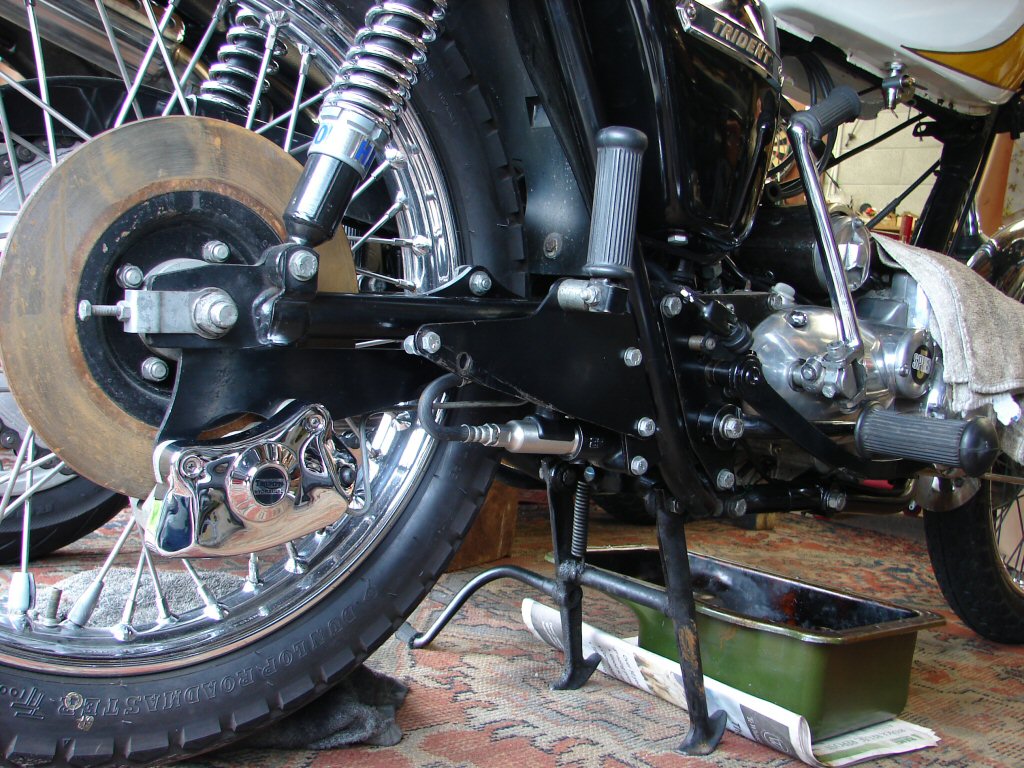
The next day I checked for any leaks around the cylinder area, and as there were none I put everything else back on that I could. I will press the pistons back inside the caliper and allow them to find their own new rest position, so once the bike is running we will be able to give that disc a real good polish up on the road. I had been simultaneously working on another T160 rear brake which had begun leaking, not long after a new cylinder had been fitted. That one had suffered a failure of the rubber hose leading down from the reservoir, and fluid was oozing out through some splits where it fitted to the cylinder inlet. The new hoses are considerably thicker cross section and it is a bitch threading them through the middle of the bike, and larger clamps are also needed at both ends. This one is in good condition so it stays put.
These reservoir hoses are of a special type of rubber 'EMD', as normal rubber hose will not withstand brake fluid, so there are not many options when replacing other than what can be readily got. Nor are they cheap...
Both bikes were still leak-free after two days so I consider that a win. Yay.
Well - here's a welcome sight.
After a record delay all the engine parts came back, having been missing in action for seven months.
Admittedly I have had my hands full with another problematic rebuild over the same time period, but as that is nearing completion this is a great piece of timing.
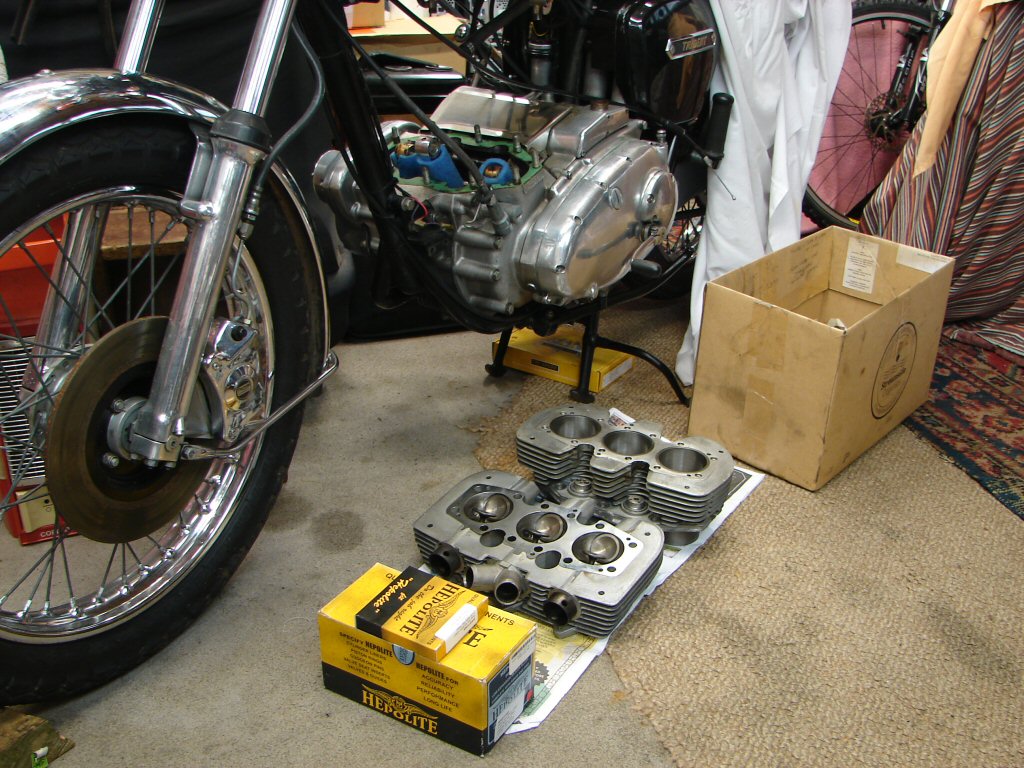
The barrels are looking fabulous - now out to +040" from standard - and the increased taper at the bottom of the liners is going to make refitting the bores over the pistons a delight rather than a nightmare.
The head cleaned up brilliantly thanks to Glen's expertise, and while he confirmed that valves and guides are in great shape, the head surface was not, and had to be skimmed as little as he could get away with. This is another clue as to the cause of the melted piston, as I had figured the only logical culprit was air getting sucked into the cylinder via the manky head gasket that was fitted, but the head was bent as well, so two issues in the same place which might give the same result.
That should cure a number of odd symptoms the bike had presented which had made it impossible to tune properly prior to the meltdown.
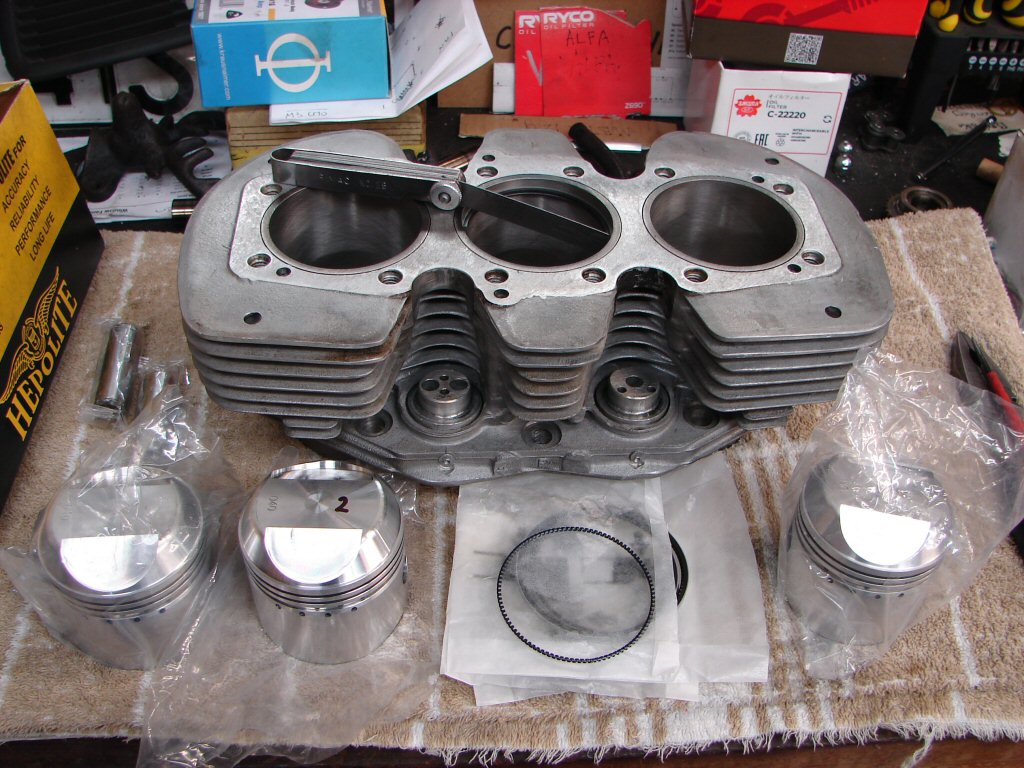
First job is to gap all the piston rings in case any have too little clearance. It is a tedious job but one that is totally necessary as one ring that has too little room to expand can damage a piston fairly quick.
I have yet to find a new ring that was not correct, but I guess it is an insurance policy that you only get one chance at. As each ring is done it gets fitted to its piston until all are in position, then that piston is fitted to its conrod. I start with the centre one as the outers obscure its circlip holes if they are fitted first.
So now we have all pistons fitted and the crankshaft is in the position to have the timing side piston fitted into the bore first, as the timing chest extends above the cylinder base which makes that cylinder tricky unless done first. I rotate the crankshaft backwards as the pistons enter their bores, so the drive side is next and the centre last.
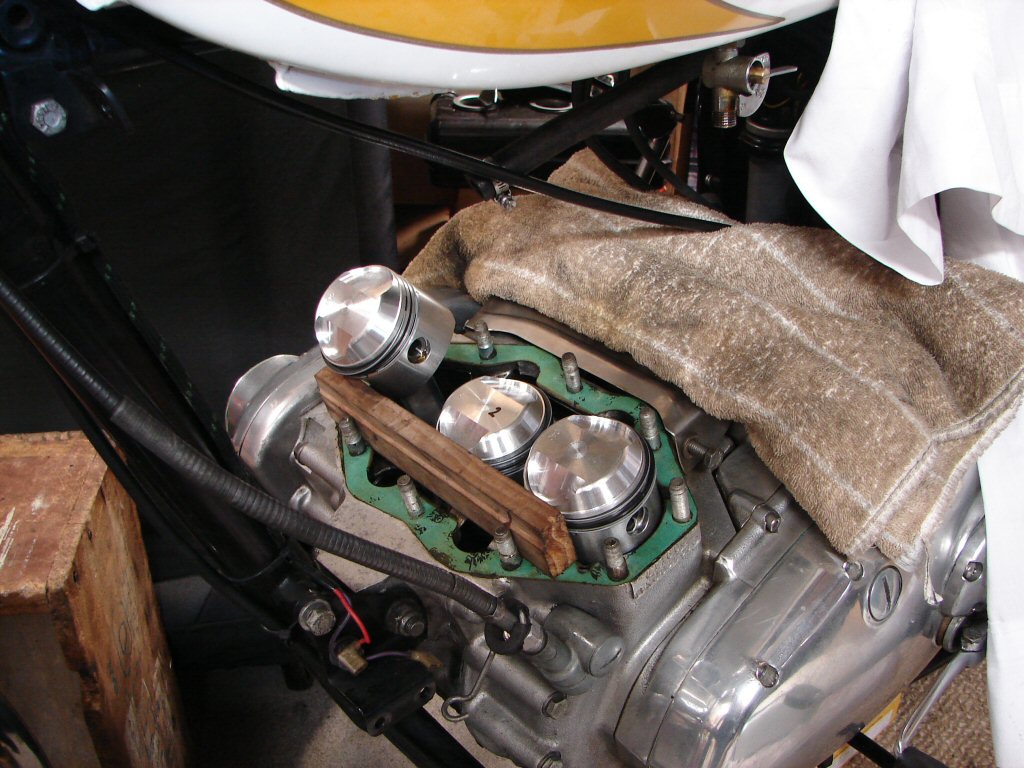
Now comes a fair bit of preparatory work before the barrels go on. Grease on the base gasket, oil on the lower cylinder bores, oil on the pistons and rings so they enter the bore happily, and some assembly lube on the cam followers to keep them happy until plenty oil is getting splashed about inside the crankcases.
Before that can even happen, the cam followers will have to be reunited with their original guides, oiled, and retained with cable ties so they don't drop into the crankcases while the barrels are being fitted.
All that got done and I made an attempt to fit the barrels, but once again I fell foul of the extremely resistant oil rings with their sturdy expander. The compression rings can easily be persuaded into the bores by fingernail alone, but the oil rings put up a hell of a fight when their expanders seem a bit too ambitious. I guess that is the price we pay for not having any oil burning issues. It ends up that a ring compressor needs to be used, and working alone with the barrels hanging in midair is inviting a snapped ring.
So I adopted plan B.
The barrels came off again along with the centre conrod and piston. Then I took the two outer pistons off their rods and with the help of the ring compressor, fitted them to the bottom of their bores only far enough to leave the gudgeon pin hole accessible. The centre piston got fitted along with its conrod and left at the top of the bore. Then the barrels got lowered over the outer rods and the pins slid easily into place and their circlips fitted. The barrels were then easily pushed down to the crankcase but a gap left as the base nuts and washers need to be fitted before they go right down. Sounds complex but in 30 minutes it was all together apart from the centre conrod big end nuts still to be torqued up via the sump plate.
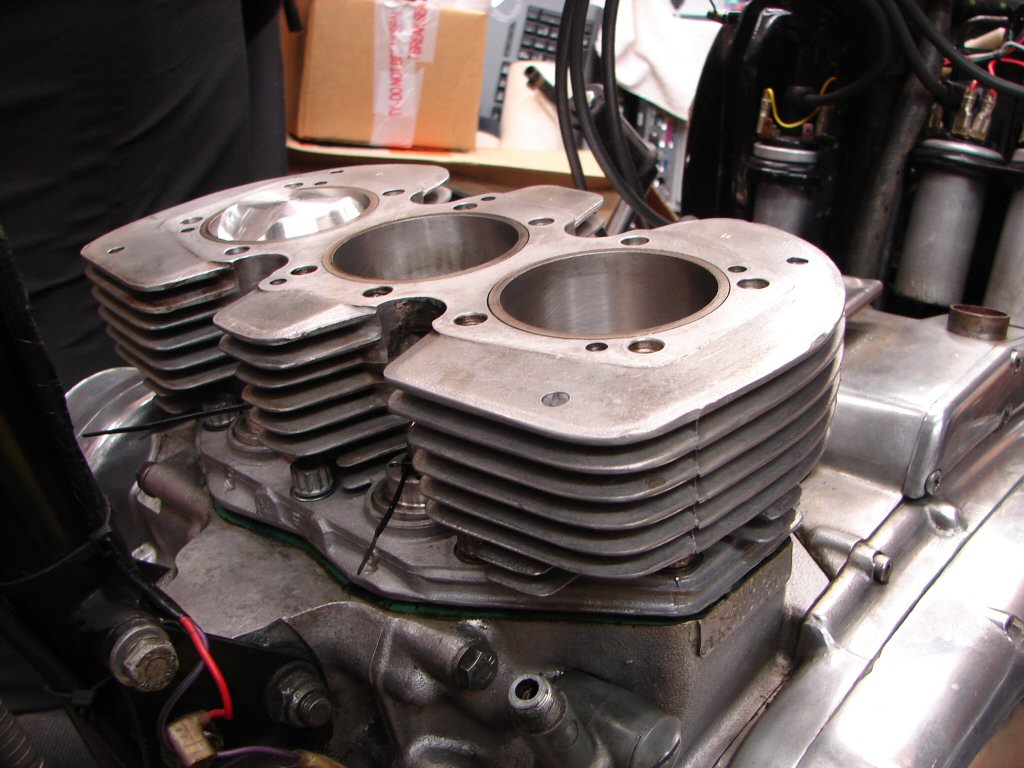
Tightening the barrel base nuts involves finding a spanner which can be ground down enough to fit over the nuts in the very confined space at either end of the barrels, and these often break due to being weakened too much in the process. I have been struggling with several different spanners for some time, but keep intending to sort a better solution.
Recently I sorted a few old and weathered spanners which had survived the earthquake mayhem in Lyttelton, and figured they may as well be added to the rest. Today I got to a point where none of the usual suspects would fit at all, so I resorted to the new additions and found the most wonderful item. It has previously been ground down and I can only think that I did it way back when and had forgotten about it. So pleased to have it back and it makes the job a breeze.
Win - and job done.
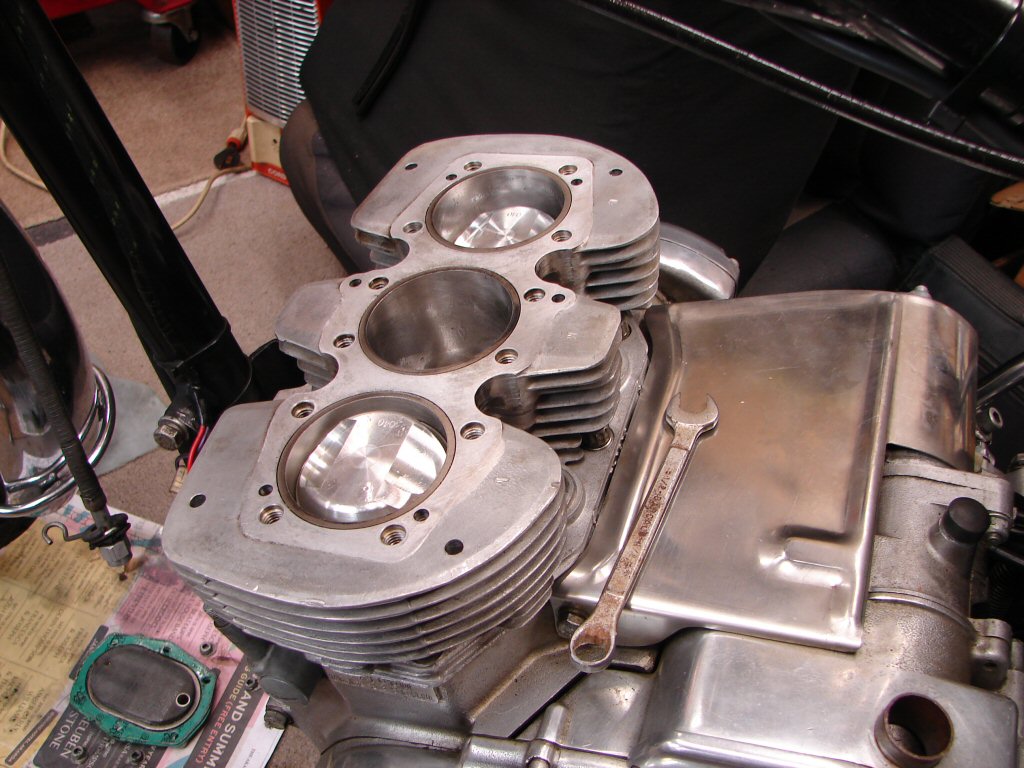
Next comes the fitting of the pillar bolts, some of which were loose during the dismantling, and as this can signify the death of the alloy thread in the barrels some care needs to be taken rather than an over-enthusiastic approach.
All the bolts have been cleaned inside and out, plus the exposed surfaces sandpapered to allow easier fitting of the head gasket. They all tightened down fine and no dodgy threads were found, so they were presumablly not tightened enough during the last build.
To my surprise the new gasket slid nicely into place with a bit of jiggling but no force required. I often spend a lot of time filing and dressing the holes in these gaskets as they do not seem to be accurately made, but this one was not from a gasket set - it was purchased as a standalone gasket and the fit is perfect.
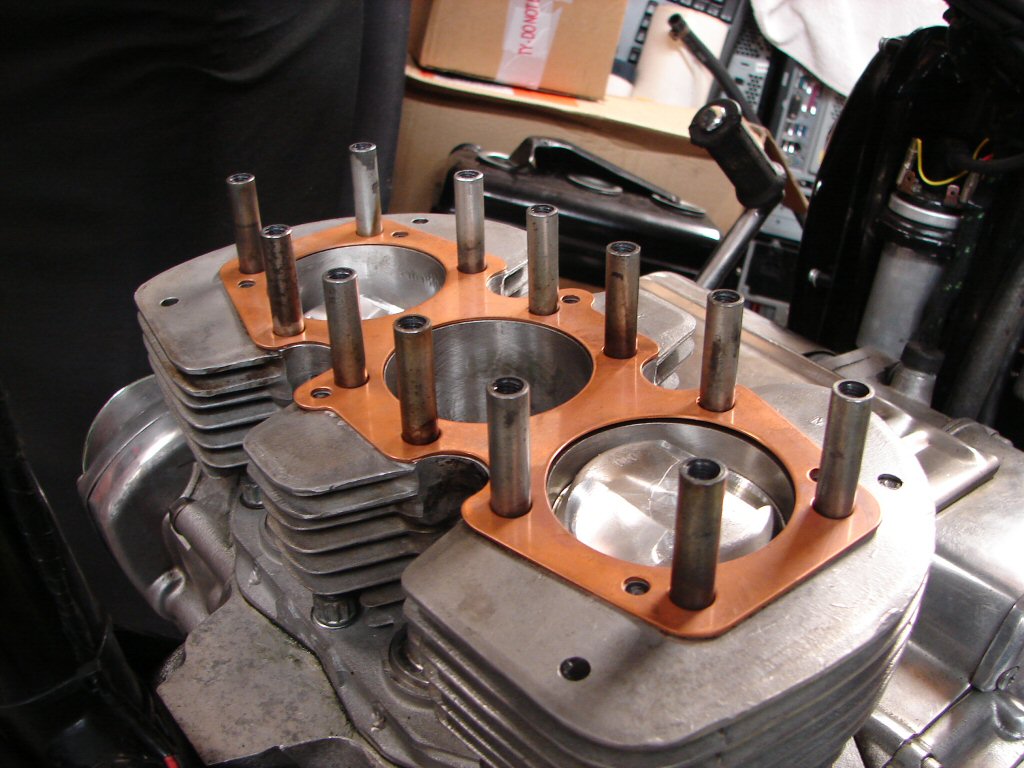
With the head all assembled including the oil drain dowels the gasket once again impressed by fitting the head just as easily. This bodes very well indeed, although just because it fits both individually, that does not guarantee that it will fit both simultaneously as nicely as this, but here's hoping.
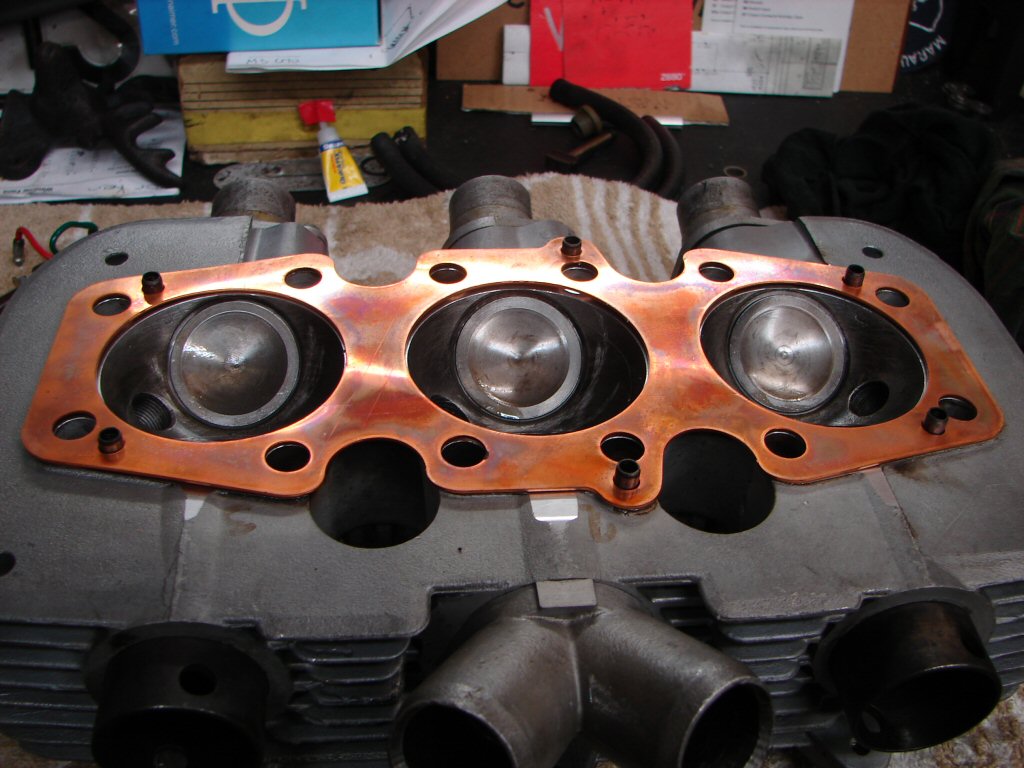
A trial fit of the head to barrels proved that they will indeed mate up with no fuss at all, so all I need to make that happen is a warm enough day to use my copper gasket spray outdoors. I can't believe what an accurate head gasket this is - wish I had bought several.!
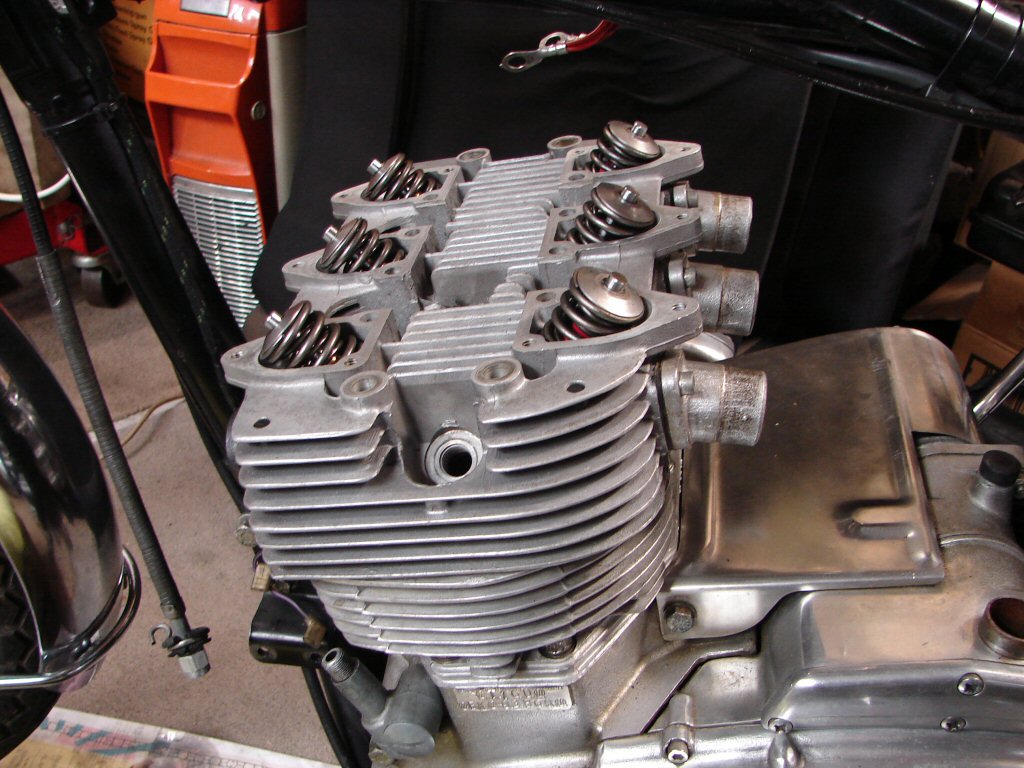
It seemed like a good time to connect the tacho cable to the tacho drive so that it wouldn't flap around and would be kept out of the way when the exhaust system goes back on.
During the process the little drive gearbox swivelled on its mounting, so the left hand threaded nut inside the box had come loose. Good find, as they do not need much encouragement to leak oil.
So the end plug came out, the drive gear also, and the nut got tightened with the world's smallest socket set - as that is the only thing that fits in there.
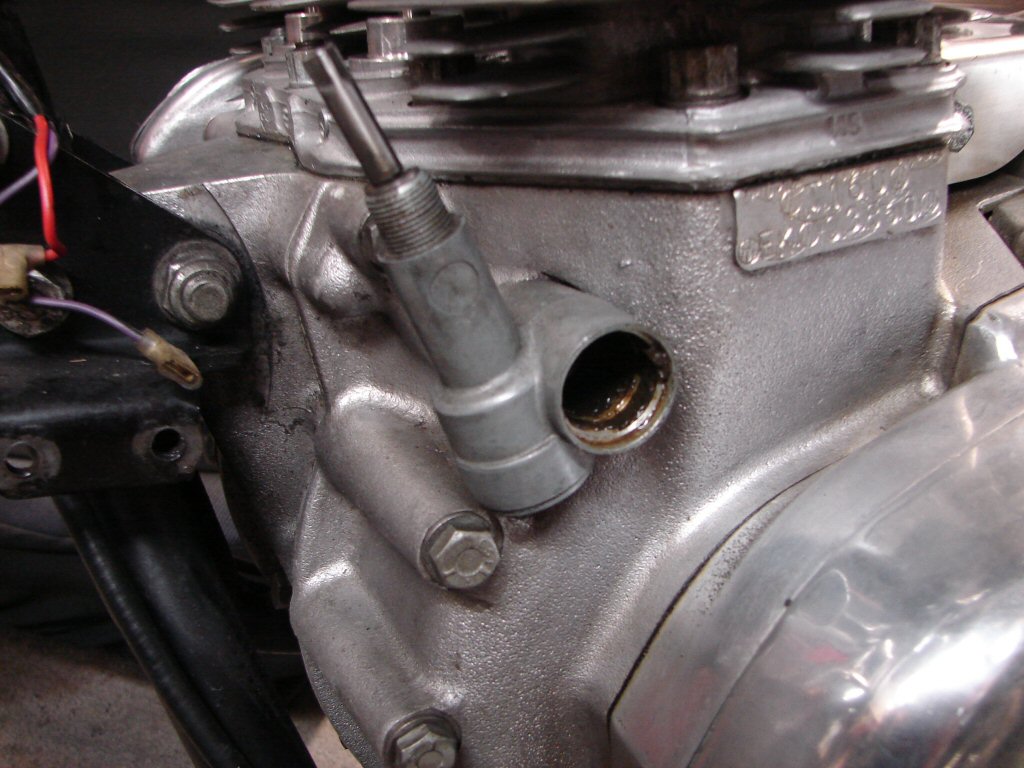
Today proved warm enough, so the head gasket got suitably coated both sides and laid on the block. The head then got sat on top, and a few smacks with the rubber mallett got the oil drain dowels to settle into the block. I put a medium tension on the four outer head bolts to keep it alltogether firmly enough while the next steps take place.
That amounts to cleaning up the rocker boxes and their previously used aluminium gaskets, after which it is time to drop the exhaust one over the pushrod tubes but without the pushrods. This is to make sure that there is going to be enough compression of the pushrod tube seals that they won't leak oil.
Can't be having that...
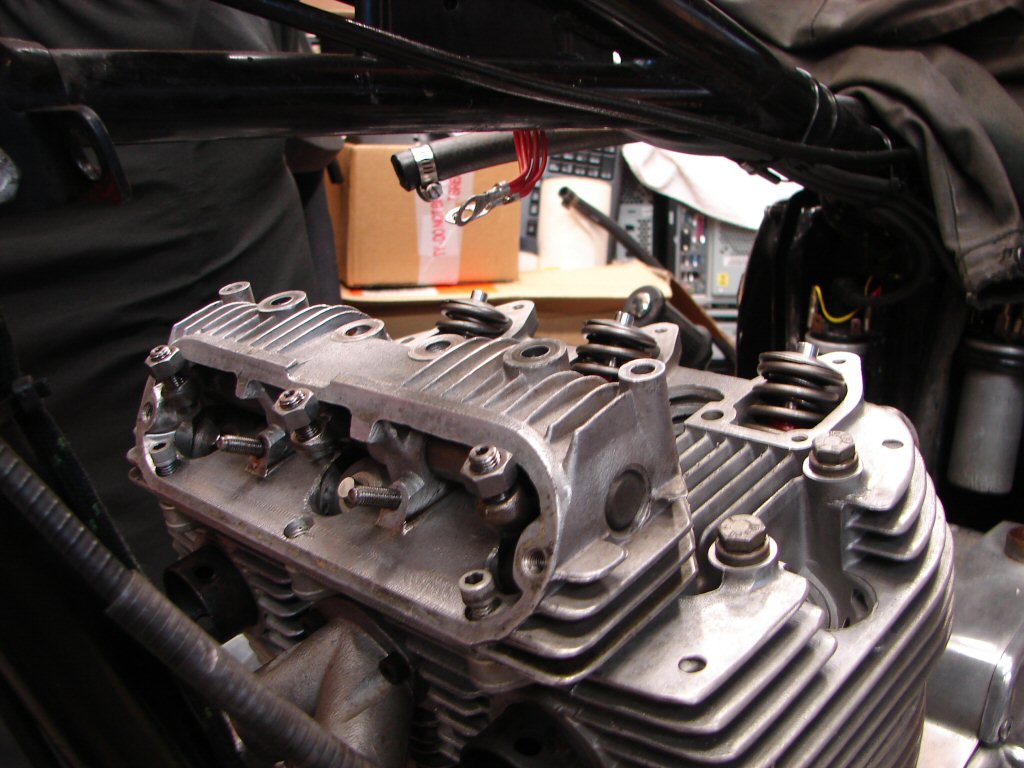
The gap between the rocker box and gasket proved to be around .035" which can be seen along the lower rear edge of the rocker box. This will do just fine for squishing the seals, so now the inlet rocker box gets the same treatment.
Pleasingly it measured just the same, and that is reassuring because I was the last person to refit the rocker boxes on this engine.
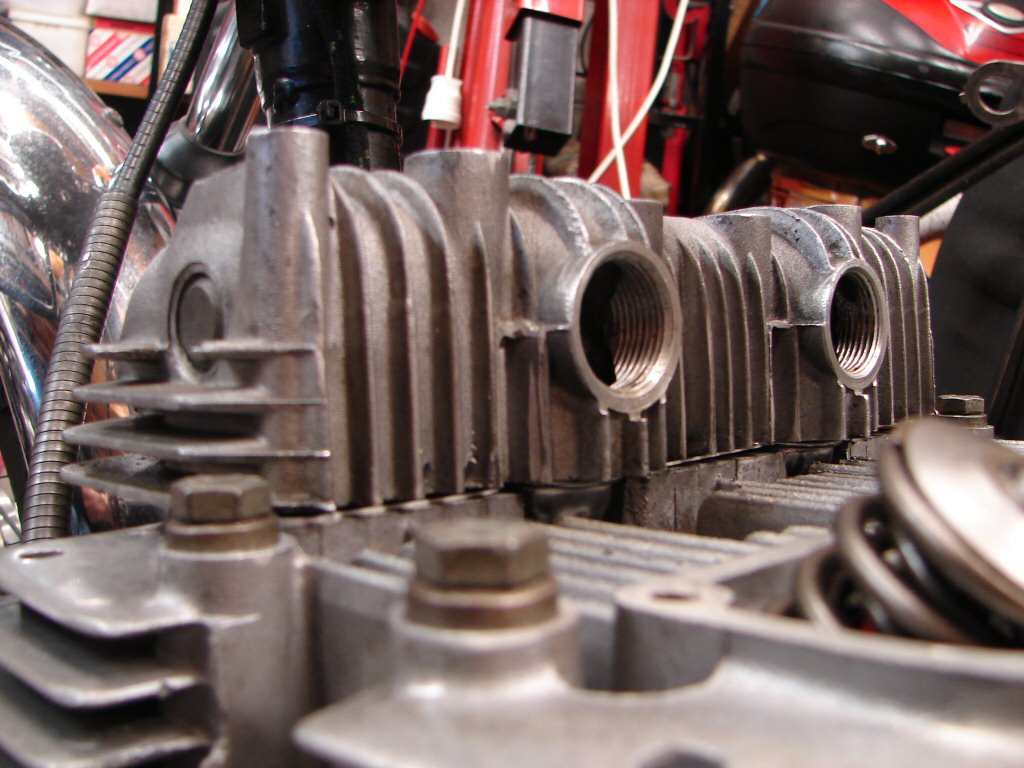
I did not have time today to begin the final assembly of these parts, so I shall leave the two rocker boxes on the engine and have fitted the four centre head bolts and nipped them down to keep everything under the same tension overnight.
They will both come off again to apply sealant to the base gaskets and to fit the pushrods before the head gets bolted down and the valve clearances sorted.
Pleased with progress today.
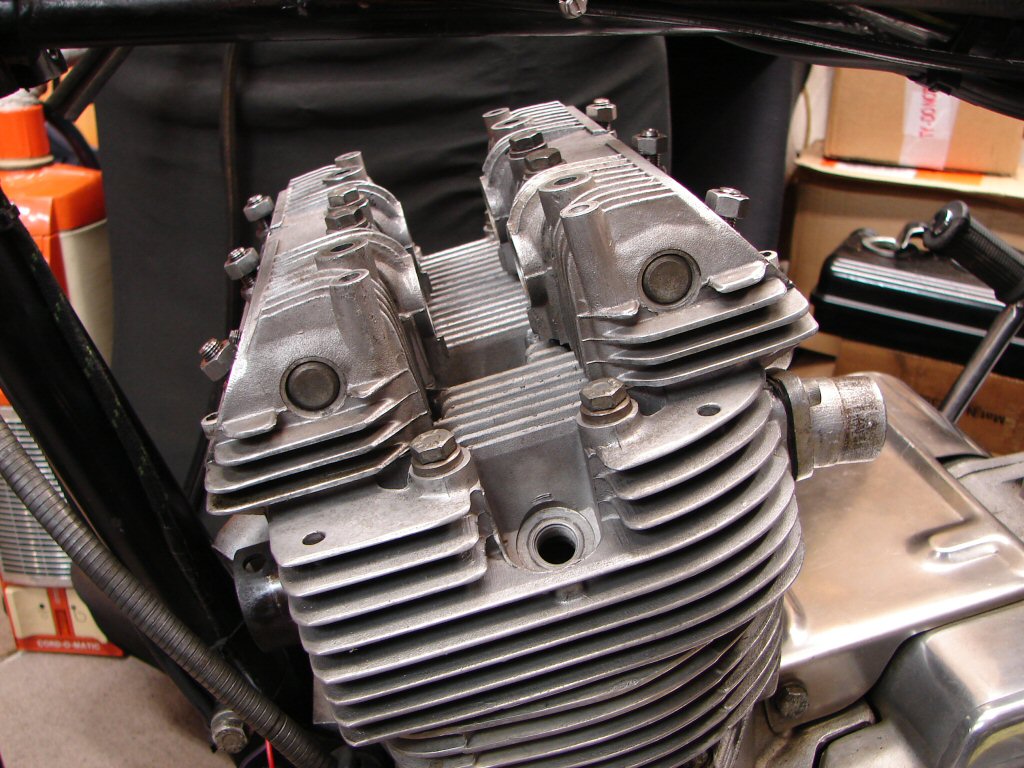
So the rocker boxes came off, and after more cleaning and prep the exhaust pushrods were fitted and the rocker box fitted and nipped down. The valve clearances are roughly set as they will close up when the head is torqued down.
I always do the exhaust rocker box first on T160s, as the forward slope of the motor causes the pushrods to fall inwards and become difficult to retrieve while trying to seat them, whereas the inlets fall outwards and present no problems. This also allows the exhaust inspection caps to be fitted which is easier than when both boxes are present.
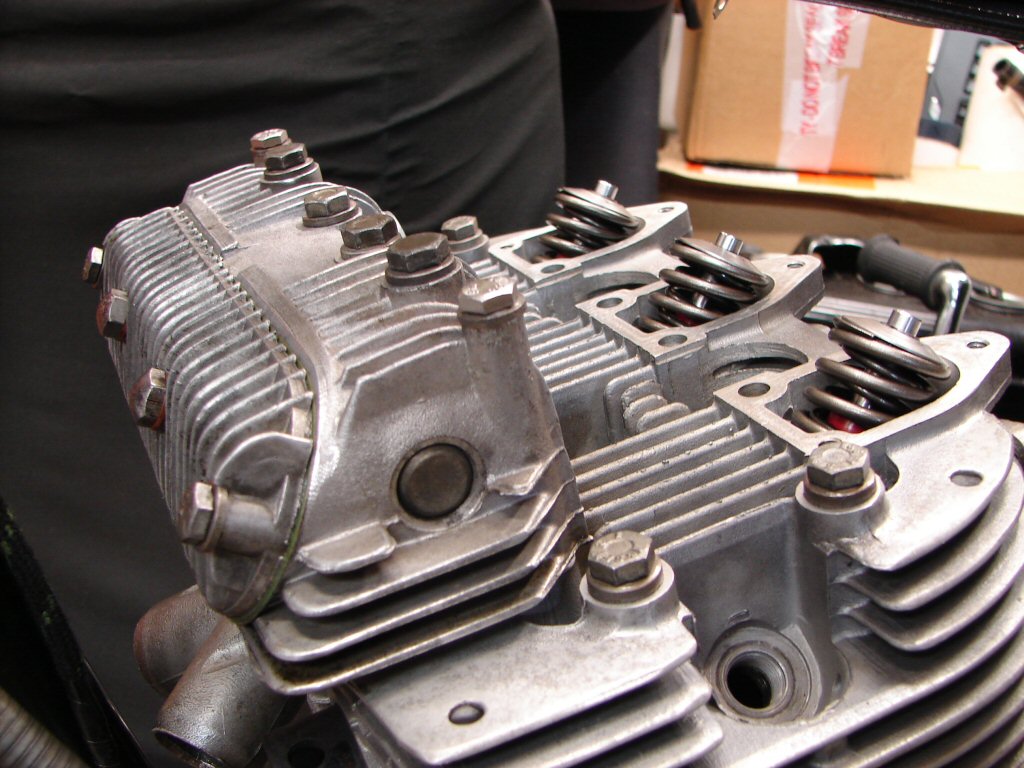
During this first fitting exercise I uncovered a new problem altogether - not with the assembly - with the aluminium gaskets that seems to be the result of poor manufacturing practice. At some stage in the history of these aftermarket designs it was decided by somebody that the head bolt holes would be opened up to a larger size than the bolts required. I can only imagine that would be done because there had been issues with bolts fouling the gaskets, so rather than correct their sub-standard drilling they just made the holes bigger. Yes - I am guessing, but there are not many reasons to explain it.
Anyway, in doing this they created a new - and potentially worse - problem which managed to catch my attention due to some deformation of these used items. I did not manage to photograph the damaged ones - well I did but they did not show the problem - but here you may see that I have had to file the four corners which surround the pushrod tubes. Because the holes are bigger, the alloy had been widened outside the holes, in turn causing interaction with the shoulders on the pushrod tubes which support the seals. Several of the corners were folded at the very edges showing that they had indeed collided with the pushrod tubes, and of course would only do so while the rocker boxes were being tightened down, by which time the parts are no longer visible.
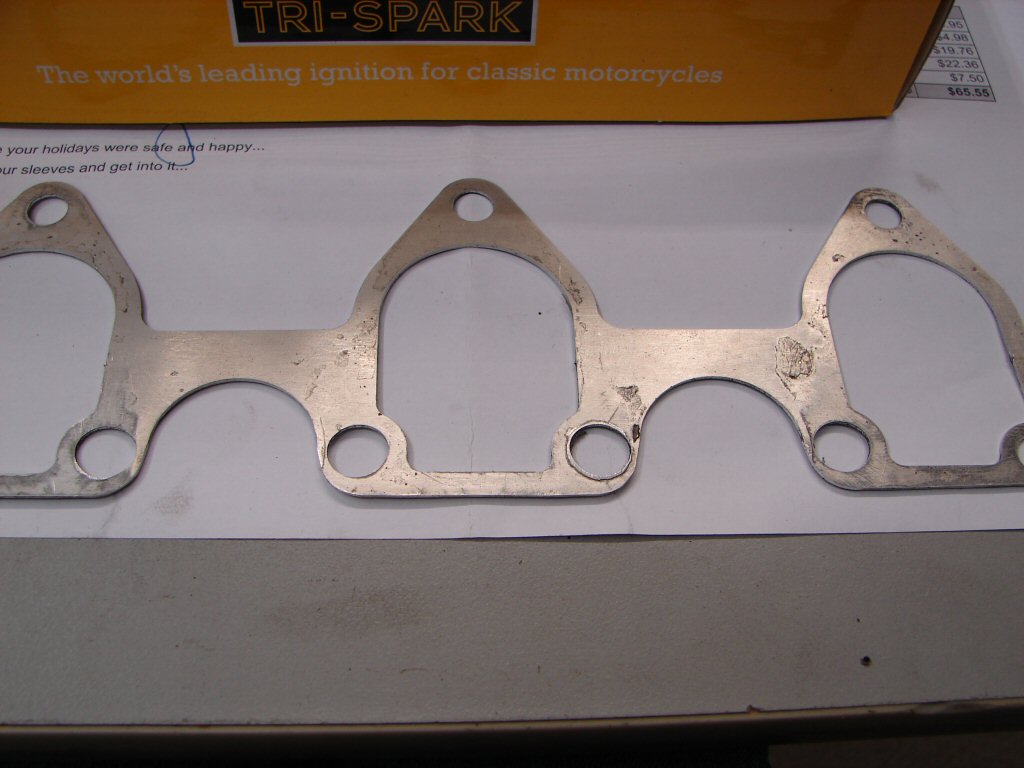
The primary symptom of this taking place would likely be oil leaks from the pushrod tubes, but a worse case scenario might be the inability for rocker boxes to bolt down properly which could lead to other issues long term. Pleased this has come to light and been solved on this bike, but I shall be more critical of such gaskets in future.
I decided to finish flushing the oil cooler next, so it could be fitted up while there was more working room. It got a petrol flush last, and there was virtually no sign of metal fragments to be found in what came out. This was a back flush, but there will be a forward one yet when the engine is first started and oil allowed to bleed off.
So the cooler went on, then the inlet rocker box, after which the head got torqued down and the valve clearances set. I will now leave it overnight then do a retorque of the head bolts on the next session. Sometimes the gaskets do manage to compress a little, so it is wisest to allow for it rather than encourage any combustion leaks during the trial run.
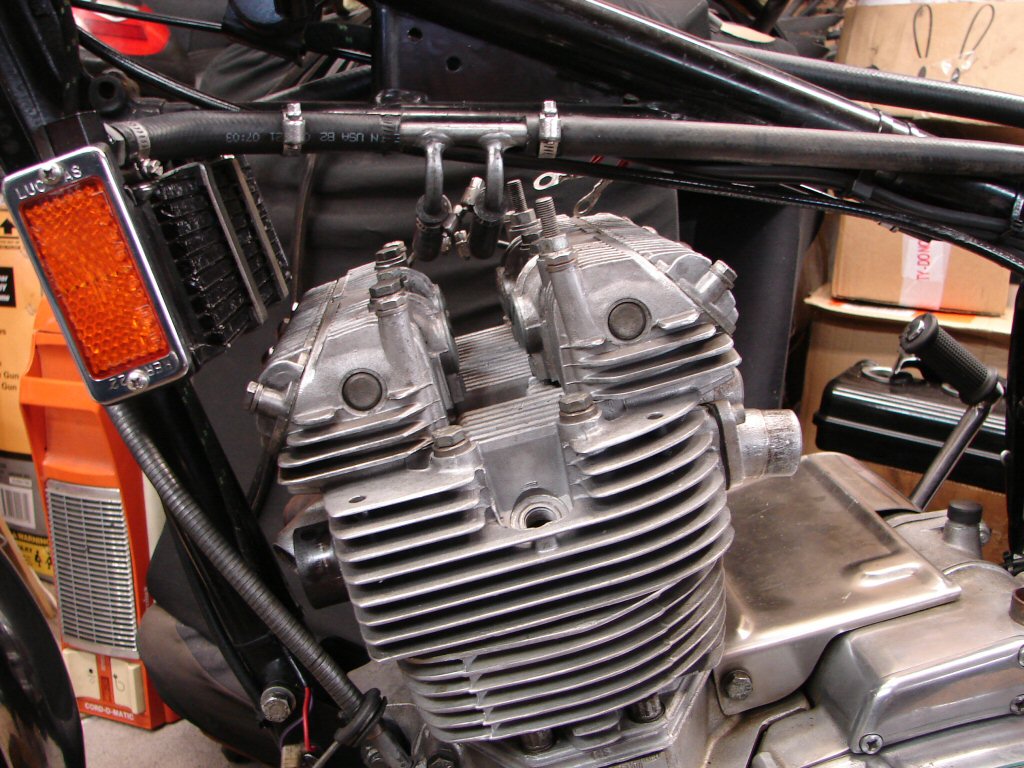
The return oil line is just sitting in place at this time, as the first oil to reach the rocker feed junction will also be bled off in case it yields anything undesirable. I will need to complete final assembly of the primary drive case before adding new oil to both primary and oil tank, but that will mark a major step in progress, seeing as oil is one of the last things I add before running an engine.
It leaves no room for doubt that you have actually remembered to do it...
Another day, and the head got retorqued, valve clearances checked, horn fitted, exhaust fitted and primary drive checked and outer case fitted. The left muffler will remain off until I have oiled the rear chain - it just makes life easier.
I also fitted a buffer to the sidestand parking bolt, as the stand was resting against the exhaust and would tend to produce annoying vibes.
Just a quality issue...
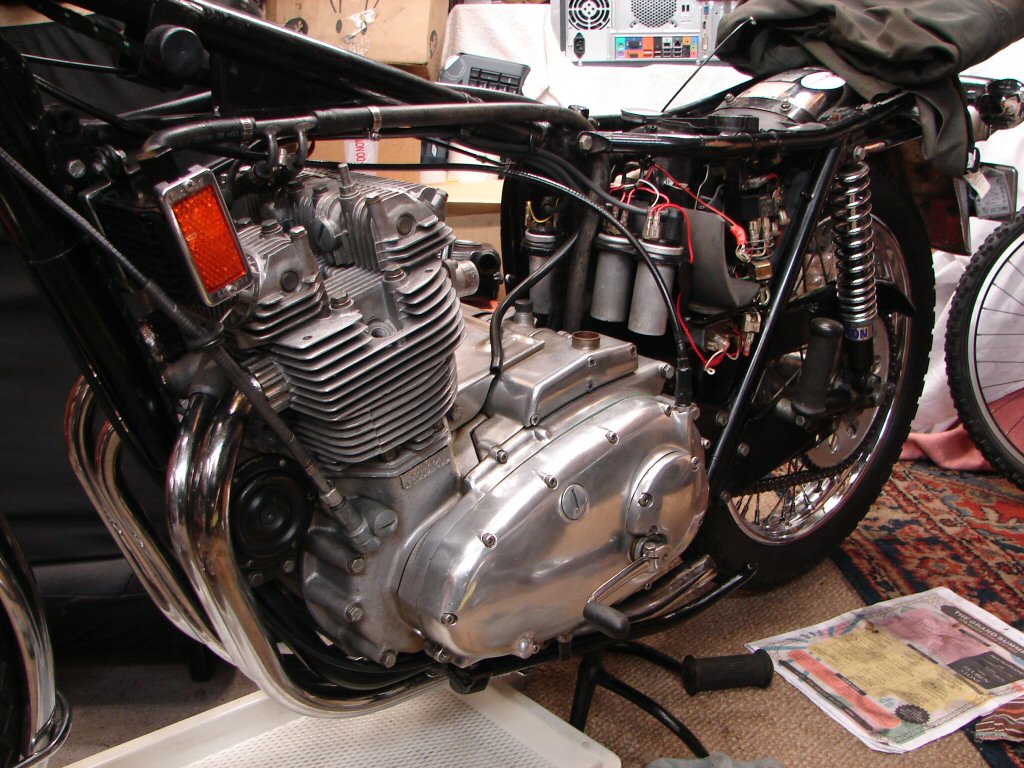
I am about to fill oils in two T160's right now, as they are both nearing completion, so it makes sense to have them both at the same stage and reduce the number of operations by half.
The primary was filled first, then the engine kicked over a few times to coat all of the primary chain with oil. The chain tension was then adjusted, and it was obvious that the chain had settled into the new sprockets since I last tensioned it, and now it needed a smidge more. I doubt it will stretch much more now that all the bits have run together for a while.
The drip tray was left there overnight to make it obvious if any of the new oil could find its way out. Happily none did.
Today a few litres of oil went into the tank, after which the engine was kicked over until new oil trickled out of the oil filter housing, so the system has now been flushed to there. A new filter went in and the cap got refitted. I will fit an oil pressure gauge to the main oil gallery before priming the system any further.
Meanwhile, battery fitted, carbs and airfilter fitted, seat fitted, sidecover trial fitted and all looking good. My only reticence is the "clear" fuel lines between taps and carbs. This type of tube goes very hard as it ages, and the hoses are easily rotated on their joints to the banjos. If they prove not to be fuel tight the whole carb setup will need to come off again.
Spark plugs were removed to allow easier kicking over while priming oil. I used the opportunity to test that we had three sparks - we do and they look healthy. May also run a compression test - just to be sure to be sure..
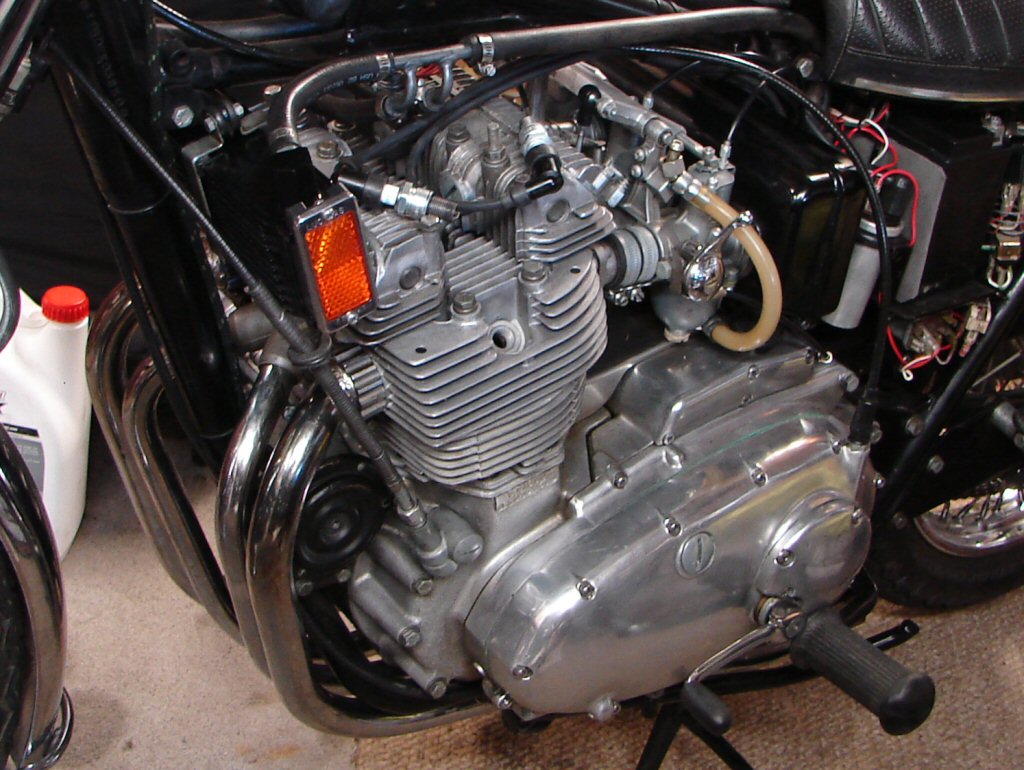
The oil pressure gauge got fitted and the starter was operated in short bursts until the first oil reached the rocker feed end and a little was bled off until new oil was evident. During this process the engine oil pressure reached 85psi just on the starter, so everything is happy in the crankshaft and bearing department.
The oil line was then connected, so from here on the returning oil will travel to the cooler, so I do not wish to make that happen until the engine starts and forces oil through the cooler with some pressure to dislodge any possible traces of debris.
Meantime the rear chain got lubed and the left muffler refitted, throttle cable connected and adjusted, so we are very close to attempting the first start. First the fuel tank will go back on and the bike will be wheeled outside to check for any fuel leaks.
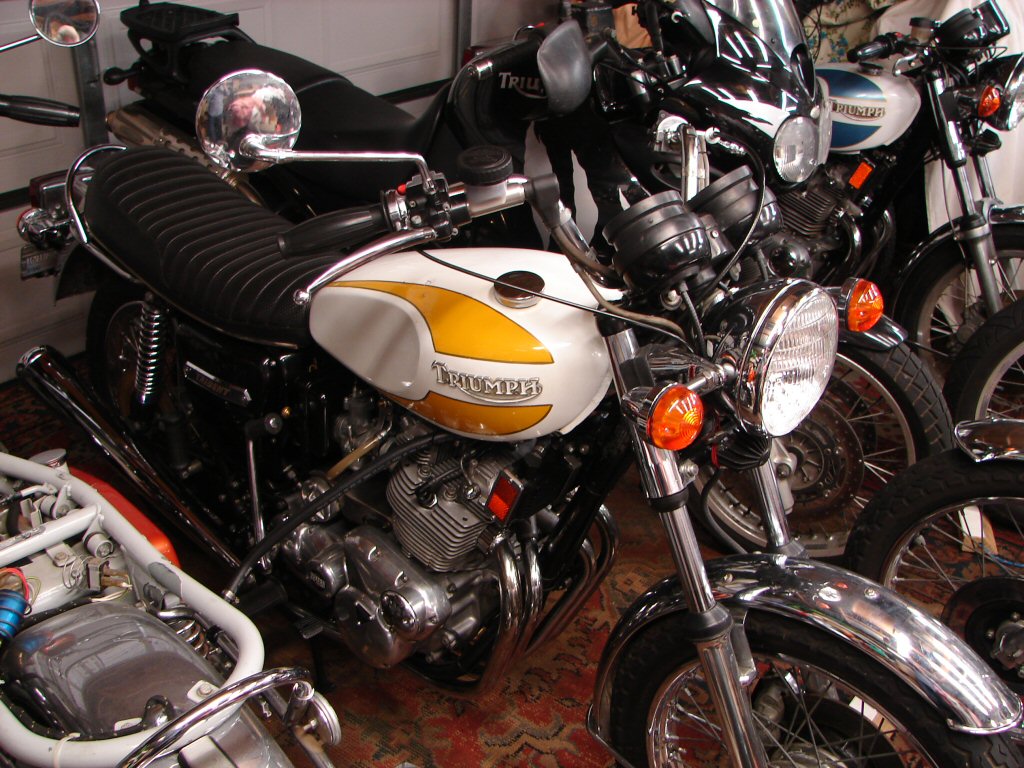
And here it is - complete and ready to start, albeit with its return oil line waving in the breeze. I prop a container up next to the bike and run the engine until half to one litre of oil has been expressed, by which time it has usually turned frothy, indicating that it is now sucking air from the pickup and has thus emptied the crankcase.
That oil gets ditched and the tank topped up to the mark for the second run with the return line now fitted back to the tank. The second run is used to tune the carbs for best idle and to strobe the ignition to make sure everything is still on the money. I intend to make a video record of the first or both of these test runs.
So this T160 drew the short straw to be the first to trial run. The fuel taps were turned on and I arranged things for a while, giving it a chance to leak if it had to. It didn't leak a single drop. That is good.
I gave all three carbs a tickle prior to a few priming kicks to get some fuel down the holes. Then I began to smell fuel. It was pouring out of the left side carb - not a leak but an overflow. I gave the float bowl a rap with a screwdriver handle but it didn't slow, so taps off, seat off, tank off, airfilter off, carbs off and check the float levels for height and any reason for them not doing their job. I had found a potential problem with the gaskets in these carbs when I was looking for any possible connection to the holed piston, and I had found gaskets interfering with the floats and trimmed them.
This time it seemed that the floats were set a bit higher than I would normally set them, but not so high that the needle would not shut the fuel supply off when the bowls were full, but something had. I lowered all three a tad by tapping the jets up in the bowls after heating with hot water. That should give a slightly greater closing pressure on the needle jets that control the level.
After that everything got put back together, so we are back at today's starting point and no further ahead.
Happens...
Battery now charging for the next attempt.
This went much as the first - no leaks until tickling then an immediate overflow. WTF.? Carbs came off again and the left float bowl and bits were given magnified scrutiny. There were some tiny black dots at the base of the needle jet which you would think could not have made it through the banjo filter, but there they were. Could there be some minute particles coming from the fuel tank. One of the fuel taps had been found to contain some particles of rust, but these were black.
I decided to flush the left side fuel tap, as it was the nearest to this carb. I was not prepared for what came out, but it sure made me laugh...
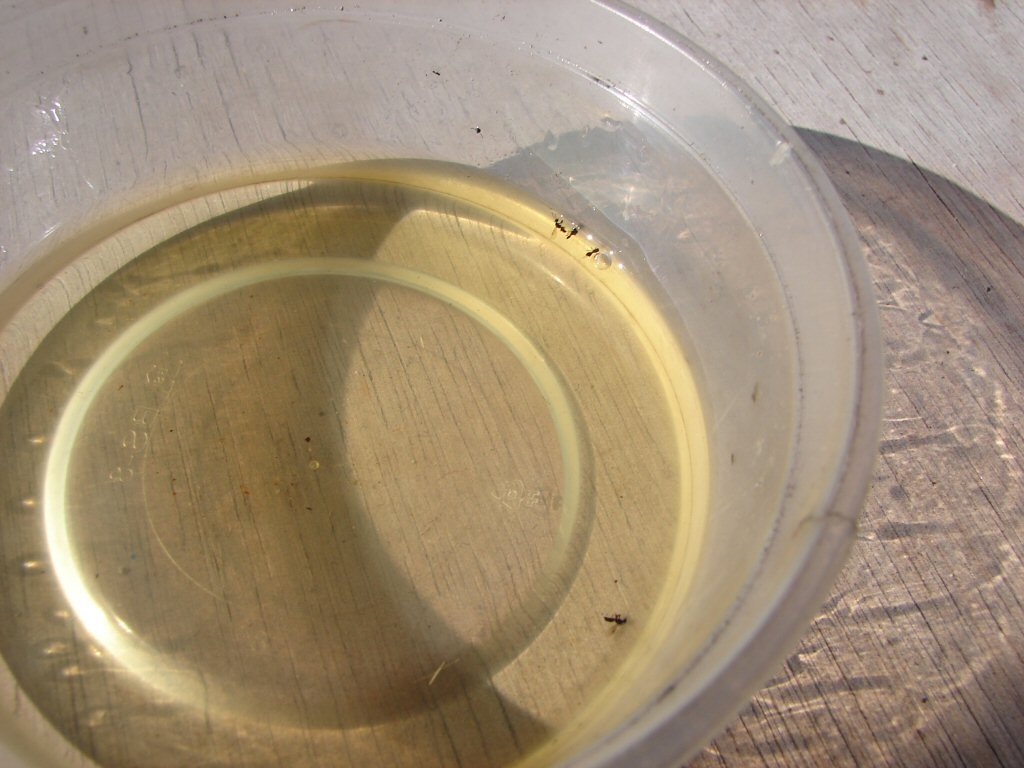
There were ants inside the fuel tap..!?
Is this some kind of cosmic joke.?
The only resonable explanation is that they crawled in there while the fuel tank was on the floor, but why the hell they would fancy a fuel tap makes little sense. The other thing that didn't add up was that these were all intact ants of the winged variety, no signs of anything small enough to have gotten into the float bowl.
Rather than take the chance that this was merely a red herring prompted me to attach my test fuel line to the tank and see what happened under wartime conditions.
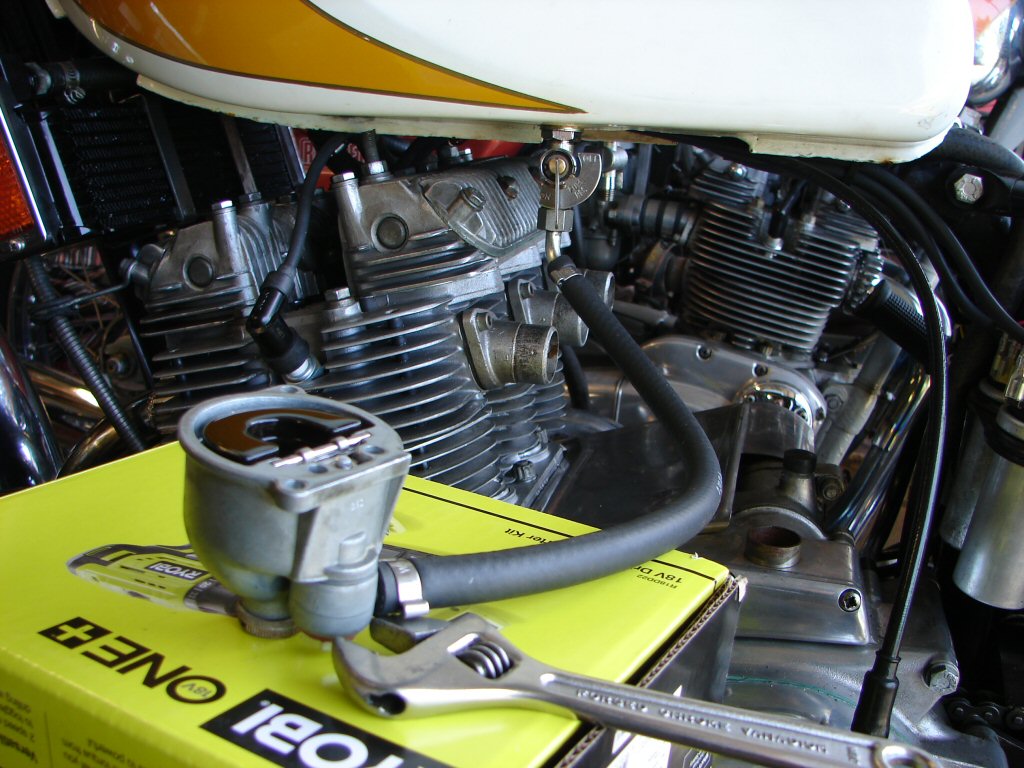
Usually the float will behave as intended and not just lift up the pivot, especially as these "stay-up" floats are a little heavier than the old style plastic ones. As it turned out, they did, and the bowl filled to where it should and stopped.
It is always a surprise how low the fuel level is compared to the float level when you test these, but the float was definitely where it had been set to cut off.
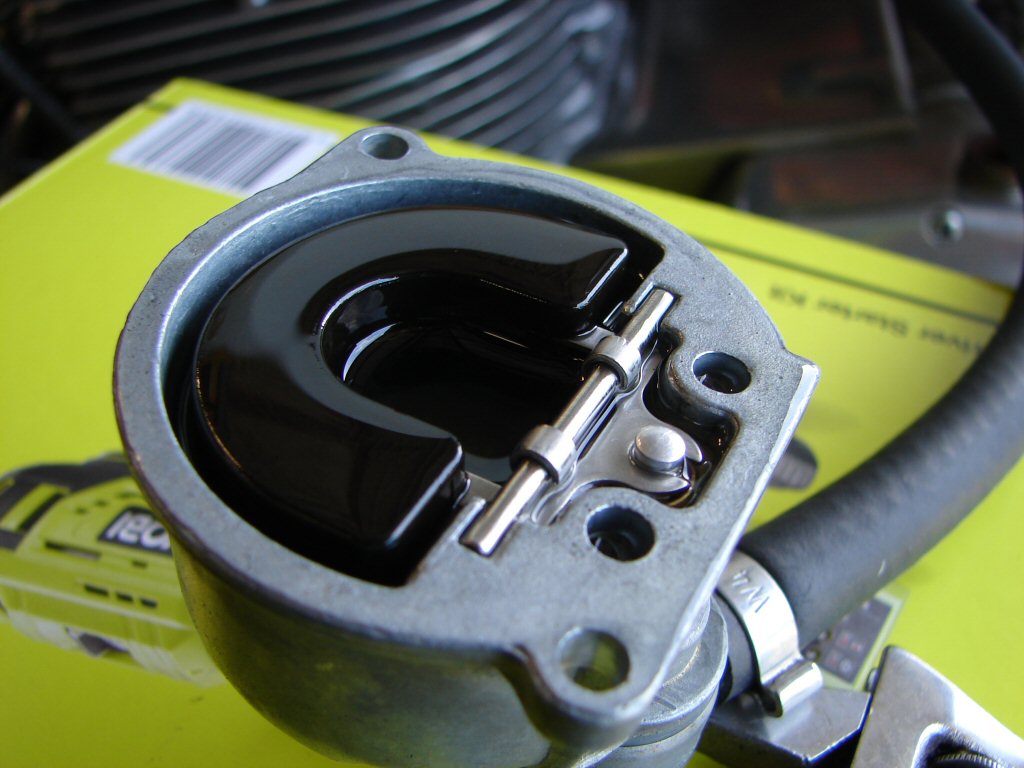
That all looked to be fine and dandy, even when I pushed the float down to simulate the tickler operating, more fuel entered then shut off when I took the pressure off.
Maybe it was ant-icles after all. It all went back on.
Fuel taps on and wait. All good. Tickle this carb - immediate overflow. I rapped the bowl with screwdriver handle and overflow stopped. Gave the bike a few kicks which only resulted in a few minor attempts to fire. I turned the ignition key off and on and then noticed that the ignition came on then went off again before reaching the headlight position. Then I remembered that I had noticed this when the bike arrived, and made a mental note to clean the switch. Mental note now activated.
Well I can't leave the carb as it is, so its coming apart yet again. Shame - it looks like it is ready to go...
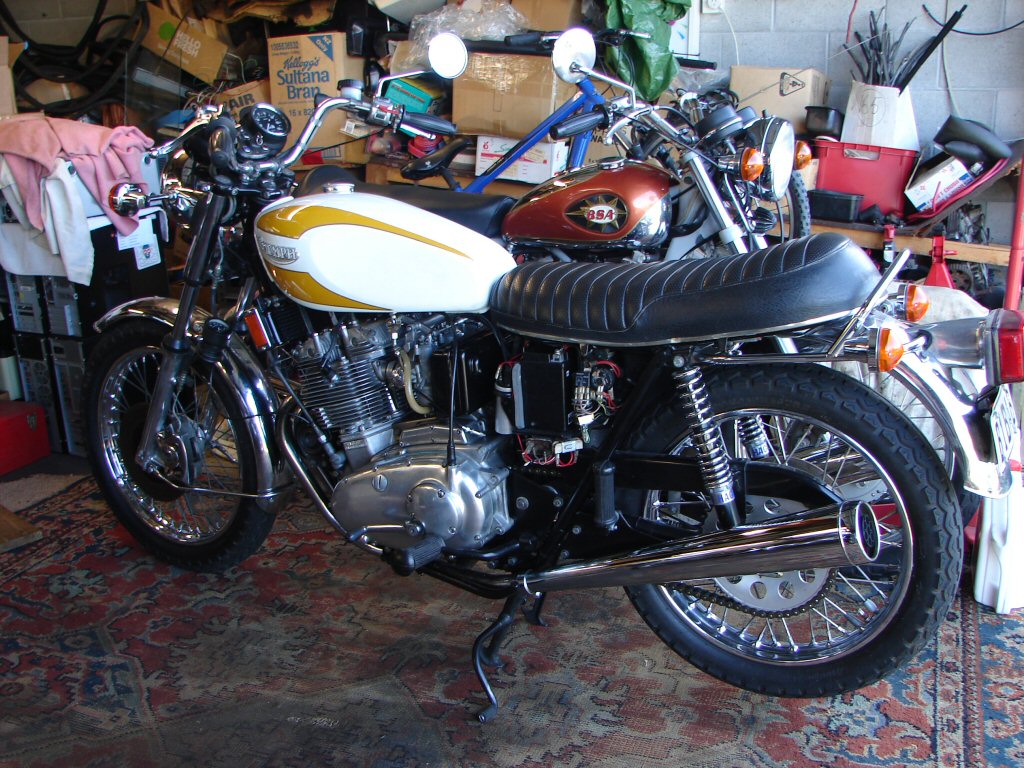
Right. Time to try a different float and needle - both of which I have kicking about somewhere...
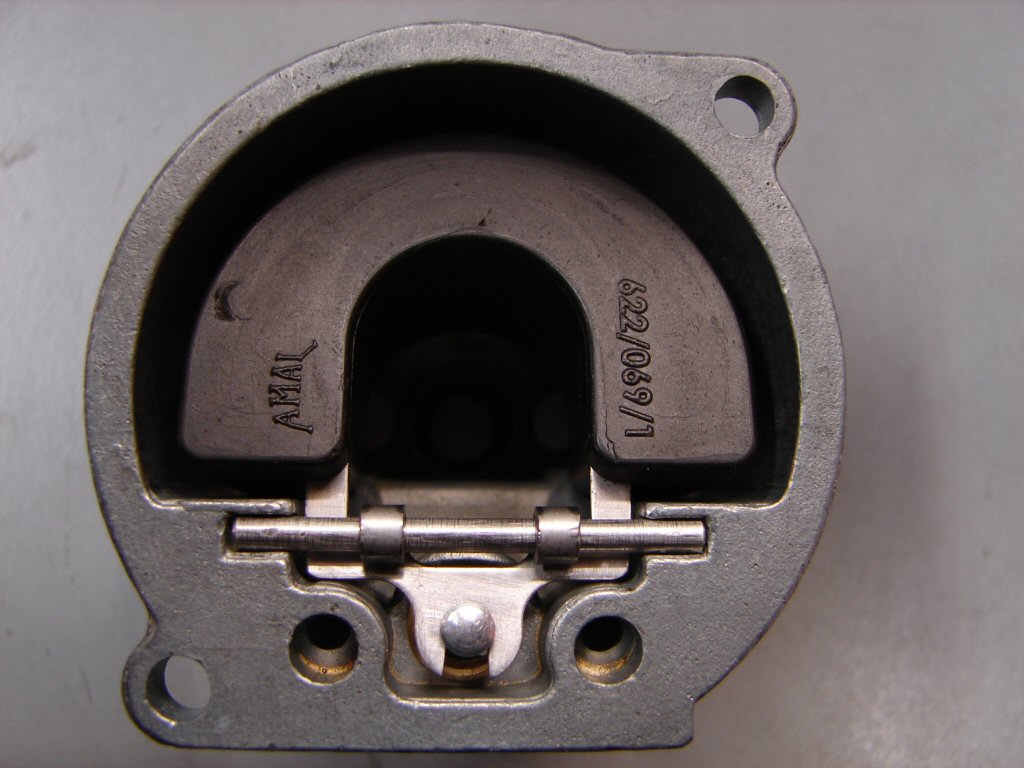
But - not so fast. Upon checking every visible dimension I could see inside the float bowl with my magnifying visor on, that the forked opening in the float was off centre. Perhaps this could cause the float to bind somehow...
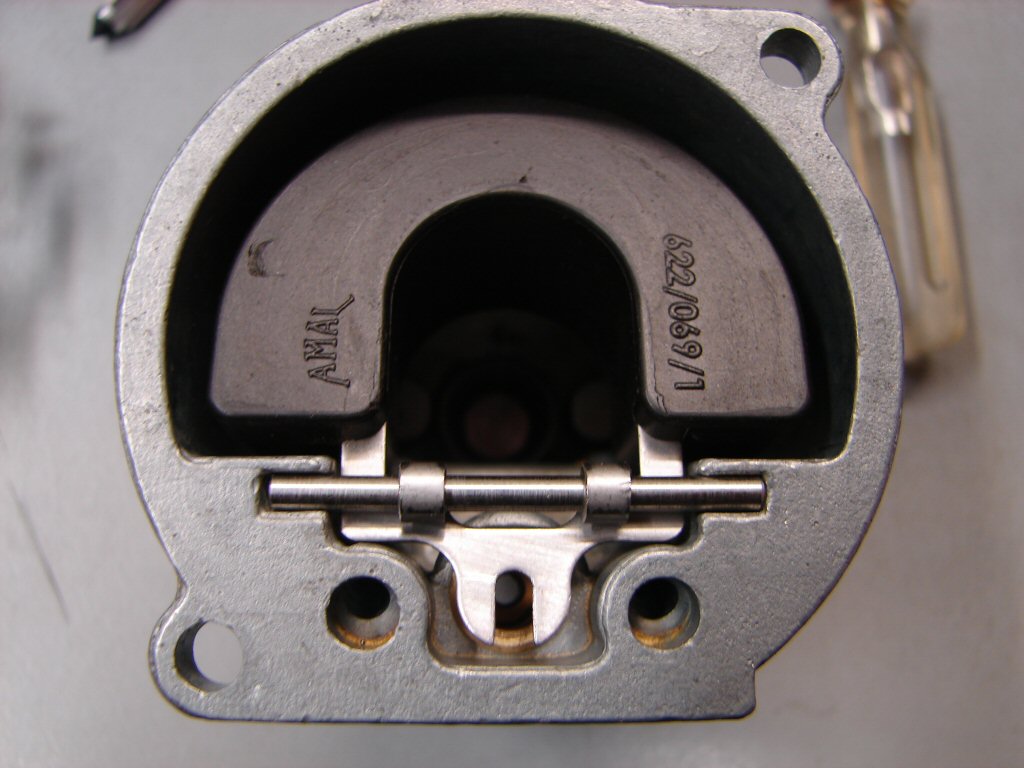
If I tipped the bowl to the left while holding the shaft in place until the float began to slowly swing outwards, it would travel all the way to the top limit, causing the float needle to shut off, but when I did the same thing to the right the float would stop about 1/8" below its limit, which would cause an overflow if it stayed there.
You can see a scratch on the top of the float half way up the left side. That is where the tickler contacts the float to press it down when richening the mixture for a cold start. You can also see that the scratch is only the left half of the circular tickler end, as the tickler is on an angle tending inwards at the bottom, so it will push the float to the right after contact, thus encouraging the float needle to bind and stop the float rising to shut-off point.
So I spent some time with a tiny file opening up the fork that retains the needle until the float would now rise to its limit when tipped either way. This does not alter the float height setting as that is only dependent on the needle reaching its limit.
I left the other two bowls alone as they were both performing normally and I did not wish to risk upsetting them. Today I put everything back on the bike and swapped the return oil line to the left side of the bike so that it would not interfere with kickstartng - surprised I had not thought of doing it that way long ago...
So here is how the universe managed to reward me for my sleuth work on the errant carb..
I had been warned by a spiritual source that this first week of May was going to be very difficult, and we would be sorely tested in a number of ways.
No shit..?
So, as you can imagine, the carbs came off in the usual fashion, and it seems to take less time to do this each time I need to. Small mercies. I am still blown away by how this has happened, but having said that, a friend who has also tuned this bike had the same observations as I did about it continually going out of tune. It would tune fine, but not stay that way. The next tune would obtain the desired result, but it would revert sooner or later. I will add that I have many reservations about Amal "Premiers" and their lack of quality control.
Anyways - slides, jets and needles cannot change their settings while in use, which suggests that fuel delivery has been the issue. Now you could say "matters have come to a head" - my head to be exact.
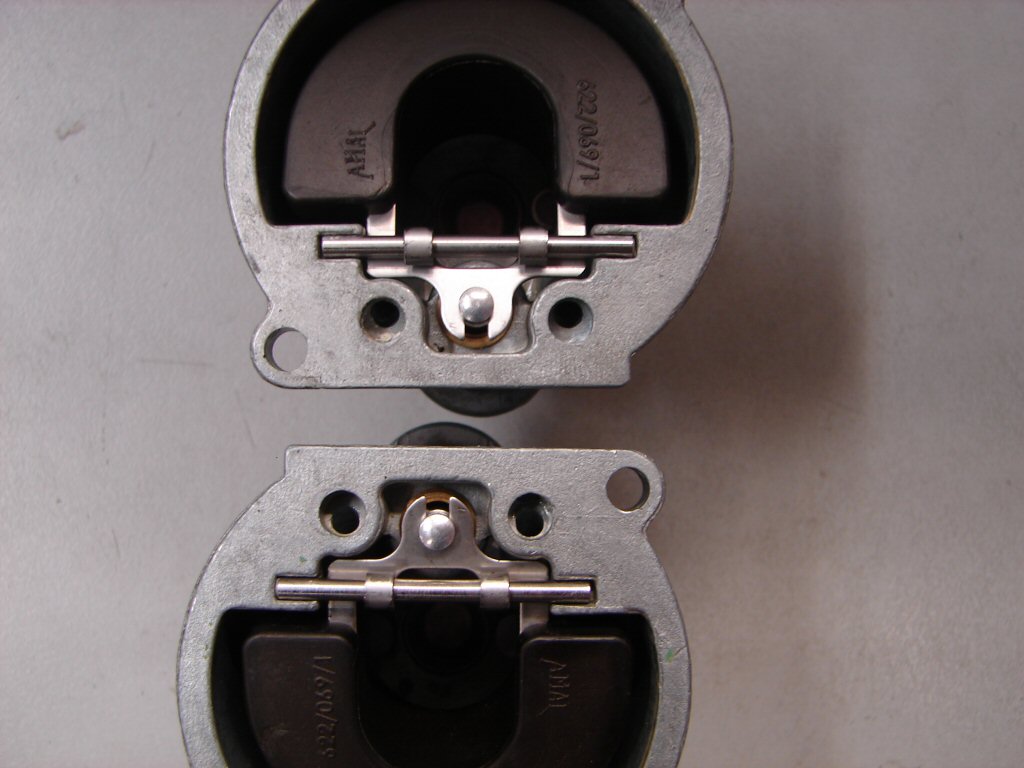
I had thought that these other two floats looked to be pretty well centred last time I checked, but with my newly retrained eyes I can now see that both floats are offset to their left - lower one reversed of course - which may indicate that they are being pushed that way by the needle.
Assuming the top bowl position as the reference, watching the float movement when tipped to the left side showed that the float would travel to its limit. Doing the same towards the right side it hung up at roughly the same position as the first bowl had. I duplicated the tests with the last bowl and it did exactly the same.
Hmmm.
I drew a circle around the needle head of both these floats while in place and you can clearly see that the float tang has been firmly in contact with the left side of the needle. I had begun filing it before taking this photo.
This is what the first bowl's float and needle had suffered from, but it had been very obvious that the tang was offset - these two not so - and until now these two had appeared to be working as intended.
Now I suspect that they would have been guilty of the same tuning issues and the at least occasional flood, so I shall reluctantly treat it as a blessing that all this has come to light and the mystery has been solved.
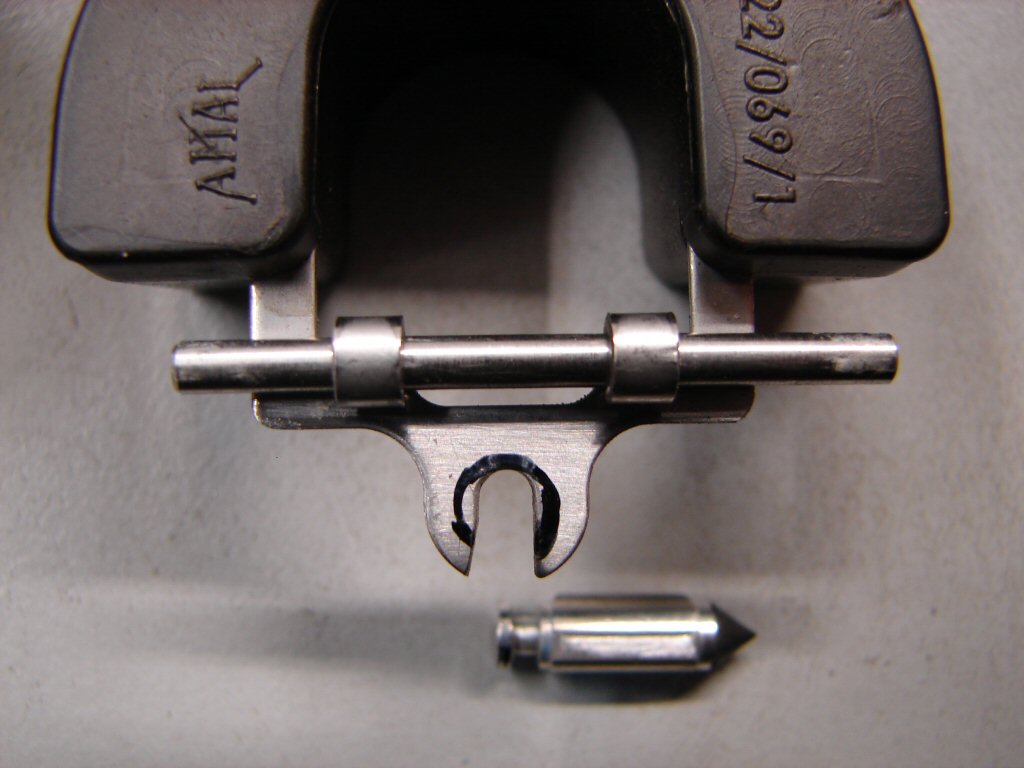
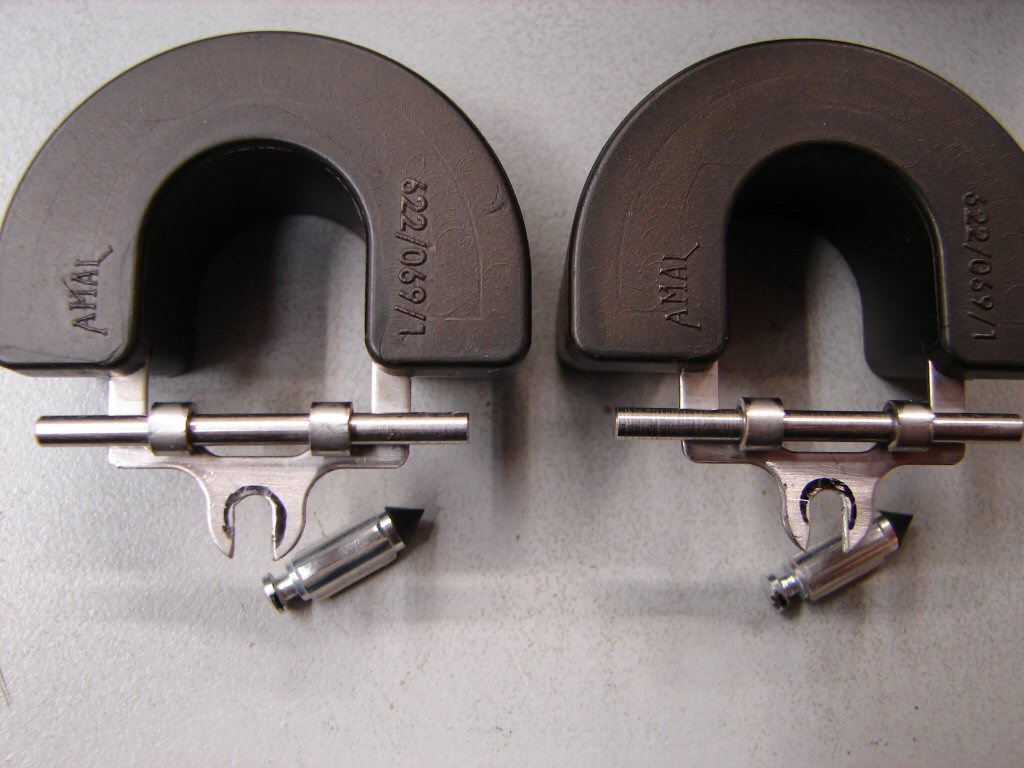
So back to much work with a small points file and using a drill bit to maintain the radius of the neck of the float tang we finally reached a point where the floats would all travel to their full limit regardles of which way they were orientated.
That included revisiting the "repaired" one as I decided to raise the float levels back to their original heights now that the flooding issues wre presumably explained and cured.
There is nothing like "being sure", so I connected my single banjo fuel line to each carb in turn, connected that to the fuel tap on the bike, and tickled them vigorously to see if I could catch any of them out.
I didn't, so we shall put everything back together for the umpteenth time and see what gives. Phew.!
Back together and oil disposal container on the far side for once - away from the action.
I will let the video tell the story and add the details next - 'worth a crack Nigel'.
Once it sounded like firing I let the electric start spin it up while I played with the choke and off it went. First start engines can be quite reluctant to come to life, but once they have and the juices are flowing it gets easier from there on.
We had a healthy 95psi oil pressure and in no time at all about 1.5 litres of oil were in the container so I shut it down. This is a very necessary stopping point as the oil leaving the tank is total loss, with none returning. I poured some of the waste oil into a clear container and could see that it had turned a pretty dirty colour just while flushing the cooler.
After emptying the container fully there were a couple of shiny little specs, but I could not feel them when rubbed between my fingers. After the test rides all the oil will be dumped and a fresh lot put back in - no point in encouraging anything to circulate where it shouldn't. The exhaust will have to come off to drop the sump plate, but once again - we have to be sure its all gone.
After reconnecting the plumbing the bike started easily and I set about making it idle happily enough for the next steps. First was to strobe the timing to make sure it was optimal, and it was perhaps one or two degrees less advanced than we could get away with so I adjusted it to be on the mark. After that the airfilter came off and the vacuum gauge was used to get all three carbs passing the same amount of air, pilots adjusted - which effects the idle - then around all the settings once again until it was as happy as it was going to get. The choke takes a while to not be needed, especially as the engine is not under load, so that had to be managed and after a test ride at some stage it might be necessary to fine tune the pilot screws again when it is at normal running temps.
Not a trace of any smoke from the exhausts, although some smoke began rising from around the cylinders which would likely be the residue from Glen's engine cleaning bath which is the last stage of the reboring process. No oil leaks from any gaskets anywhere that I can see, so that is a happy state of play.
Tomorrow I will remove the fuel tank and check the head bolts and valve clearances, as the engine has undergone one heating/cooling cycle. While this used to elicit a fair bit of extra tightening as gaskets had got compressed, the solid gaskets used today hardly move a bit, so I have to release all the bolts 1/8th of a turn, then watch how far they turn as they get torqued down again, and if it is not much more the valve clearances will be fine, but the rocker box allen screws will get some sealant to prevent oil finding its way down their threads in future.
It is a bit of a finicky process, but you only get one chance to do it right, and this is definitely the time.
Really happy it is finally running and so far the carbs are playing ball.
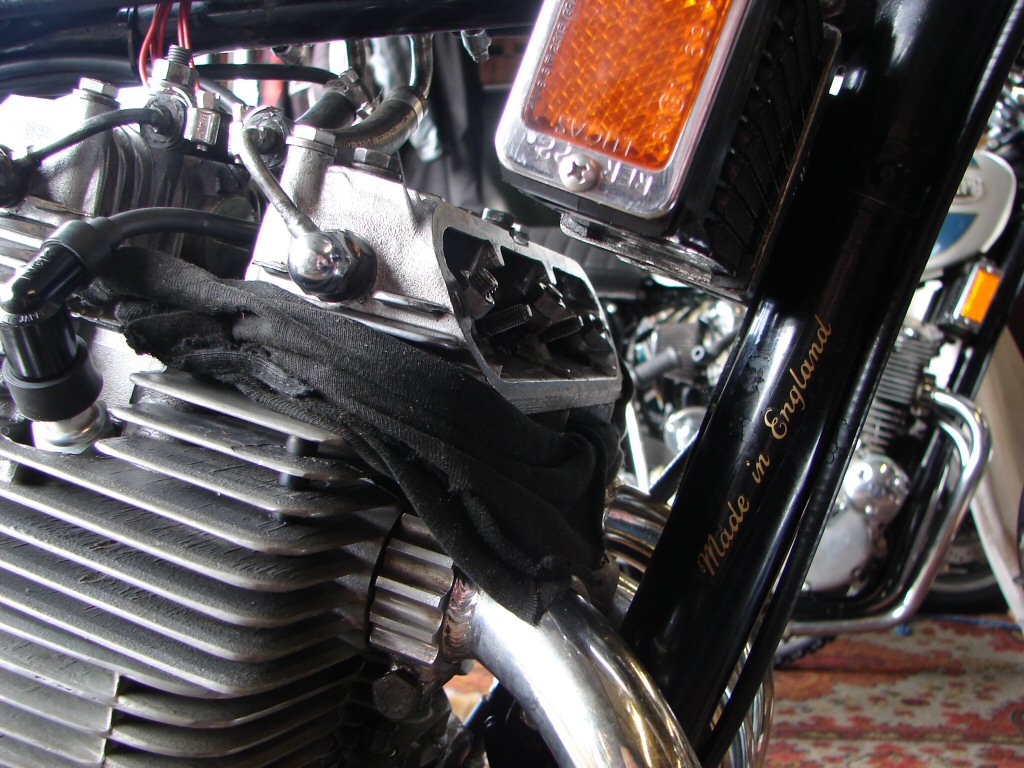
The head got retightened. The bolts went only a fraction further than they had been released, but I checked the valve clearances anyway. To my surprise all the exhausts were spot-on, and I could not improve on them. I do the exhaust rocker box first because it is the most difficult.
The inlets were very close, but in fact I even reduced the clearance on two valves a tiny amount. I use the slightly larger clearances that were adopted late in the day at Triumph, albeit not officially to my knowledge. Because these give more leeway I am not too worried for the first runs, but I am more fastidious when the bike is going back into service.
All the rocker box allen screws were cleaned up, as were their threaded locations, and all went back in with a smear of sealant to keep them dry.
I am hopeful that the engine will not be revealed again before matters are complete.
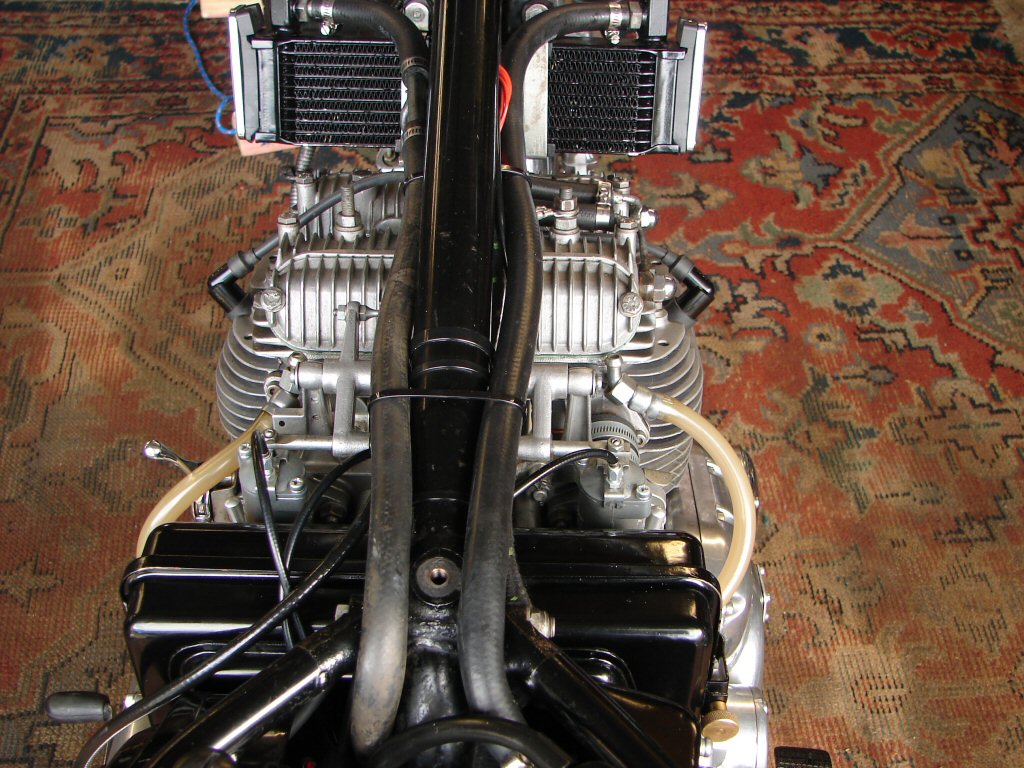
Today I wheeled the bike outside and fuelled it up - not a drop outside the carbs after tickling. With full choke I hit the licquorice start and in about two compressions it was running. Fantastic.
A brief ride around the neighbourhood followed but I was still running half choke when I got back again. Pretty low air temps today. I was expecting to need an idle settings adjust but it was not required, the bike just sat and idled at the perfect revs.
Encouraged I took it out a second time, and was experimenting with the choke to see what position it preferred, as there was a tendency to run a bit hesitant on trailing throttle, but no choke position seemed to improve the problem. Giving it more throttle made it run smooth instantly, so I began to suspect it might be a misfire rather than a fuel issue.
I had cleaned and re-used the spark plugs that were in the bike when it came, as they were not very old, but I guess that at least the centre one had suffered some serious stress during the piston holing. I decided to fit another set to see what difference that would make.
As it happened, I had a new set. As it also happened, I found I could not use them. My suppliers were out of BR8ES when I last bought some, and they gave me BR8ES-11 instead, as they were the same plug but just came with a larger gap, which would be easily reset. Well - they lied.
The spark plug caps on this bike require the plugs to have the threaded cap removed, as they clip against the bare threads. These 'same plugs' do not have removable caps, so I can't use them on this bike, and likely most others.
Always with the push back...
The suppliers were happy enough to swap them for the right ones, but they still did not have any, so have ordered some and they should arrive Monday.
Nothing is simple in these times.
Most impressed with the bike though, and we are so close to being as good as can be. Woot.!
Once the new plugs are fitted the bike will get another test ride after which all the oils will be dumped. The exhaust will come off and the sump drained and filter cleaned. The oil tank filter will also be checked and cleaned. Once all is restored the oils will be replenished and any other issues that may come to light will be attended to.
That will get us very close to complete.
The plugs arrived so I moved the bike into a clear spot to fit them then run it to see if there was a difference. Pushing the bike felt quite difficult, and I found that the front disc was binding. Pumping the lever felt lifeless and the pads did not release.
I then recalled that the front brake was pretty ineffective during the two brief test rides, and now I looked inside the fluid reservoir and it was obvious that the fluid was kind of past its best-by date.
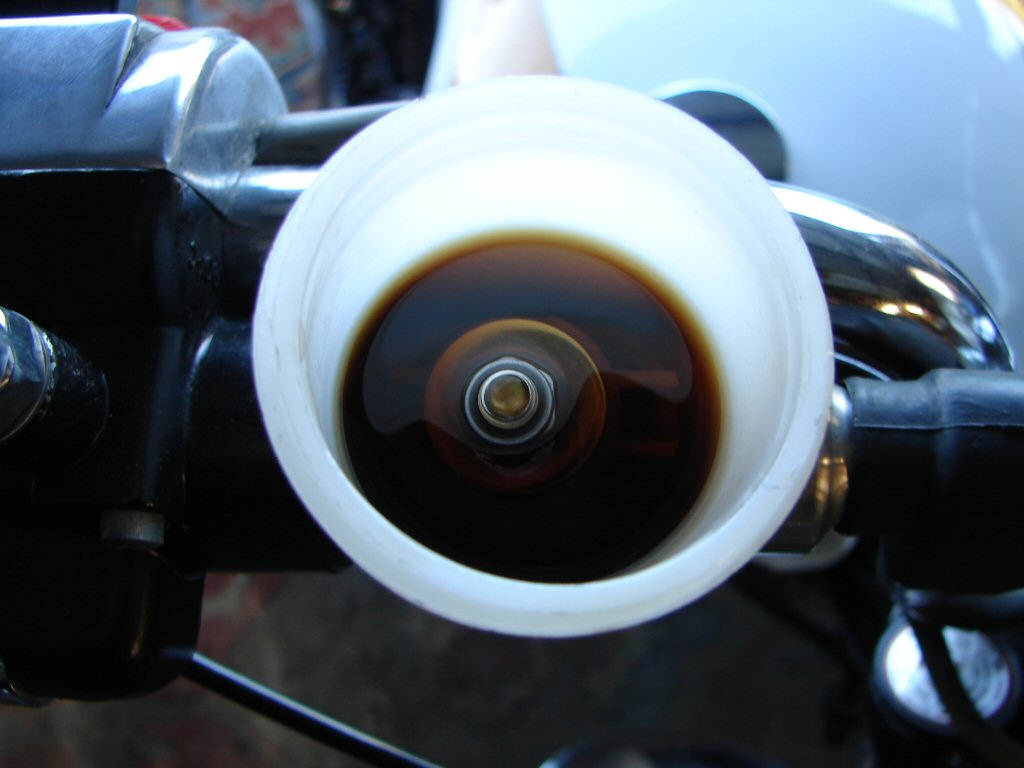
I mopped the fluid out then looked at the disc pads, which were reluctant to move at all, so I removed the pins and prised the pads out. They were oily to the touch, as was the disc itself, but no sign of where it may have come from. I degreased all the parts, and after fitting a bleeding hose and cracking the bleed nipple I forced the pistons back into the caliper as far as they would go, then put the pads in and added new fluid to the reservoir.
There is a trick to bleeding the easy way, which involves putting the bike on the side stand and turning the bars full left lock. This is the only position where the fluid lines are uphill all the way from caliper to master cylinder - so no air gets trapped anywhere - and the bubbles begin to appear as soon as the fluid goes in.
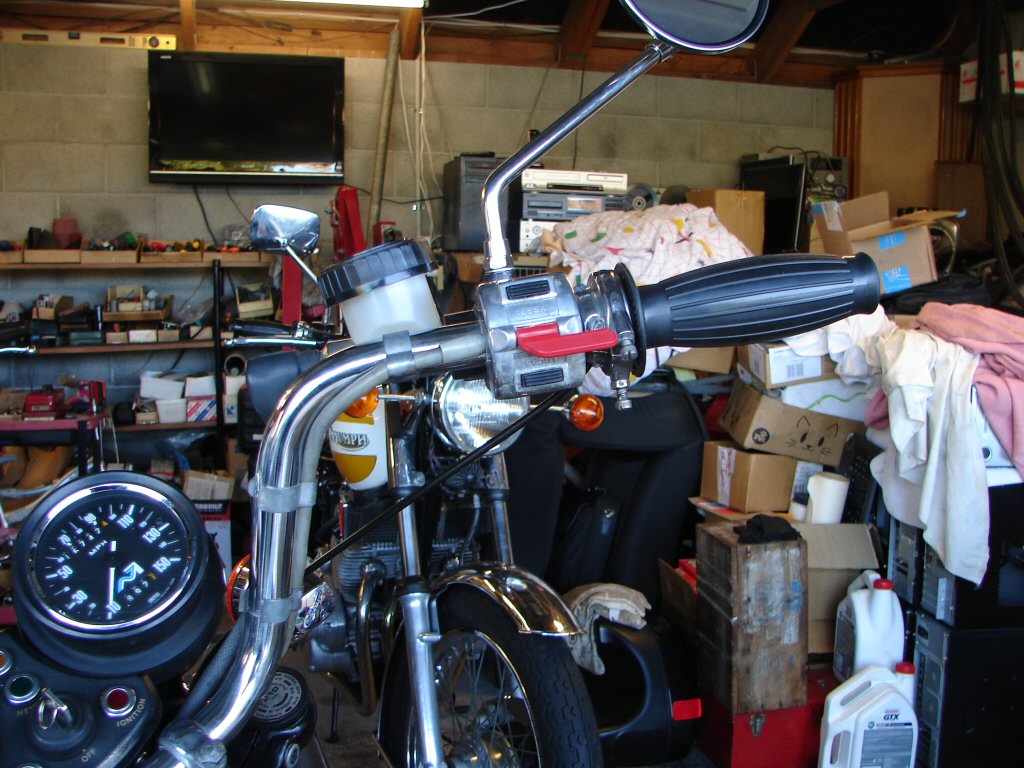
Once the bubbles had stopped I gave the lever a number of pulls and the pistons found their position and we had some pressure. From there it was a normal bleed, pulling the lever and holding it in while pinching off the bleed nipple, release the lever and the bleed nipple - repeat.
It only took half a dozen cycles total and the brake was really responsive, applying the brake while pushing the bike gave immediate bite, and best of all, it freed itself totally when the lever was released.
I feel we have been very lucky with the result, as it seems whatever grubbage was inside the sytem got bled out and all is well. It is possible that the oil substance was brake fluid, but there are no signs of a leak, and neither had the fluid level been extremely low to begin with, so perhaps we have had two different problems.
I will be a bit ginger with the front brake during the next ride, as the degreasers can make them pretty bitey to begin with, but now we at least have clean fluid in the system.
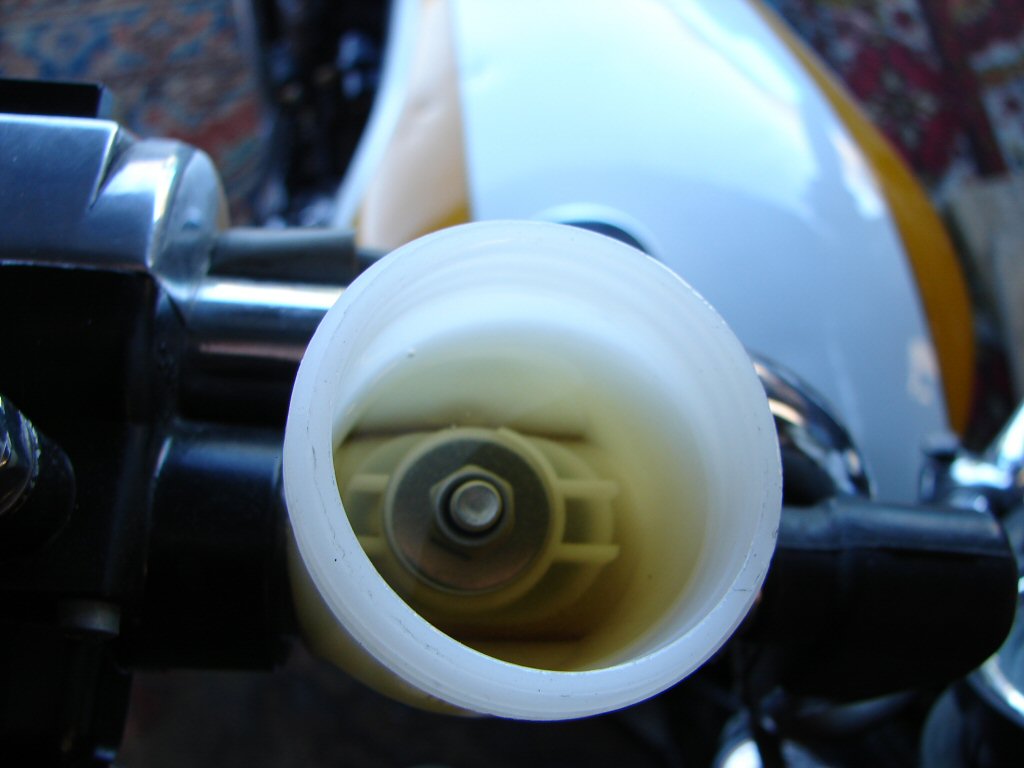
Oh.
And then I fitted the new spark plugs.
I am puzzled and slightly irked by the fact that of recent times, every single thing I attempt to do suddenly needs something else done first, and often that is the bigger job.
Strange times we are living in.
While testing the carbs before the next ride I found that I could cause a flood by holding the tickler down hard for a few seconds, then the float would fail to shut off. Normally just clicking the tickler button until the first fuel can be seen this does not happen, but I need to know that during running conditions the float is not sometimes letting extra fuel through. This would likely give the same symptoms as a faulty spark plug might, so either way we are going to find out.
I have also noticed that the tickler buttons sit at differing heights to one another, which means they are pushing their respective floats down by different amounts, so I should be able to synch them pretty easily as they just press on to the roll pins that touch the floats.
Nothing left to chance.
With the carbs stripped again a measurement was made of how far the ticklers traveled on full compression. Two were close to 1/4", the third was 5/16", so a significant amount further and on the problematic carb which is left side.
It all went back together and today I test rode it again. It tickled predictably and started promptly, so off we went for a few circuits of the neighbourhood. Despite the engine warming up pretty well in our May temps it did not want the choke fully off. Each time I tried it complained by stuttering, yet settled again when I put some choke back on.
I did not prolong things as I wanted to drain the oil while it was still warm, so headed back and did that. Once tank, primary and oil filter cavity were empty I removed the spark plugs for a read. The right and centre plugs were quite sooty - as you would expect when running with the choke on - but the left was clean as a whistle. Despite the fact that the carbs have been tuned and synched for the best possible idle, the left carb is not delivering anywhere enough fuel.
I have a steadily decreasing respect for Amal Premier carbs.
In order to continue progress I lastly removed the exhaust system which will allow me to remove the sump plate tomorrow, and see what I find - hopefully nothing.
I now suspect that the left carb has missed out on a necessary drilling somewhere in the pilot circuit, but I will have to rip the whole thing apart to find out.
Give me original Amals any day...
Oh yes - the front brake performed a lot better than it has thus far.
So today the sump plate and filter came off, revealing some nice clean oil which was waiting its turn to get back to the tank. No 'lumps' to be seen anywhere, but a few tiny shiny specs as had been seen amongst the tank oil when I emptied the contents of the waste container. Once again - they cannot be felt between the fingers - they are evidence of the failure at a microscopic level, but will likely end up settling in the oil tank or the filter. We have done all that can be done.
With the sump plate bits all cleaned up they went back on with the vaguest smear of silicone sealant to discourage any drips. The exhaust went back together much easier than the first time courtesy of the time I had spent making it fit proper then. This time I even gave it a polish...
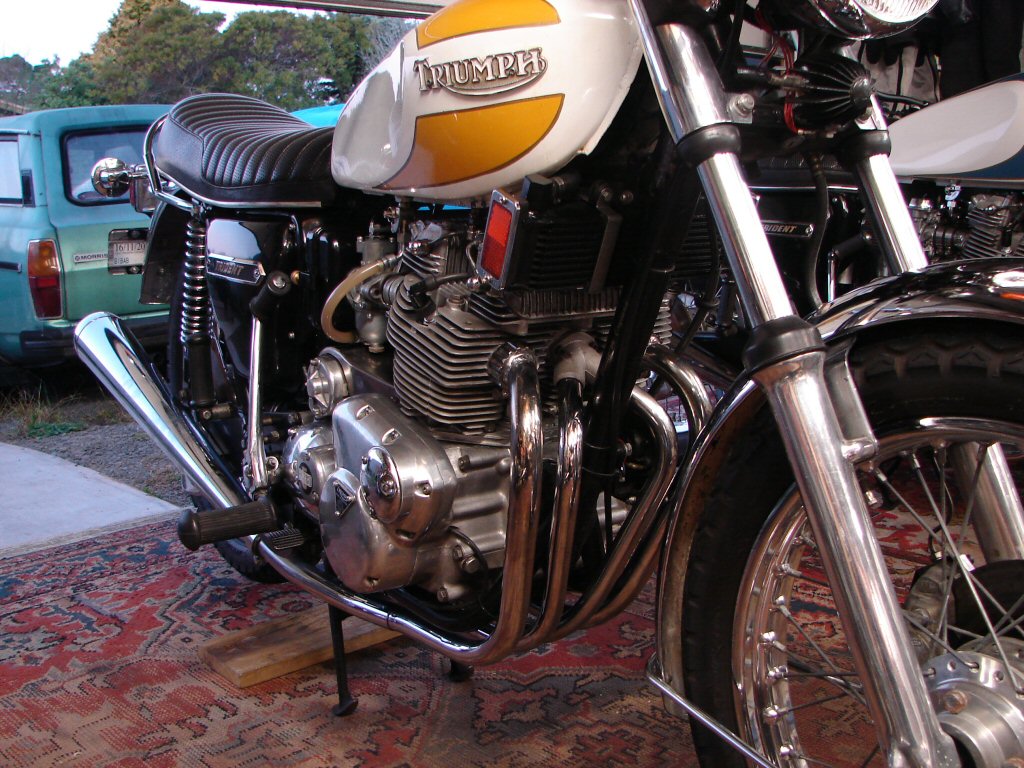
One of the 'arts' of mounting exhaust systems for me is to spend a bit of time making sure that the mufflers are at the same height when viewed from behind. They seldom are when first fitted, and it can involve moving the mounting plates to the limit of their bolt holes to get there. This one is close but the right side needs the meerest lift, as I did the bracketry adjustments on the first fit.
There are some people's bikes that I just cannot ride behind, as I am sitting there thinking that I could sort their up/down mufflers in 15-20 minutes, but if they havn't noticed - what would be the point. It is not for their benefit but for mine...
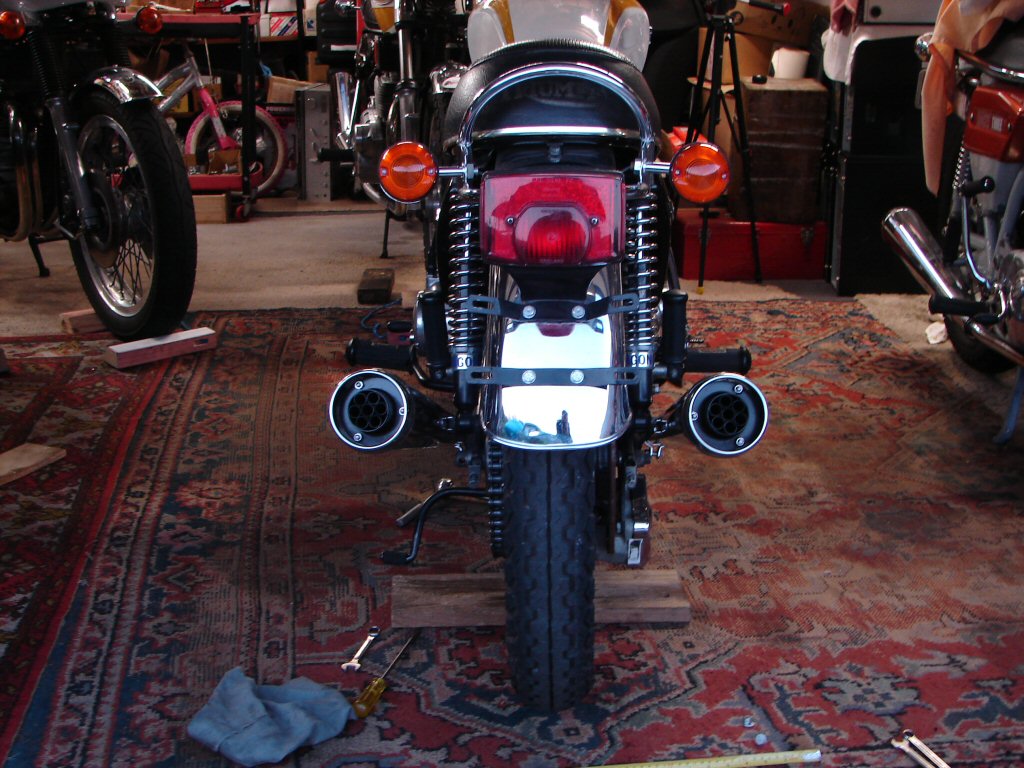
Next session will be yet another go at the premiers from hell.
It occurred to me while pondering the problem that while most pilot screws when set right will cause a drop in the idle revs when moved a half turn in either direction, as the right and centre do, but the left needs a complete turn either way before it has that same effect. This now suggests to me that the pilot jet drillings will be the major suspect. A number of Premiers have already been found to have missed having some holes drilled properly or at all.
We may be in that camp..
The carbs are so well used to coming off they nearly do it themselves, but I chose to assist anyway. Once all the fuel was drained I removed the left carb from the manifold - the T160 is user friendly having the ability to wind the throttle rod out of the operating bar so two carbs can remain undisturbed - and I removed idle jet and pilot screw to see what sort of drilling would link the two. It is a reasonable size and easy to see through, so no problem there. The pilot jet bore is tiny but I have a stainless cleaning tool for the fixed pilot jets in the pre-Premier Amals and it would not fit through the jet. I removed one of the other pilot jets and found that the tool was a neat fit through it, so out came the tiny drill bits to find a matching size, which turned out to be 0.4mm, a drill so small it is hard to grip in any form of chuck.
Using animal cunning and a pair of pliers I was finally able to break through the bore of the jet - I would say it had been factory drilled - which had been solidly blocked with some sort of swarf from the drilling process I would guess. I put the jet back in the carb body and blew contact cleaner through the idle jet circuit from the float bowl pickup opening and it shot out of all the proper drillings.
I checked the remaining jet which was also a goodie, then removed all the float bowls to see if there was still any clearance issue I could find. There was something. When the floats were pushed sideways in the direction they used to stick, there was no play in the head of the float needle, even though the float would still rise. I figured that may still be an issue so I relieved the necks of the float needles which were not as smooth as they could have been, until I had free play with the floats at both limits of their side travel. I could not think of anything else in there I have not already attended to.
Then I noticed something that had not been revealed before because the slide was now out. The cutaway spray tube inside the throat of the carb has been fitted askew.
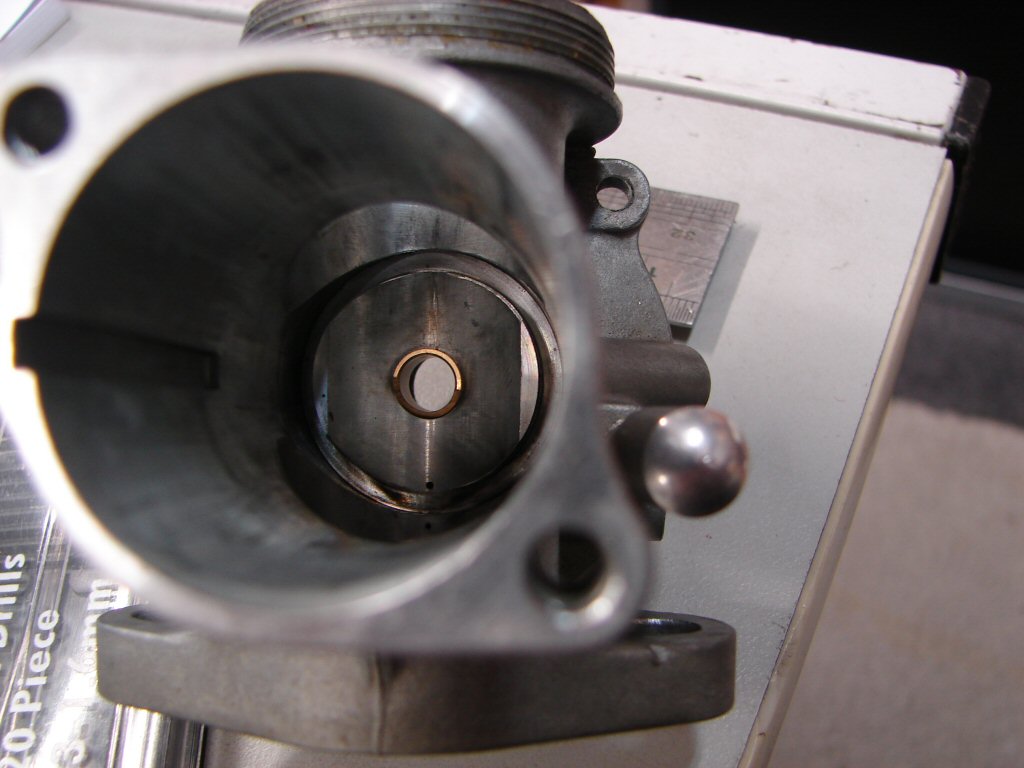
It seems that this carb missed quality control somehow. I know that the shape of the cutaway on these tubes is critical, depending on what model engine they are fitted to, but I have no idea what effect this might have on our engine. Either way it was an easy job to tap it out of the body and fit it back as it was intended to be. As this cylinder has been at odds with the rest of the bike every time I have tried to tune it I am not going to let such things slip by, whether they are causing problems or not.
I put everything back together and onto the engine. I then filled the primary case and oil tank with their expected amounts of oil, and with the spark plugs out, whizzed the engine over on the electric start until the oil light went out and then the plugs went back in.
Fuel taps on - no leaks.
Ticklers applied until first signs of fuel - no floods.
Choke on and hit the button and the bike lit up happily. I kept it running while getting idle and air screws adjusted by which time I was able to reduce choke to about 2/3, which it had not been happy to do on previous runs.
I turned it off and removed the airfilter so I could synch the carbs with my vacuum gauge. Now it was happy to idle with no choke at all, and it got happier as the process went on, so I had it at a very happy idle in quick time.
Left side air screw now behaves the same as the others.
Not a single hiccup - I love it.!
...and I levelled the mufflers up. Woot.!
Currently awaiting weather in which to test ride three T160's so the shed has been rearranged to put the imminent rides on the front row of the grid.
I doubt that I have previously had a more desirable seven triples in the shed together, especially with four being T160's...
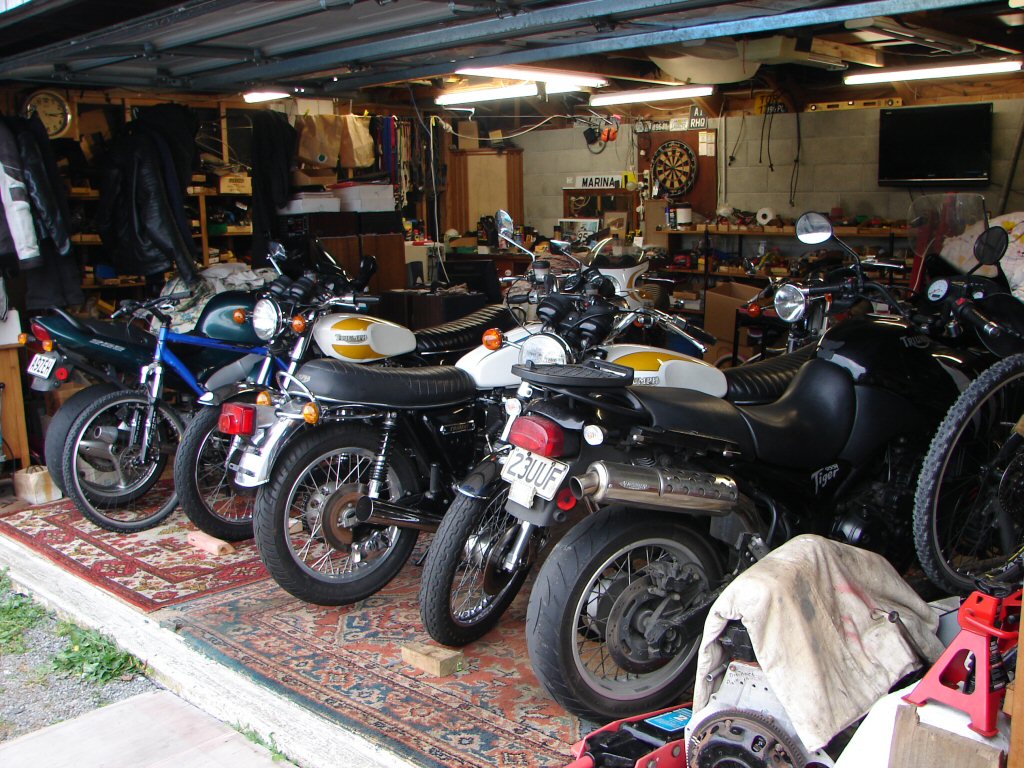
The next test ride.
The carbs all filled right and tickled right and the bike fired up on the electric with full choke. Pretty cold air and I don't like idling engines for long periods so I rode off quietly with the choke fairly well on until things warmed up. All cylinders appear to be pulling their weight properly now, although most engines behave well with a bit of throttle applied, it is just the slow bits that take extra sorting to be as smooth when transitioning from idle to slide to needle to main jet.
While I did several circuits of the local track the bike still did not want the choke fully off, and would complain noticeably at intersections if the revs got too low, but it was happy idling with the chokes off.
>I was remembering another T160 I worked on that did not want its choke off, and it too had freer flowing mufflers than stock. When it came to me it had #3½ slides instead of the "proper" #4 jobs, so I swapped them to #4 and that was when the bike would not run happily without some choke. I had to put the #3½ slides back in to make it happy.
I get the distinct impression that the same is happening here, now that the other gremlins are not sticking their oar in, so I have taken the #4's out of these carbs and put some good used #3's in and we will see what that does.
It has not been a good season for test rides to date..
But today the test ride did happen, in fact two of them. First I ran it up and adjusted idle and idle mixture albeit on a cold engine. It still wanted full choke to fire up, but while tuning I was already able to reduce the amount of choke guided by the engine revs staying at their happiest.
The ride itself was only a few miles at town speeds, but I had the choke fully off before reaching home again. Throttle gives instant response even at low revs, although I operate all triples at 3000rpm in town and choose whichever gear suits it to do that. This keeps plenty of oil splash going on in the crankcase as the cam followers need it. Back home the bike went on the main stand and the vacuum gauge was used to synch all the slides to achieve the same airflow. Another round of idle mixture tweaks and away we went again.
This time I included a bit of 80kph zone and was impressed with the engine's eagerness to pick up revs through the gears with no hesitation at all. On my return I filled the oil exactly to the mark and that will be the baseline for observing any oil usage during the running in period. Spark plugs came out looking good for town use, but I leaned the right side mixture screw by a quarter turn as it was running slightly richer than the other two.
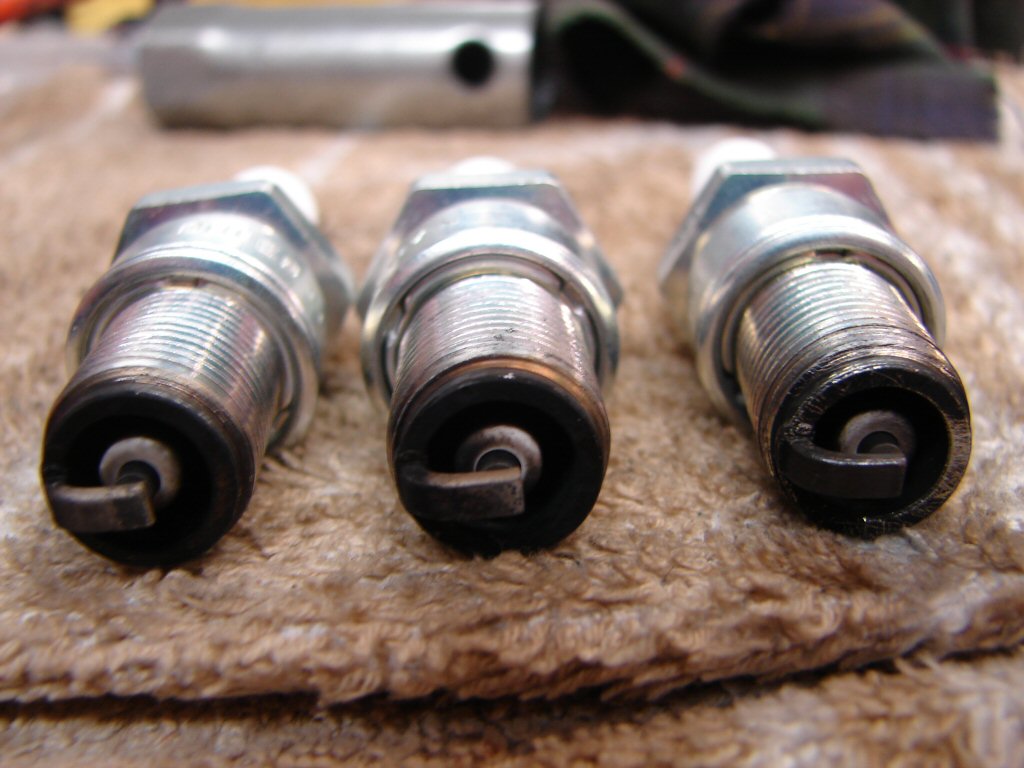
The next manoeuvre will be to check the head bolts for a final time and run a compression test on the cylinders - more for my curiosity than anything else - and this will be a quality control test of the head gasket sealing properly amongst other things.
I would guess that the slight blueing of the nearside exhaust header pipe would have been down to the blocked pilot jet on that cylinder.
All the panel work went back on and it is looking rather meaningful I reckon..
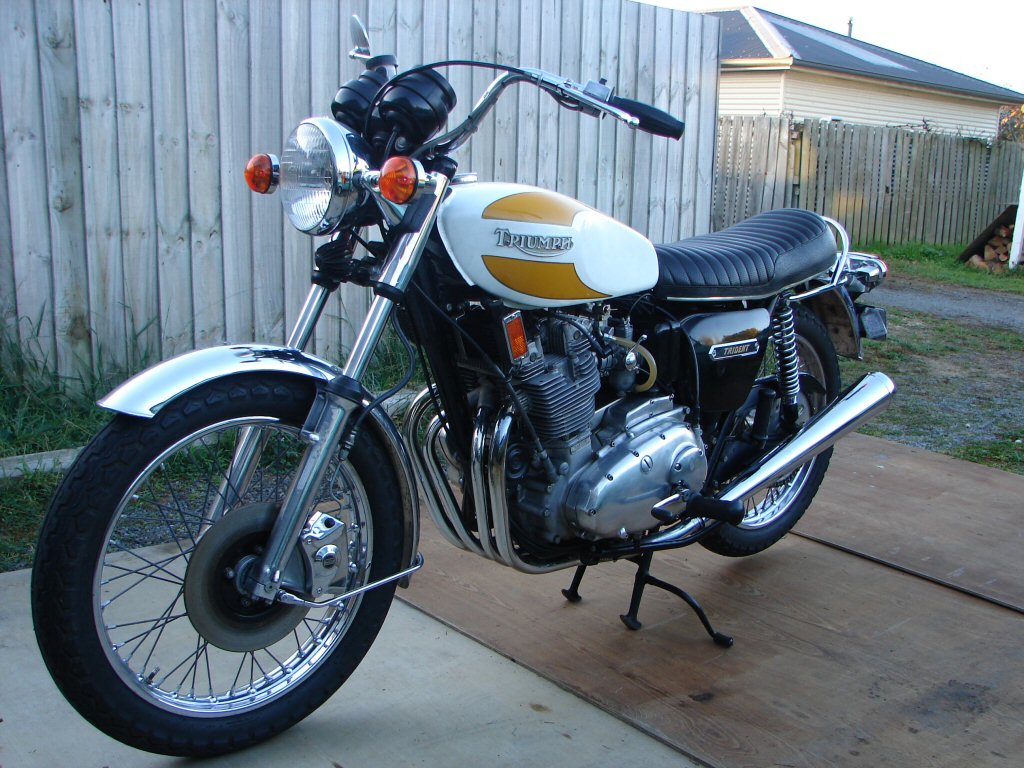
The retension of the head only produced a slight extra movement on one head bolt, which I take as a good sign. Despite that I checked all the valve clearances - seeing that the bike lives a long way from me - and managed to nitpick a couple of clearances but mostly to appease my obsessive nature than because they needed it.
I then did a compression test - for which the electric start is a real blessing - and all cylinders were laughingly within a lb of each other at 125psi. The gauge showed the pressure dropping off quite fast after each test, which I would expect with piston rings that have only covered a few miles, but the degree to which they all correspond is the important part. Another fifty miles running will make a lot of difference to both observations, and I would expect compressions somewhat higher once the rings have bedded in.
I will hopefully achieve one more test ride before the bike is declared finished, but the cold air temps we are currently not enjoying make it difficult to get these engines properly hot while on the move.
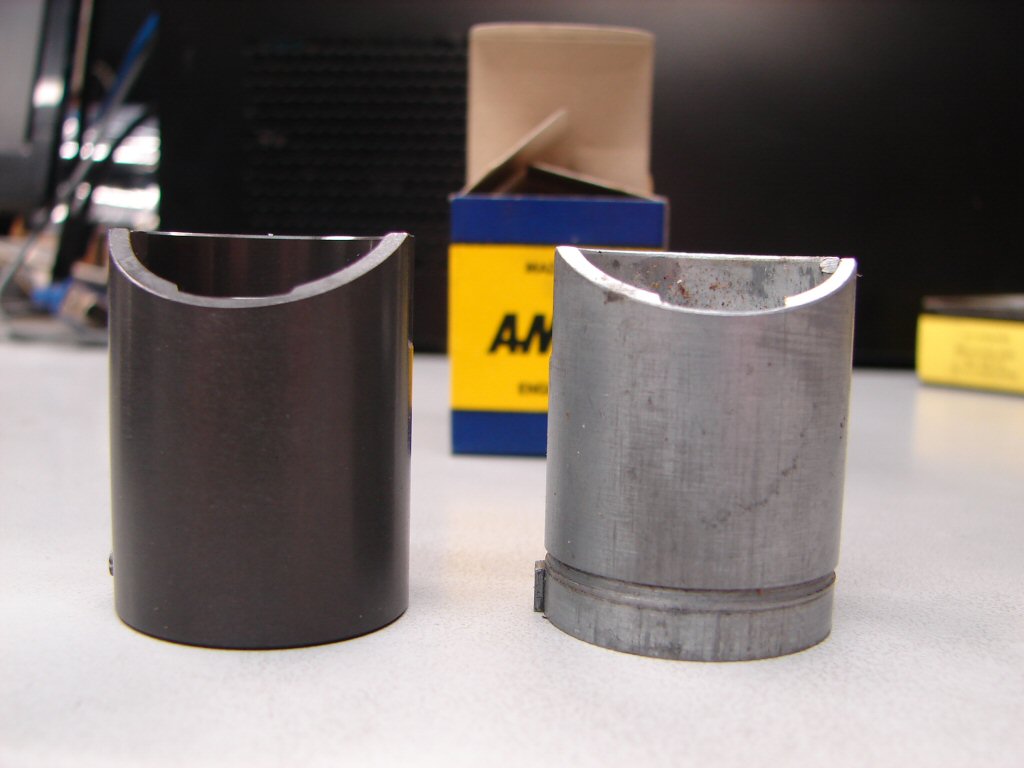
The 'anodised' slides - like the one on the left - currently supplied by Amal are outrageously priced at $130 each, let alone a set. I have found instances where the new slides behave less predictably in action compared to the original type, despite the rather basic appearance of the latter compared to the expensive jobs.
I have a selection of used but viable early type such as the one shown, and these are what I used in the bike. It is possible to see that the cutaways of the two are slightly different at their lowest point, although the difference between #4 and #3½ is only about 1/32" less cutaway, but it is enough to make the mixture richen up noticeably at low throttle settings. This is most important when riding in town traffic at only a fast idle if you're lucky, but then want to accelerate briskly when you see the gap.
I am of the opinion that the mufflers on this bike are responsible for the need to change the slides, and I will send the #4's back with the bike in case some more original spec mufflers get fitted at a later stage, and these would need to go back in.
I am as happy with the bike as I have ever been..
One hundred years later...
A day turned up during which I was happy enough with the state of the roads that I felt safe in taking the bike out for its final test ride post all previous adjustments. It rode as I would wish it to after having started on the button, even after many long cold nights. Well done that battery.
The choke was partially off before I got moving but I figured that in the meagre temps it was unlikely to be fully off for a few miles. Everything seemed fine except the front brake, which only responded after I had given it a bit of deliberate work to do. Otherwise the only thing that was annoying was a slight stutter from one carb during low throttle bits of steady riding - such as in slow traffic. Annoying as it had not been there last time I rode it.
Once home again I checked for oil leaks and found two minor - one from the primary drain plug and another from the exhaust rocker box cover gasket. I don't usually use sealant on these unless they dare to leak, and now it has, I will.
I decided to give the vacuum gauge another round to see if anything was obviously out of synch. While all three carbs were still drawing the same amount of air I found something else which has never happened before. Usually placing the vacuum gauge over a carbie throat causes the idle to drop noticeably, but on the right side carb it now speeded up. Then I remembered that I had leaned the pilot screw after the first test ride because the plug had been a little carboned more than the other two. So I richened the pilot screw back to where it had been and now it behaved the same as the other two carbs. I took the plugs out for a look and all were exactly as they had been last time. I suspect now that the extra carbon on the right plug has been created by a bit of oil before the rings began their settling in, rather than rich mixture. A few miles will cure it if it hasn't done so by itself already.
I cleaned the rocker cover gasket and applied a tiny amount of silicone around the bottom half of it before refitting. The primary drain plug is odd in that it is a smaller size thread than any I have seen before, so the standard thick fibre washer does not fit and a doughty washer has been used such as those used in the bottom of the forks. This is not able to make a proper seal it seems, so it got the clean up and silicone treatment as well.
I removed the front disc pads for a look at what was ailing them. The oily whatever that I had cleaned off disc and pads seems to have left a burnished layer on the surface of the pads so they have not been able to burn themselves clean. I gave them a rough-up with a file then sanded them smooth until all the odd colouring was gone and the sintered metal can be seen in the pads. That should be the answer there.
Just have to refill the primary oil and final tighten the rocker box cover before the tank goes back on. I also re-routed the throttle cable which had been a little jerky in use and is now as smooth as a smooth thing...
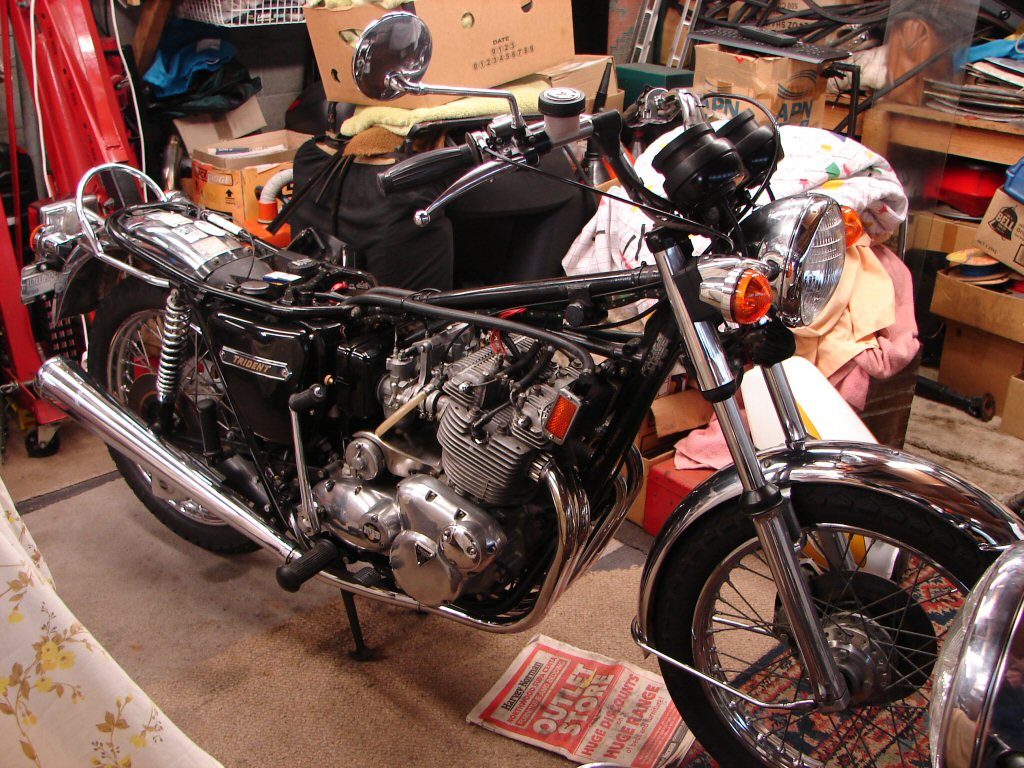
In the course of having the inspection cap off the primary I checked the chain tension and felt it was a fraction too tight, so backed it off to the normal amount of free play. A tight primary chain can make itself felt when letting the clutch out after a gearchange, but I am not sure whether the same behaviour applies now that there is a triplex chain and new sprockets fitted. I would expect there to be a small amount of loosening in the first few hundreds of miles after fitting any new chain, but would imagine it has settled in by now and will probably not need any adjustment for a considerable mileage.
Oil got refilled and I think everything is officially done - so the tank went back on and it is complete.
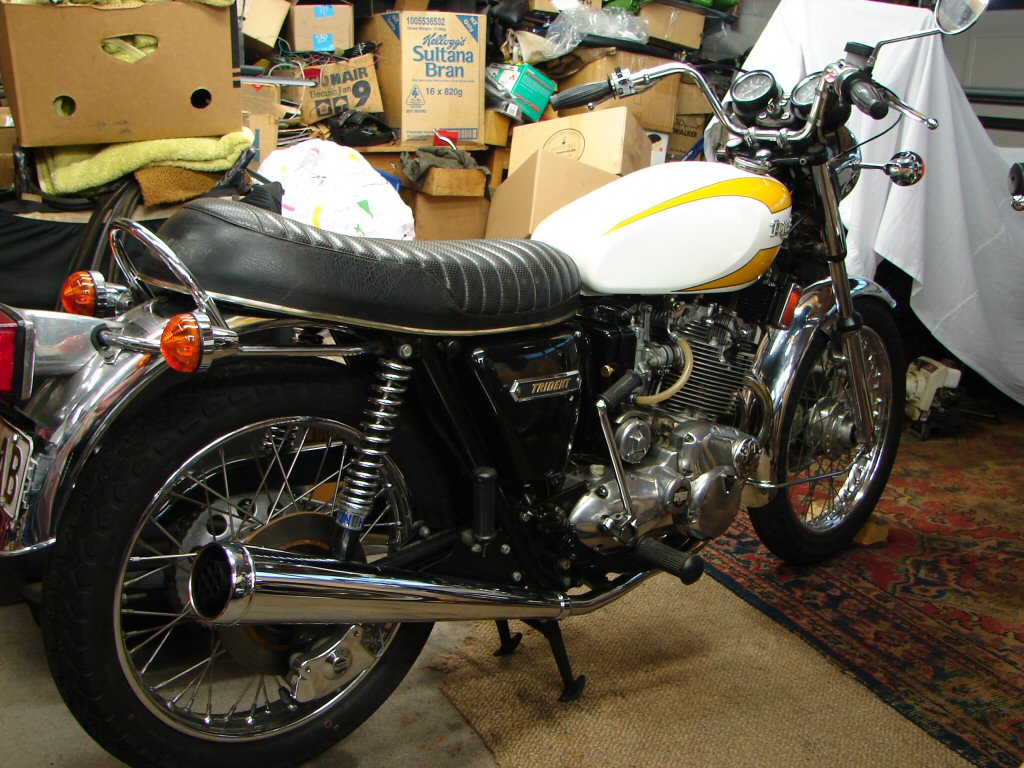
I have noticed that when loading into the transporter Andrew folds the rear vision mirror back out of harms way for loading and unloading other bikes next to it. I figure I will go one further and remove the mirror altogether rather than risk it suffering in transit. I will either place it under the seat or in a package tied to the top of the seat if there is not enough room to accommodate it underneath.
It seems to be a done thing, but if I can make any further improvements before it leaves I won't be able to stop myself doing it....
Having finally finished both T160s to be shipped together I fished them out, started them and checked the oil levels after they had scavenged properly. Both took some oil to reach the full mark, although they had not been kept to it during the testing rides. It helps to get them on the mark so that any appetite for oil will be noticeable to the owner while the running in process is completed. I tend to assume 500 miles will easily fulfill this task, after which I would be changing my bike to synthetic 20W/50 from then. It does seem to reduce observable wear rates in the eareas which do so the most, and I would guess that the fact that it flows more easily when cold plays a significant part in this.
I had intended to adjust the rear brake caliper if I got the chance to ride it, plus I had also refaced the front disk pads, so a little heating of the brakes would be a good thing.
This bike does not respond well to kickstarting - possibly because it is on the lean side of fuel mixture which I think is due to the mufflers - but as it lights up on the electric very happily it matters not. A brief ride on the usual 'track' showed everything to be working well together, and as I had pushed the pistons back into the rear caliper beforehand I got to pump them back out and after holding a slight pressure on the pedal got a good bite during further use. The front one got similar treatment, but will take a bit longer to give its best while the pads wear back in.
The bike rides just as you would want it and seems free of vices, other than wanting a small amount of choke left on for the first few miles. Much better today than during the sub 10 degree days when I was first testing it I might add.
Excellent conclusion, and when I got home the rear brake was nice and free at rest. I was so enthused by the results I rode two more triples this afternoon, and all of them performed flawlessly.
When its good - its brilliant..!

All packed now with mirror, key and paperwork under the seat. Has been a major journey.
I took this photo in order to ascertain how many miles it has done during its various test rides. Compared to an earlier pic before the engine was running it has covered 43 miles, which is more than I would have expected. Each test ride is probably only 6-8 miles at most - depending on what is found and how quickly it needs to return to base - so I guess it is just a good number of short rides.
Happily they got better and better as time went on, so I guess that is how you want it.
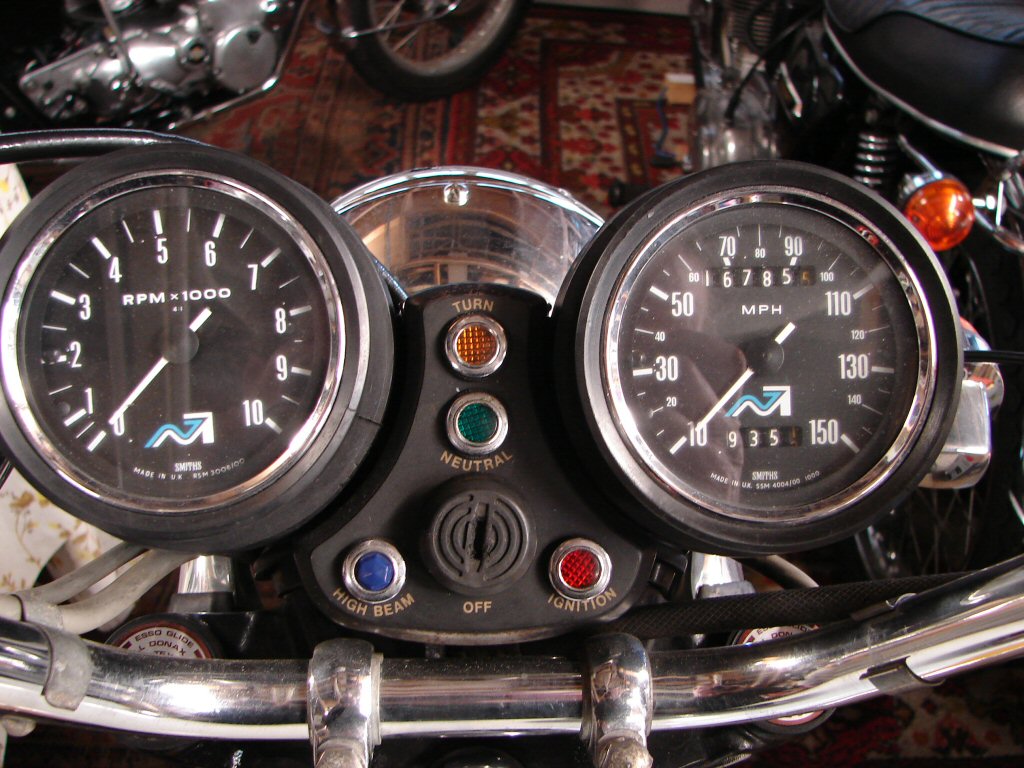
Have been contacted by the bike courier so it will soon be on its way home. Hopefully it gets plenty miles as the weather improves from here on.
Here's to a long and healthy tour of duty.

